
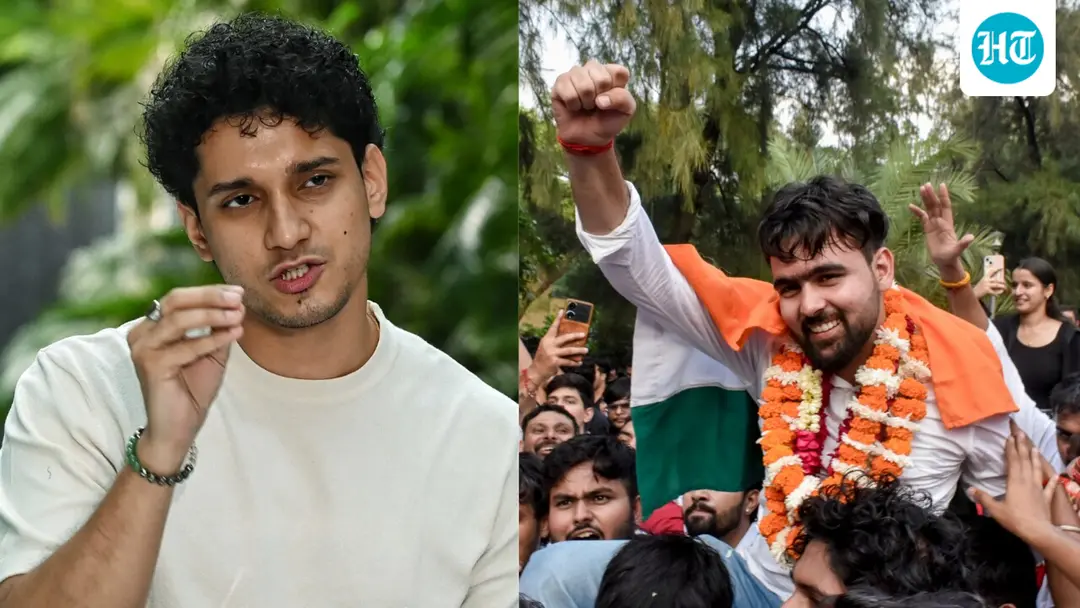
Independent Deepanshu Shokeen wins DUSU vice-president post
Independent candidate Deepanshu Shokeen won the vice-president's post in the Delhi University Students' Union election with 30,615 votes, defeating ABVP's Ishu Maurya, who polled 16,910. NSUI's Vir Chatrath got 4,313 votes and AISA-SFI's Akshat Shikhar 2,383. It marked an independent's return to the central panel after 17 years. CJP co-convener Saurav Das called it a "sign of the times" and the "real Gen-Z story" on X. ABVP won three of four posts.
Source
Hindustan Times — India · read the original report ↗
Desk check · compared with the source
What the desk checked (5)
- Deepanshu Shokeen won the DUSU vice-president post with 30,615 votes, defeating ABVP's Ishu Maurya (16,910 votes). — Figures appear in source; NSUI's Vir Chatrath 4,313 and AISA-SFI's Akshat Shikhar 2,383 also listed, internally consistent.
- It is the return of an independent to the DUSU central panel after 17 years, with the highest votes ever in DUSU. — The 17-year claim is stated by the source without attribution; the 'highest votes ever' claim is attributed to Saurav Das's post on X.
- CJP co-convener Saurav Das called the win a 'sign of the times' and a 'real Gen-Z story'. — Quotes attributed to Das's post on X in the source.
- ABVP's Yash Dabas won the president's post with 24,576 votes, a margin of 2,053 over NSUI's Vijai Shankar Meena. — Figures and margin appear in source; ABVP won three of four central panel posts.
- Shokeen, 21, contested after being left out of NSUI's final candidate list announced on September 11. — Biographical details and date given in source, partly based on Shokeen's own remarks to HT.
Analysts’ view opinion
The DUSU result sends two opposite signals at once: the ABVP retained organisational dominance with three of four central panel posts, yet the single highest vote-getter in the election was an independent. Deepanshu Shokeen's 30,615 votes exceeded even the ABVP's winning presidential tally of 24,576, suggesting some students rewarded individual groundwork over a party machine. The clearest loser is the NSUI — a contender it declined to field polled over 30,000 votes, while its own vice-presidential candidate was held to 4,313.
- The ABVP still controls the panel majority, but losing one post to an unaffiliated candidate dents its narrative of dominance.
- Shokeen's win after being denied a ticket raises direct questions about the NSUI's candidate selection and its reading of campus sentiment.
- The NSUI's slide to near-last place in the vice-presidential race suggests the independent consolidated the anti-ABVP vote in that contest.
- AISA-SFI's 2,383 votes again underline the limited reach of the Left student bloc at Delhi University.
- The return of an independent to the central panel after 17 years is being read by some as an anti-establishment signal, though mapping student union voting onto national politics would be overreach — a caution the CJP co-convener himself flagged.
What to watch — Watch whether the NSUI overhauls how it picks candidates before the next DUSU polls, and whether Shokeen stays independent or is courted by an organisation.
The story does not establish why Shokeen won so heavily — caste, locality or college-wise voting patterns are not detailed — nor does one campus result prove anything about broader voter sentiment or Delhi's electoral politics.
Deep dive
Research brief · 8 facts · 5 dates · exam-readyThe brief
Context
The Delhi University Students' Union (DUSU) election, held for four central panel posts, saw the RSS-affiliated ABVP win three posts, including the presidency. But the standout result was in the vice-president's race, where 21-year-old independent Deepanshu Shokeen — denied an NSUI ticket — won with 30,615 votes, the highest ever polled in a DUSU election according to the source. It marked the return of an independent to the DUSU central panel after 17 years, and drew comment from CJP co-convener Saurav Das as a "sign of the times" and the "real Gen-Z story".
Key facts
- Deepanshu Shokeen won the DUSU vice-president post with 30,615 votes, described in the source as the highest votes in DUSU ever.
- ABVP's Ishu Maurya finished second in the VP race with 16,910 votes; NSUI's Vir Chatrath got 4,313 and AISA-SFI's Akshat Shikhar 2,383.
- Shokeen's win marked the return of an independent candidate to the DUSU central panel after 17 years.
- ABVP won three of the four central panel posts; Yash Dabas won the president's post with 24,576 votes.
- Dabas defeated NSUI's Vijai Shankar Meena by a margin of 2,053 votes.
- Shokeen's name was missing from the NSUI final candidate list announced on September 11, after which he contested as an independent.
- Shokeen, 21, is a Shaheed Bhagat Singh College graduate now pursuing a master's in the Department of Buddhist Studies; he has been active with NSUI since 2023 and sought an NSUI ticket twice, in 2025 and 2026.
- He said he had only three days to launch his manifesto and campaign; his father is a DTC bus conductor and his mother an ASHA worker.
Timeline
- 2023Shokeen becomes active in student politics with the Congress-backed NSUI.
- 2025 and 2026Shokeen attempts twice to secure an NSUI ticket for DUSU polls.
- September 11NSUI announces its final list of DUSU candidates; Shokeen's name is missing, prompting him to contest as an independent.
- Three days before polling (as stated)Shokeen launches his own manifesto and campaign independently.
- Saturday (vote counting concluded)ABVP's Yash Dabas wins president; Shokeen wins vice-president as an independent; ABVP takes three of four posts.
Who has a stake
- Deepanshu Shokeen — Independent winner of the VP post; his victory validates ground-level student work over organisational backing.
- ABVP — Swept three of four central panel posts, including president, but lost the vice-presidency to an independent.
- NSUI (Congress-backed) — Lost the president's race by 2,053 votes and saw a rejected aspirant win the VP post with far more votes than its own candidate.
- AISA-SFI — Its VP candidate Akshat Shikhar polled 2,383 votes, the lowest among the four.
- Saurav Das, CJP co-convener — Publicly framed the result as a 'sign of the times' and the 'real Gen-Z story' for those in government.
- Delhi University students — Voters whose choice broke a 17-year pattern of organisation-backed winners on the central panel.
Why it matters
DUSU polls are treated as a bellwether of youth political mood and a nursery for national politicians, so an independent outpolling every organised outfit is politically significant. It suggests candidate-level ground work and Gen-Z voter behaviour can override party machinery in campus elections, even as the ABVP retained three of four posts.
UPSC angle
Prelims pointers
- DUSU = Delhi University Students' Union; central panel has four posts (president, vice-president, and two others as implied).
- ABVP won three of four DUSU central panel posts; president Yash Dabas polled 24,576 votes.
- Independent Deepanshu Shokeen won VP with 30,615 votes — first independent on the central panel in 17 years.
- NSUI is the Congress-backed National Students' Union of India; AISA-SFI contested jointly for VP.
- ASHA (Accredited Social Health Activist) worker and DTC (Delhi Transport Corporation) — Shokeen's family background.
- NSUI's final DUSU candidate list was announced on September 11.
Mains framing
Campus elections in Delhi University have long been structured around national party affiliations — ABVP linked to the Sangh, NSUI to the Congress, AISA-SFI to the Left — with organisational machinery, funds and cadre deciding outcomes. The 2026 DUSU result complicates that picture: Deepanshu Shokeen, denied an NSUI ticket on September 11 and with only three days to build a manifesto and campaign, polled 30,615 votes for vice-president, nearly double ABVP's 16,910 and far above NSUI's 4,313, breaking a 17-year absence of independents from the central panel. The causes he himself cites are four years of sustained ground work among students and a personal connect that a ticket cannot manufacture; observers like CJP's Saurav Das read it as a generational signal that "those in government must understand". Yet the same election saw ABVP sweep three of four posts, so the lesson is less an anti-incumbency wave than the growing salience of candidate credibility and local presence. The way forward lies in student bodies making ticket distribution more merit- and work-based, and in reading youth verdicts as a demand for responsive representation rather than partisan loyalty.
Key terms
- DUSU
- Delhi University Students' Union, the apex elected student body of DU, with a four-member central panel.
- ABVP
- Akhil Bharatiya Vidyarthi Parishad, the student organisation associated with the Sangh; swept three DUSU posts.
- NSUI
- National Students' Union of India, the Congress-backed student wing that left Shokeen off its final list.
- AISA-SFI
- Left-leaning student organisations that contested together; their VP candidate got 2,383 votes.
- CJP
- Organisation whose co-convener Saurav Das publicly hailed Shokeen's win as the 'real Gen-Z story'; full form not stated in the source.
- Central panel
- The four top DUSU office-bearer posts, including president and vice-president, contested university-wide.
Practice questions
- Do student union elections meaningfully reflect wider political trends, or are they a distinct campus phenomenon? Discuss with reference to the 2026 DUSU result.
- The victory of an independent candidate with 30,615 votes after 17 years suggests a weakening of party machinery in campus politics. Critically examine.
- What does the DUSU verdict reveal about Gen-Z political behaviour and the expectations of youth from representative institutions?
Grounded only in the source report — figures and dates are the source's, not inferred.