
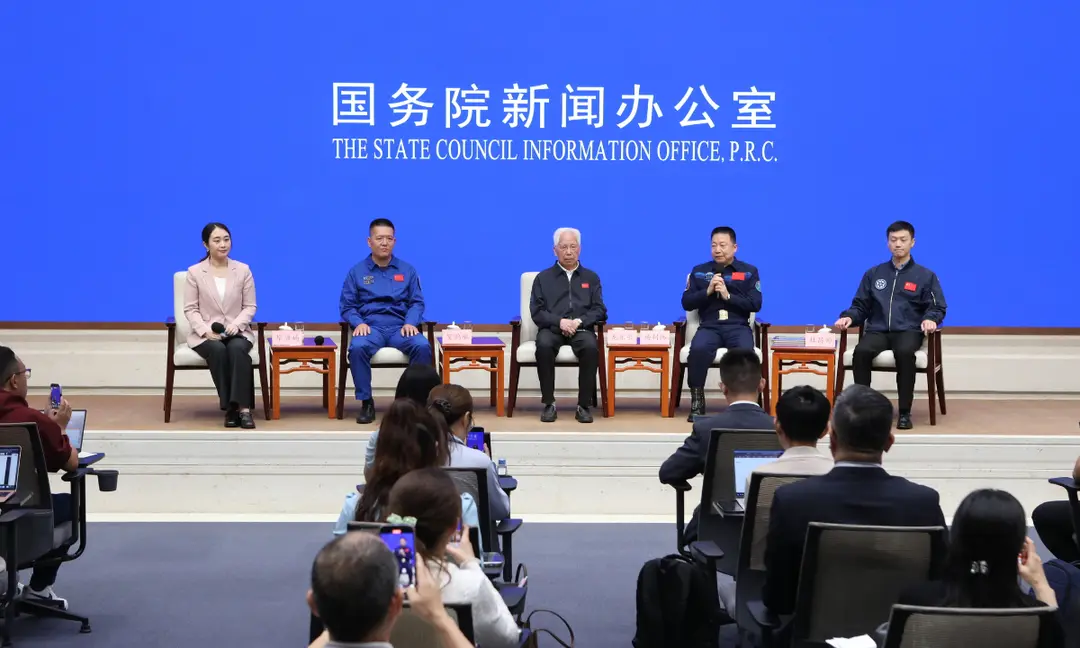
Pakistani astronauts to fly to Chinese space station soon: Yang Liwei
Two Pakistani astronauts are training at the China Astronaut Research and Training Center and will fly aboard China's space station with Chinese astronauts in the near future, Yang Liwei, deputy chief designer of China's manned space program, said Monday in Beijing. In April, the China Manned Space Agency said two Pakistani candidates had been selected as its first foreign astronauts for mission training. Under the current plan, one will join a short-duration mission as a payload specialist.
Source
Global Times (China) · read the original report ↗
Desk check · compared with the source
What the desk checked (4)
- Two Pakistani astronauts are training at the China Astronaut Research and Training Center and will soon fly to China's space station. — Attributed in the source to Yang Liwei, deputy chief designer of China's manned space program, at a State Council Information Office briefing.
- In April, the China Manned Space Agency said two Pakistani candidates were selected as the first foreign astronauts for its space mission training. — Attributed in the source to the China Manned Space Agency; no exact date given beyond the month.
- One Pakistani astronaut will join a short-duration mission as a payload specialist. — Attributed to a spokesperson at the May 23 Shenzhou-23 press conference; described as the current plan, not final.
- Li Jiaying (Lai Ka-ying), the first astronaut from Hong Kong, flew on Shenzhou-23 in May with the Hong Kong-developed Tianyun camera. — Figure and details appear in the source, attributed to Yang Liwei and the outlet Global Times.
Analysts’ view opinion
China taking Pakistanis as the first foreign astronauts aboard its space station is not merely scientific cooperation — it is a deliberate strategic signal. Beijing is positioning its orbital outpost as an alternative platform to the US-led International Space Station and Artemis grouping, and choosing a close security partner as the first guest is no accident. The payload-specialist role suggests limited technology transfer, but the symbolic and diplomatic dividend for both capitals is substantial.
- Giving Pakistan the first foreign astronaut slot shows how closely China's space diplomacy tracks its security partnerships.
- It reinforces the Chinese space station's emergence as a rival 'club' to the ISS, with the likelihood of similar invitations to other countries later.
- For India, this sharpens the competitive environment and adds pressure to accelerate independent human spaceflight ambitions and its own space diplomacy.
- A short-duration mission as payload specialist means core systems and critical technology stay firmly in Chinese hands — partnership without parity.
- The prominent framing around a Hong Kong astronaut and a Hong Kong-developed payload shows the programme also doubles as a domestic cohesion message.
What to watch — Watch for the announced mission date, the nature of the experiments assigned to the Pakistani astronaut, and whether China extends similar invitations to other partner states.
The story does not establish the mission date, the astronauts' identities, training specifics, or any military or defence dimension — it reports announced civilian space cooperation only.
Deep dive
Research brief · 8 facts · 5 dates · exam-readyThe brief
Context
China has opened its Tiangong space station programme to foreign crew for the first time, with Pakistan as the first partner country. At a State Council Information Office press briefing in Beijing on China's new-era space exploration efforts, Yang Liwei — deputy chief designer of China's manned space programme and a senior astronaut — said two Pakistani astronauts are training at the China Astronaut Research and Training Center and will fly aboard the Chinese space station with Chinese astronauts in the near future. The announcement follows the China Manned Space Agency's April selection of two Pakistani candidates as its first foreign astronauts for mission training, and comes as the Shenzhou-23 crew, which includes Hong Kong's first astronaut, continues work in orbit.
Key facts
- Yang Liwei, deputy chief designer of China's manned space program, said on Monday that two Pakistani astronauts are training at the China Astronaut Research and Training Center and will fly aboard China's space station in the near future.
- The briefing was held by China's State Council Information Office in Beijing on the country's new-era space exploration efforts; the accompanying photo is dated September 21, 2026.
- In April, the China Manned Space Agency announced two Pakistani candidates had been selected as the first foreign astronauts for China's space mission training.
- At a May 23 press conference for the Shenzhou-23 mission, a spokesperson said the two Pakistani astronauts entered the China Astronaut Research and Training Center on China Space Day.
- Under the current plan, one Pakistani astronaut will join a short-duration space mission as a payload specialist.
- Li Jiaying (Lai Ka-ying in Cantonese) is the first astronaut from China's Hong Kong to take part in a space mission; Yang praised her performance in space.
- Lai travelled to space in May this year aboard Shenzhou-23 and worked on the Multi-spectral Imaging Carbon Observer, or Tianyun camera, the first Hong Kong-developed payload sent into space.
- Yang said the Shenzhou-23 crew has been working smoothly, sent best wishes to astronauts on the ground on Monday, and that more people from the mainland, Hong Kong and Macao are expected to join the programme.
Timeline
- AprilChina Manned Space Agency announces two Pakistani candidates selected as the first foreign astronauts for China's space mission training.
- China Space Day (as stated at the May 23 briefing)The two Pakistani astronauts enter the China Astronaut Research and Training Center for mission training alongside Chinese astronauts.
- May this yearLi Jiaying (Lai Ka-ying), Hong Kong's first astronaut, flies aboard Shenzhou-23 and works with the Tianyun camera payload.
- May 23At the Shenzhou-23 mission press conference, a spokesperson confirms one Pakistani astronaut will fly a short-duration mission as a payload specialist.
- Monday (State Council Information Office briefing, photo dated September 21, 2026)Yang Liwei says the two Pakistani astronauts will fly aboard China's space station with Chinese astronauts in the near future.
Who has a stake
- China Manned Space Agency — Runs the space station programme and selected the first foreign astronauts, positioning Tiangong as a platform for international cooperation.
- Pakistan — Gains its first astronauts to fly in space, with one slated for a short-duration mission as a payload specialist.
- China Astronaut Research and Training Center — Hosts and trains the two Pakistani astronauts alongside Chinese astronauts.
- Yang Liwei — Deputy chief designer of China's manned space program and senior astronaut; public face of the announcement and of recruitment appeals to youth.
- Hong Kong (Li Jiaying / Lai Ka-ying and Hong Kong universities) — First Hong Kong astronaut flew on Shenzhou-23; several Hong Kong universities participated directly in building the space station.
- Shenzhou-23 crew — Currently aboard the space station, reported to be working smoothly and making good progress.
Why it matters
Flying foreign nationals on Tiangong turns China's space station from a national asset into an instrument of space diplomacy, and Pakistan is the first beneficiary. For India, a neighbour's astronaut reaching orbit on Chinese hardware underlines how human spaceflight access is becoming a currency of strategic partnership in Asia.
UPSC angle
Prelims pointers
- Yang Liwei is deputy chief designer of China's manned space program and a senior astronaut.
- China Manned Space Agency announced in April that two Pakistani candidates were selected as its first foreign astronauts for mission training.
- The two Pakistani astronauts train at the China Astronaut Research and Training Center; they entered it on China Space Day.
- One Pakistani astronaut is planned to fly a short-duration mission as a payload specialist.
- Li Jiaying (Lai Ka-ying) is the first astronaut from Hong Kong to fly a space mission, aboard Shenzhou-23 in May.
- The Tianyun camera, or Multi-spectral Imaging Carbon Observer, is the first Hong Kong-developed payload sent into space.
Mains framing
China's decision to train and fly Pakistani astronauts on its space station, announced by the China Manned Space Agency in April and reaffirmed by Yang Liwei at a State Council Information Office briefing, marks the internationalisation of the Tiangong programme. The drivers are visible in the source: China frames the selection as a \"landmark achievement in international cooperation on the Chinese space station\", pairs it with the inclusion of Hong Kong's first astronaut and a Hong Kong-developed payload (the Tianyun camera on Shenzhou-23), and signals wider recruitment from the mainland, Hong Kong and Macao. The implications are twofold: crewed access to orbit becomes a deliverable in bilateral partnerships, and scientific participation — a payload specialist slot on a short-duration mission, university involvement in station construction — builds long-term technical constituencies around the Chinese platform. The way forward, as the source presents it, rests on expanding the pool of astronauts and drawing young people into careers in human spaceflight; the source does not state any policy detail beyond this, and comparative or India-specific responses are not addressed in it.
Key terms
- China Manned Space Agency
- The Chinese body managing crewed spaceflight; it announced the selection of the first foreign astronauts for mission training.
- China Astronaut Research and Training Center
- The facility in China where astronauts, including the two Pakistanis, undergo mission training.
- Payload specialist
- A crew member who flies primarily to operate experiments or instruments; the role planned for one Pakistani astronaut on a short-duration mission.
- Shenzhou-23
- The Chinese crewed spaceflight mission that carried Hong Kong's first astronaut in May and whose crew is currently aboard the space station.
- Tianyun camera
- The Multi-spectral Imaging Carbon Observer, the first Hong Kong-developed payload sent into space, used in a Shenzhou-23 research mission.
- China Space Day
- The occasion on which the two Pakistani astronauts entered the China Astronaut Research and Training Center for training.
Practice questions
- How does the inclusion of foreign astronauts on China's space station reshape space diplomacy in Asia? Discuss with reference to the Pakistani astronaut selection.
- Examine the significance of payload specialist roles and partner-developed payloads, such as Hong Kong's Tianyun camera, in building international participation in a national space station programme.
- Human spaceflight cooperation is increasingly an instrument of strategic partnership rather than pure science. Critically evaluate.
Grounded only in the source report — figures and dates are the source's, not inferred.