
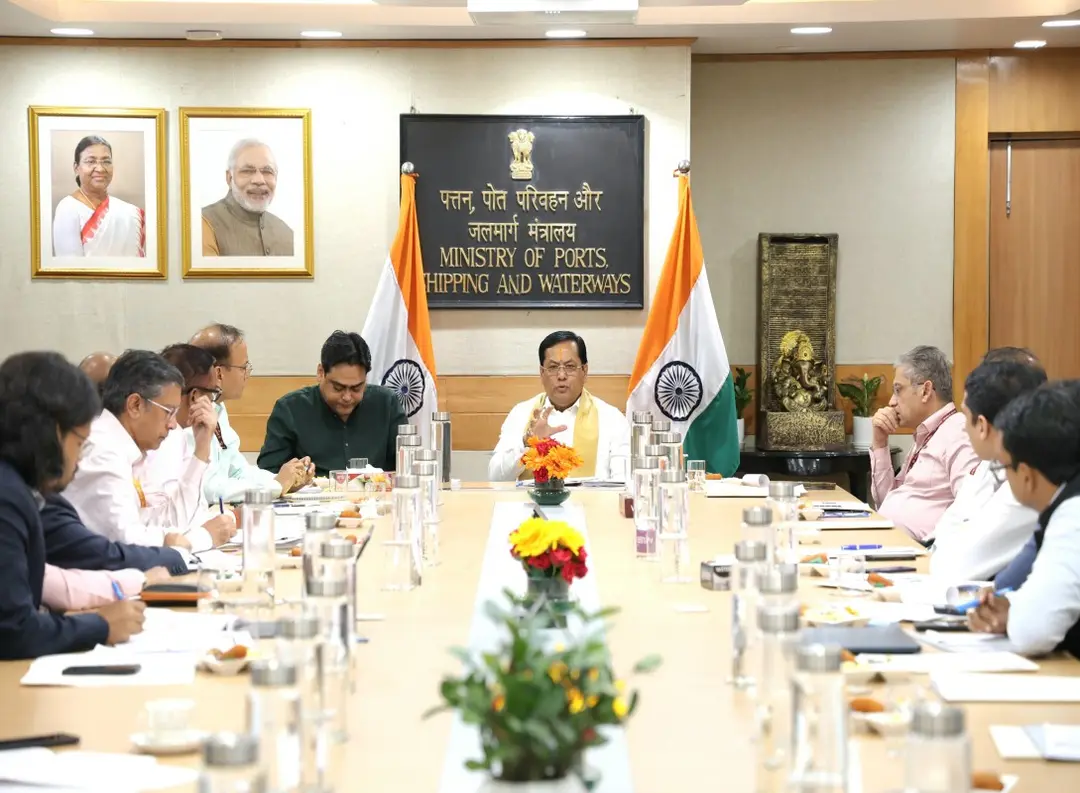
Sonowal calls for stronger preventive vigilance in maritime sector
Union Minister for Ports, Shipping and Waterways Sarbananda Sonowal, along with Minister of State Shantanu Thakur, interacted with Chief Vigilance Officers of ports, public sector undertakings and maritime organisations in New Delhi. Sonowal said true vigilance should not merely find faults but empower honest officers, prevent irregularities and safeguard public resources. The interaction also focused on using technology and digital systems to improve transparency and monitoring. Recent initiatives such as the E-Samudra platform reflect the Ministry's focus.
Source
Ports & Shipping — Sarbananda Sonowal · read the original report ↗
Desk check · compared with the source
What the desk checked (4)
- Union Minister Sarbananda Sonowal and MoS Shantanu Thakur interacted with Chief Vigilance Officers of ports, PSUs and maritime organisations in New Delhi. — Stated in source with both ministers named; no date given.
- Sonowal said true vigilance should not merely find faults but empower honest officers, prevent irregularities and safeguard public resources. — Directly attributed to the minister in the source.
- The interaction focused on using technology and digital systems to improve transparency and reduce procedural lapses. — Appears in source; described in general terms without specifics.
- The E-Samudra platform is cited as a recent digital initiative in the maritime sector. — Named in source; no launch date or performance figures provided.
Analysts’ view opinion
On the surface this is administrative housekeeping, but the political signal is unmistakable — it keeps the NDA government's 'transparent governance' plank in play in one of its biggest infrastructure portfolios. The framing that vigilance should 'empower honest officers' rather than merely hunt for faults is a deliberate choice: it answers a long-standing bureaucratic grievance about decision-paralysis under fear of scrutiny, without diluting the anti-corruption image. With large contracts and private participation flowing through the ports sector, building a preventive shield in advance is the practical politics here.
- For Sonowal, such national-level reform messaging helps consolidate an image beyond his Northeast political base.
- Appearing alongside Minister of State Shantanu Thakur is a routine but useful signal of ministerial unity and regional balance within the portfolio.
- The stress on digital systems and the E-Samudra platform extends the government's broader 'technology equals transparency' narrative.
- The shift from reactive inquiries to preventive vigilance can be read as an attempt to reduce official hesitation in decision-making; critics could read it as softening accountability.
- No specific case, allegation or deadline appears in the story, which makes this for now a statement of intent rather than a list of actions.
What to watch — Watch whether the intent translates into concrete guidelines, time-bound instructions or visible outcomes in port tenders and PSU contracts.
Beyond the minister's stated intent, the story establishes no new rules, funding, timelines or any specific irregularity case.
Deep dive
Research brief · 8 facts · 2 dates · exam-readyThe brief
Context
The Union Ministry of Ports, Shipping and Waterways oversees major ports, maritime public sector undertakings and regulatory bodies, each of which has a Chief Vigilance Officer (CVO) responsible for vigilance administration. In New Delhi, Union Minister Sarbananda Sonowal and Minister of State Shantanu Thakur held an interaction with CVOs of ports, PSUs and maritime organisations. The meeting's theme was shifting vigilance from a fault-finding, reactive exercise to preventive vigilance embedded in institutional functioning, backed by technology and digital systems. The source does not state the date of the interaction.
Key facts
- Union Minister for Ports, Shipping and Waterways Sarbananda Sonowal, with Minister of State Shantanu Thakur, interacted with Chief Vigilance Officers (CVOs) of ports, PSUs and maritime organisations in New Delhi.
- Sonowal said true vigilance should not merely focus on finding faults, but should empower honest officers, prevent irregularities and safeguard public resources.
- The Minister stressed that preventive vigilance must become an integral part of institutional functioning to identify potential risks at an early stage.
- The interaction focused on leveraging technology and digital systems to improve transparency, strengthen monitoring and reduce scope for procedural lapses.
- The E-Samudra platform was cited as a recent digital initiative making maritime administration more transparent, integrated and stakeholder-centric.
- The meeting reviewed vigilance practices and underlined proactive measures, effective internal controls and greater awareness among officials.
- The Ministry emphasised coordination between vigilance units, administrative authorities and operating organisations to protect public assets and ensure compliance.
- The emphasis on preventive vigilance was described as a shift from a purely reactive approach to a proactive institutional culture.
Timeline
- Date not stated in the sourceSonowal and Thakur hold interaction with CVOs of ports, PSUs and maritime organisations in New Delhi on preventive vigilance and transparency.
- Recent (exact date not stated in the source)Launch of digital initiatives in the maritime sector, including the E-Samudra platform, cited at the interaction.
Who has a stake
- Ministry of Ports, Shipping and Waterways — Leads modernisation of maritime governance through transparent processes, digital transformation and stronger institutional accountability.
- Chief Vigilance Officers (CVOs) — Expected to move from reactive fault-finding to preventive vigilance, internal controls and risk identification at an early stage.
- Major ports and maritime PSUs — Must embed integrity, accountability and responsible decision-making in day-to-day institutional functioning.
- Honest officers and officials — Vigilance framework is meant to empower them and encourage honest, timely decision-making rather than penalise risk-taking.
- Maritime stakeholders and the public — Stand to gain from efficient service delivery, protection of public assets and greater confidence in maritime institutions.
Why it matters
Ports and maritime PSUs handle large public assets and high-value procurement, so lapses directly affect public resources and trade efficiency. A preventive, technology-backed vigilance culture aims to catch risks before irregularities occur, while reassuring honest officers that decision-making will not be penalised. The Ministry frames this as complementing wider reforms for efficiency, resilience and public confidence in India's maritime institutions.
UPSC angle
Prelims pointers
- Sarbananda Sonowal is Union Minister for Ports, Shipping and Waterways; Shantanu Thakur is Minister of State.
- Chief Vigilance Officers (CVOs) handle vigilance administration in ports, PSUs and maritime organisations.
- E-Samudra is a digital platform cited by the Ministry for transparent, integrated and stakeholder-centric maritime administration.
- Preventive vigilance: identifying risks early and strengthening systems before irregularities occur, as against reactive, punitive vigilance.
- The CVO interaction was held in New Delhi; the source does not state the date.
Mains framing
India's maritime sector — major ports, shipping PSUs and regulatory bodies — manages substantial public assets, large contracts and time-sensitive clearances, making it vulnerable to procedural lapses and eroded public trust. The Ministry's interaction with CVOs reframes vigilance from a punitive, post-facto exercise into a preventive function: embedding risk identification in institutional functioning, tightening internal controls, and raising awareness among officials so that systems are corrected before irregularities occur. A second plank is technology-driven governance — digital systems such as the E-Samudra platform for better process tracking, monitoring and timely decision-making — which reduces discretion and creates audit trails. The stated approach also protects honest officers, addressing the risk that aggressive vigilance chills legitimate decision-making. The way forward, as outlined in the source, lies in stronger coordination between vigilance units, administrative authorities and operating organisations, sustained reforms for efficiency and resilience, and a culture where integrity, transparency, technology and accountability reinforce one another to support sustainable growth in maritime governance.
Key terms
- Preventive vigilance
- Vigilance approach that identifies risks early and strengthens systems and processes before irregularities happen, rather than only punishing lapses.
- Chief Vigilance Officer (CVO)
- Officer in a port, PSU or organisation responsible for vigilance practices, internal controls and compliance.
- E-Samudra
- Digital platform cited by the Ministry to make maritime administration more transparent, integrated and stakeholder-centric.
- Ministry of Ports, Shipping and Waterways
- Union ministry responsible for ports, shipping and inland waterways governance and reform in India.
- Technology-driven governance
- Use of digital systems to track processes, strengthen monitoring, enhance accountability and support timely decisions.
Practice questions
- Distinguish between punitive and preventive vigilance. How can preventive vigilance strengthen governance in India's ports and maritime public sector undertakings?
- Examine how digital platforms such as E-Samudra can reduce procedural lapses and improve accountability in maritime administration.
- "Vigilance must empower honest officers rather than merely find faults." Critically discuss this proposition in the context of decision-making in public sector organisations.
Grounded only in the source report — figures and dates are the source's, not inferred.