
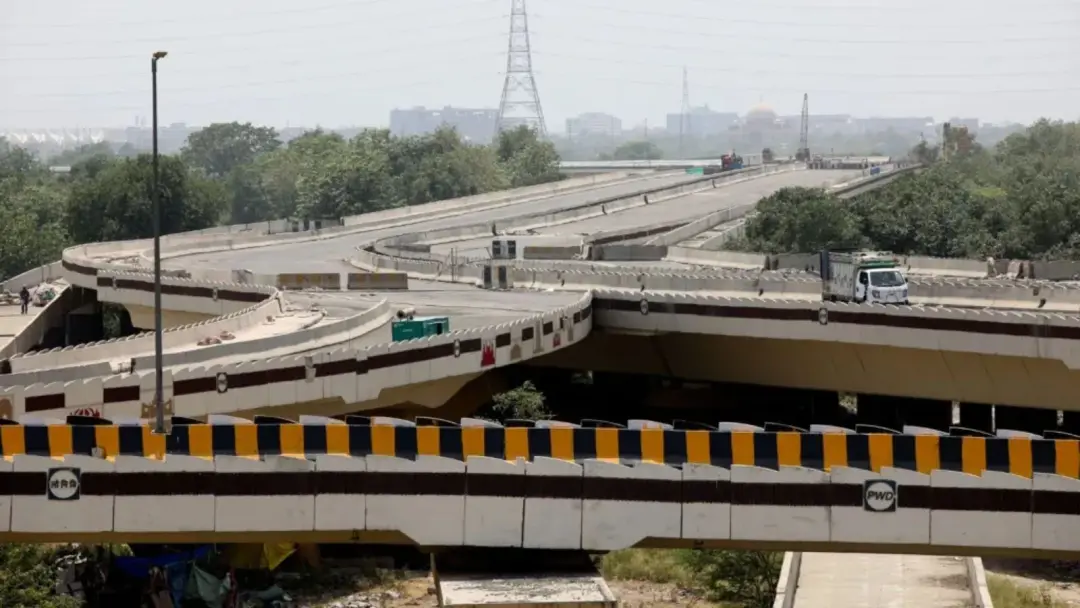
Delhi's Barapullah Phase 3 flyover to open on September 29
Delhi's long-delayed Barapullah Phase III flyover will open to the public on September 29, PWD Minister Parvesh Sahib Singh said on Saturday. Union Home Minister Amit Shah will inaugurate it. The 3.5-km, three-lane corridor has eight loops, four each at Sarai Kale Khan and Mayur Vihar. Approved in 2014 and begun in 2015, the project's revised cost is about Rs 1,635 crore. Travel time from East Delhi to AIIMS will fall from 35-40 minutes to 15 minutes.
Source
Indian Express — Cities · read the original report ↗
Desk check · compared with the source
What the desk checked (5)
- Barapullah Phase III flyover will open to the public on September 29, to be inaugurated by Union Home Minister Amit Shah. — Attributed to Delhi PWD Minister Parvesh Sahib Singh, speaking on Saturday.
- Revised project cost stands at approximately Rs 1,635 crore. — Figure appears in source; no specific agency cited for the revision.
- The 3.5 km three-lane flyover has eight loops, four each at Sarai Kale Khan and Mayur Vihar. — Figure appears in source, repeated twice; no source named.
- Travel time from East Delhi to AIIMS will drop to about 15 minutes from the current 35-40 minutes. — Projection stated in source without named authority; unverifiable estimate.
- Corridor will cut CO2 emissions by about 2 tonnes a day, equal to absorption by nearly 30,000 trees. — Attributed to unnamed officials; estimate only.
Analysts’ view opinion
Completing and inaugurating a project delayed for over a decade is about as favourable a political script as the BJP could ask for — a ready-made platform for the message that things moved once it took charge. The fact that Union Home Minister Amit Shah is doing the honours, while Delhi PWD Minister Parvesh Sahib Singh stresses his own repeated site visits and bottleneck-clearing, pushes the 'same party at Centre and state delivers' argument. But with the project approved in 2014 and begun in 2015, the credit question is one the opposition can contest.
- The strategy of turning the delay itself into the campaign asset is visible — 'stalled earlier, finished now' is a frame that works for the BJP.
- Bringing the Union Home Minister to inaugurate a state-executed road project is a deliberate signal about Centre-state alignment in Delhi.
- The commuters who gain — East Delhi and Noida residents travelling to South Delhi — are a politically significant middle-class constituency.
- Cost is the opening for counter-attack: a revised outlay of about Rs 1,635 crore invites questions about who bore the price of the delay.
- The 2014 approval and 2015 start give earlier dispensations room to claim they initiated the work, so a contest over credit is likely.
What to watch — Watch who is given prominence on the inauguration stage, how the opposition frames the credit argument, and whether this 'missed deadlines, now delivered' template is applied to Delhi's other pending infrastructure projects.
The story records announcements on the opening date, cost and travel-time savings; it does not establish where political responsibility for the delay lies, or whether this will shift voter sentiment.
Deep dive
Research brief · 8 facts · 7 dates · exam-readyThe brief
Context
The Barapullah elevated corridor is a phased signal-free road project in Delhi. Its third phase, linking Mayur Vihar in East Delhi with Sarai Kale Khan, was approved in 2014, begun in 2015 and originally due in 2017, but became one of Delhi's most delayed infrastructure works owing to a land acquisition dispute, environmental clearances and the technical difficulty of bridging the Yamuna floodplain. Delhi PWD Minister Parvesh Sahib Singh announced that the flyover will open to the public on September 29, with Union Home Minister Amit Shah inaugurating it.
Key facts
- Barapullah Phase III flyover opens to the public on September 29; Union Home Minister Amit Shah will inaugurate it.
- The corridor is 3.5 km long, three-laned, with eight loops — four each at Sarai Kale Khan and Mayur Vihar.
- Approved in 2014, initiated in 2015, originally targeted for completion in 2017.
- Revised project cost is approximately Rs 1,635 crore after repeated delays and cost escalation.
- Travel time from East Delhi to AIIMS to fall from about 35-40 minutes to around 15 minutes.
- Delays included a seven-year land acquisition dispute, environmental approvals and construction challenges over the Yamuna floodplain.
- Officials say it is a first-of-its-kind elevated corridor with a dedicated cycle track and a special bridge structure over the Yamuna floodplain.
- Estimated to cut carbon dioxide emissions by about 2 tonnes per day, equivalent to absorption by nearly 30,000 trees, per officials.
Timeline
- 2014Barapullah Phase III flyover project approved.
- 2015Project work initiated.
- 2017Original target date for completion; missed.
- Last year (after BJP came to power in Delhi)Government intervened with the Centre and obtained clearance to transplant trees from the site.
- Past one and a half yearsAccelerated progress through continuous monitoring, inspections and coordinated action by multiple agencies, per the minister.
- Saturday (announcement)PWD Minister Parvesh Sahib Singh announced the September 29 opening.
- September 29Flyover to open to the public, inaugurated by Union Home Minister Amit Shah.
Who has a stake
- Commuters from Noida, East Delhi and South Delhi — Signal-free travel between Mayur Vihar and Sarai Kale Khan; East Delhi to AIIMS trip cut to about 15 minutes.
- Delhi PWD and Minister Parvesh Sahib Singh — Credit for clearing bottlenecks and completing a project delayed for over a decade.
- Union Home Minister Amit Shah / Centre — Inaugurating the corridor; the Centre's clearance enabled tree transplantation from the site.
- Delhi taxpayers and exchequer — Revised cost of about Rs 1,635 crore after prolonged delays and cost escalation.
- Transit agencies — NCRTC, Indian Railways, ISBT, DMRC, Delhi–Mumbai Expressway — Improved road access to the multi-modal transit hub at Sarai Kale Khan.
- Yamuna floodplain environment — Bridge structure over the floodplain and tree transplantation raised environmental clearance issues; projected 2 tonnes/day CO2 saving.
Why it matters
The project shows how land acquisition disputes, environmental clearances and multi-agency coordination can stretch an urban flyover from a 2017 deadline to 2025, with costs revised to about Rs 1,635 crore. For commuters, it promises a signal-free East-to-South Delhi link and relief on NH-24, the DND Flyway and Ring Road, while improving access to the Sarai Kale Khan multi-modal transit hub.
UPSC angle
Prelims pointers
- Barapullah Phase III: 3.5 km, three-lane elevated corridor linking Mayur Vihar and Sarai Kale Khan, Delhi.
- Eight loops in all — four each at Sarai Kale Khan and Mayur Vihar.
- Approved 2014, started 2015, original deadline 2017, opening September 29; revised cost about Rs 1,635 crore.
- Expected to decongest National Highway 24, DND Flyway and Ring Road.
- Sarai Kale Khan hosts a multi-modal transit hub involving NCRTC, Indian Railways, ISBT, DMRC and the Delhi–Mumbai Expressway.
- Described as first-of-its-kind elevated corridor with a dedicated cycle track; special bridge over the Yamuna floodplain.
Mains framing
Barapullah Phase III is a case study in Indian urban infrastructure delivery: a corridor approved in 2014 and targeted for 2017 finally opens on September 29, its cost revised to roughly Rs 1,635 crore. The causes of delay named in the source are structural rather than incidental \u2014 a seven-year land acquisition dispute, pending environmental approvals including tree transplantation clearance from the Centre, the engineering complexity of a bridge across the Yamuna floodplain, and prolonged administrative hurdles involving multiple agencies. The implications are twofold: cost escalation borne by the public exchequer and a decade of foregone benefits, since the corridor is now projected to cut East Delhi\u2013AIIMS travel from 35-40 minutes to about 15 minutes, decongest NH-24, the DND Flyway and Ring Road, feed the Sarai Kale Khan multi-modal hub served by NCRTC, Railways, ISBT and DMRC, and save an estimated 2 tonnes of CO2 a day. The way forward suggested by the project's own recovery is front-loading land and environmental clearances before award of work, single-window inter-agency coordination with continuous ministerial monitoring \u2014 which the minister credits for progress over the past 18 months \u2014 and designing corridors that integrate non-motorised transport, as with this corridor's dedicated cycle track.
Key terms
- Barapullah Phase III
- 3.5 km three-lane elevated flyover giving a signal-free link between Mayur Vihar and Sarai Kale Khan in Delhi.
- PWD (Public Works Department), Delhi
- State agency executing the flyover; headed by Minister Parvesh Sahib Singh.
- NCRTC
- National Capital Region Transport Corporation, one of the agencies at the Sarai Kale Khan multi-modal transit hub.
- Multi-modal transit hub
- Integrated interchange point — here combining NCRTC, Indian Railways, ISBT, DMRC and the Delhi–Mumbai Expressway.
- Yamuna floodplain
- Low-lying riverbed area where a special bridge structure had to be built, adding technical and clearance challenges.
- Tree transplantation
- Relocating trees instead of felling them; clearance for this at the site was obtained from the Centre last year.
Practice questions
- Examine the institutional reasons for chronic delays in urban road infrastructure projects in India, using the Barapullah Phase III flyover as a case study.
- "Infrastructure in ecologically sensitive urban zones needs stricter sequencing of clearances, not faster approvals." Discuss with reference to construction over the Yamuna floodplain.
- How can multi-modal transit hubs such as Sarai Kale Khan improve urban mobility outcomes? Discuss the role of last-mile road connectivity and non-motorised transport infrastructure.
Grounded only in the source report — figures and dates are the source's, not inferred.