
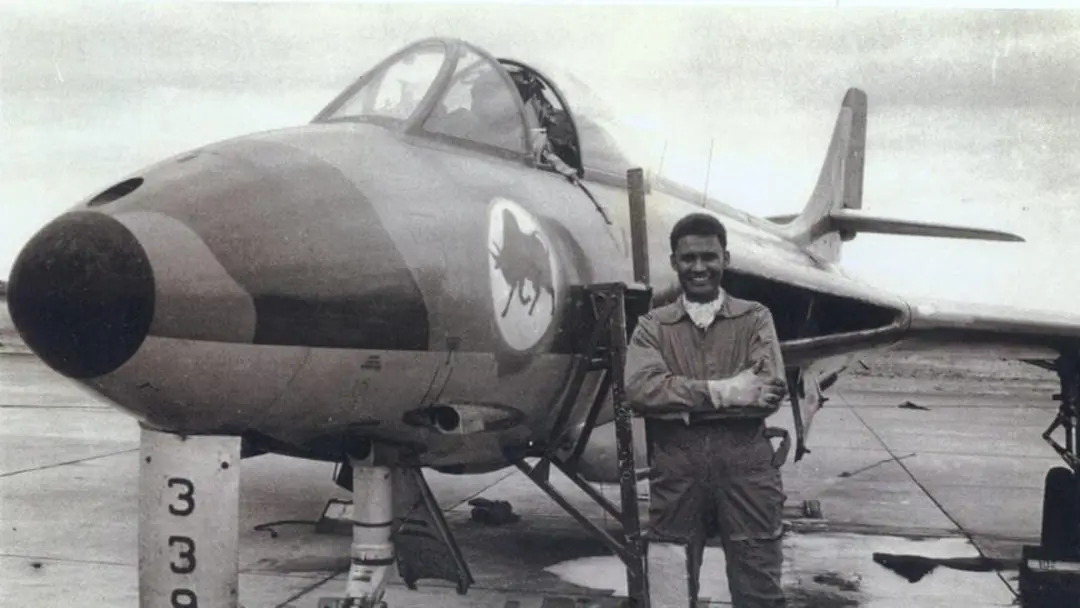
1965 war hero Alfred Tyrone Cooke dies; IAF pays tribute
Flight Lieutenant Alfred Tyrone Cooke, a Vir Chakra awardee and 1965 Indo-Pak War hero, died on Friday at Base Hospital in New Delhi. The Indian Air Force paid tribute, recalling his "legendary dogfight" over Kalaikunda. He downed a Pakistan Air Force Sabre jet on September 7, 1965, during a raid on the West Bengal airfield launched from East Pakistan, and with wingman Subodh Chandra Mamgain held off a force three times their size. Settled in Australia, he was in India for a 14 Squadron event.
Source
Hindustan Times — India · read the original report ↗
Desk check · compared with the source
What the desk checked (5)
- Flight Lieutenant Alfred Tyrone Cooke died on Friday at Base Hospital in New Delhi. — Stated in source; attributed to IAF condolence message and authorities, no cause of death given.
- IAF described his 'legendary dogfight over Kalaikunda' as a masterclass in aggressive air combat. — Directly quoted from an IAF post on X, as cited in the source.
- He received the Vir Chakra for the September 7, 1965 air battle over Kalaikunda, West Bengal, during a raid launched from East Pakistan. — Date, place and award appear in the source; attributed to the IAF and his gallantry citation.
- Cooke shot down a Pakistan Air Force Sabre jet and, with wingman Flying Officer Subodh Chandra Mamgain, held off a force three times their size. — Attributed to his gallantry award citation via a report in The Tribune.
- He had settled in Australia after retirement and was in India for an event organised by 14 Squadron. — Attributed to authorities, as reported by The Tribune.
Analysts’ view opinion
The death of Alfred Tyrone Cooke is first a chapter of military history, but in India the memory of war heroes always carries political symbolism. That the Air Force itself led the tribute, invoking the "legendary dogfight", put institutional honour ahead of any state-level commemoration — the kind of moment that usually draws consensus condolences from both ruling and opposition benches. With 1965 memory and an ongoing debate on defence preparedness in the background, such occasions tend to become platforms that reinforce the national security narrative.
- The passing of a Vir Chakra awardee is typically a non-partisan subject, and tributes from across the political spectrum are likely.
- The IAF's own official post on X reflects the armed forces increasingly curating their heritage narrative directly rather than through political intermediaries.
- Because the Kalaikunda action belonged to the eastern theatre, the commemoration could acquire particular local resonance in West Bengal.
- The news lands at a time when questions about delays in military projects are being raised at the highest levels, so remembrance of valour and criticism of preparedness may end up in the same conversation.
- His having settled in Australia after retirement and returned for his old unit's event is a reminder of why ties with veterans in the diaspora matter institutionally.
What to watch — Watch whether official commemoration stays confined to Air Force tributes or is escalated into statements and honour events by the political leadership.
The story does not establish any political leader's response, any decision on state-level commemoration, or the cause of death — what is offered here is political-lens analysis only.
Deep dive
Research brief · 8 facts · 4 dates · exam-readyThe brief
Context
Flight Lieutenant Alfred Tyrone Cooke, a Vir Chakra awardee and hero of the 1965 Indo-Pak War, died on Friday at Base Hospital in New Delhi. He was decorated for an air battle over the Kalaikunda airfield in West Bengal on September 7, 1965, when the Pakistan Air Force launched raids from East Pakistan (now Bangladesh). Cooke, who had settled in Australia after retiring from the IAF, was in India to attend an event organised by his former unit, 14 Squadron. The Indian Air Force paid tribute on X, calling his "legendary dogfight over Kalaikunda" a "masterclass in aggressive air combat and unwavering resolve".
Key facts
- Flight Lieutenant Alfred Tyrone Cooke, VrC, died on Friday at Base Hospital, New Delhi.
- He was awarded the Vir Chakra, India's third-highest wartime gallantry award, for the air battle over Kalaikunda, West Bengal.
- The Kalaikunda action took place on September 7, 1965, during an air attack launched from East Pakistan (now Bangladesh).
- His citation records that he shot down a Pakistan Air Force Sabre jet during the 1965 war.
- Cooke was on combat air patrol in a Hawker Hunter fighter jet with wingman Flying Officer Subodh Chandra Mamgain when caught in the PAF's second raid on the airfield.
- The two pilots held off a force three times their size, an action that influenced the subsequent course of the war, especially in the eastern theatre.
- The IAF citation credited him with 'conspicuous gallantry, tactical brilliance, and disregard to personal safety'.
- Cooke settled in Australia after retiring from the IAF and was in India for a 14 Squadron event; authorities confirmed this on Saturday, per The Tribune.
Timeline
- September 7, 1965Cooke, on combat air patrol in a Hawker Hunter with wingman Flying Officer S.C. Mamgain, fights off a PAF raid on Kalaikunda airfield launched from East Pakistan and downs a Sabre jet.
- After retirement from the IAFCooke settles in Australia.
- Friday (date not stated in the source)Flight Lieutenant Alfred Tyrone Cooke dies at Base Hospital, New Delhi, while in India for a 14 Squadron event.
- Saturday (date not stated in the source)Authorities confirm details of his visit; the IAF posts condolences on X recalling the Kalaikunda dogfight.
Who has a stake
- Indian Air Force — Institutional custodian of the 1965 war legacy; extended condolences and said his memory would inspire generations of Air Warriors.
- 14 Squadron, IAF — Cooke's former unit, which had organised the event he was in India to attend.
- Flying Officer Subodh Chandra Mamgain — Cooke's wingman in the Kalaikunda dogfight against a force three times their size.
- Cooke's family and the veteran community — Loss of a decorated Vir Chakra awardee and living link to the 1965 war.
- Kalaikunda airfield, West Bengal — Target of the PAF raids from East Pakistan that Cooke helped repel in the eastern theatre.
Why it matters
Cooke's death removes one of the last direct witnesses to the air war of 1965, particularly the lesser-known eastern theatre where raids were launched from East Pakistan. The IAF's tribute underlines how individual gallantry in air combat — two Hunters against a force three times their size — shaped the course of a conflict. For aspirants, the episode is a reminder that the 1965 war was not confined to the western front.
UPSC angle
Prelims pointers
- Vir Chakra is India's third-highest wartime gallantry award.
- Kalaikunda airfield is in West Bengal; it was raided from East Pakistan (now Bangladesh) on September 7, 1965.
- Cooke flew a Hawker Hunter fighter and shot down a Pakistan Air Force Sabre jet in the 1965 war.
- His wingman in the Kalaikunda action was Flying Officer Subodh Chandra Mamgain.
- Cooke belonged to 14 Squadron of the IAF and later settled in Australia.
- He died at Base Hospital, New Delhi, on a Friday; the IAF posted condolences on X.
Mains framing
The death of Flight Lieutenant Alfred Tyrone Cooke, VrC, is an occasion to revisit the eastern theatre of the 1965 Indo-Pak War, a front often overshadowed by operations in the west. Pakistan's air raids on Kalaikunda in West Bengal, launched from East Pakistan on September 7, 1965, tested India's air defence preparedness in a geographically separated theatre; Cooke and his wingman Flying Officer S.C. Mamgain, on combat air patrol in Hawker Hunters, engaged a force three times their size and downed a PAF Sabre, an action the IAF says influenced the subsequent course of the war in that theatre. The episode illustrates the decisive weight of small-unit initiative, aircrew training and air superiority in short, high-intensity conflicts, and the value of gallantry awards such as the Vir Chakra in institutionalising military memory. The way forward lies in systematic documentation of veterans' oral histories, preservation of citations and squadron records, and the use of such case studies in professional military education — so that operational lessons from 1965 remain accessible even as the generation that fought it passes on.
Key terms
- Vir Chakra (VrC)
- India's third-highest wartime gallantry award, conferred on Cooke for the Kalaikunda air battle.
- Dogfight
- Close-quarters aerial combat between fighter aircraft; the IAF called Cooke's Kalaikunda engagement 'legendary'.
- Combat air patrol
- Defensive airborne patrol to intercept enemy aircraft; Cooke was on such a patrol when the PAF's second raid came in.
- Hawker Hunter
- The fighter aircraft flown by Cooke and his wingman during the Kalaikunda action.
- Sabre jet
- The Pakistan Air Force fighter type that Cooke shot down in the 1965 war, per his citation.
- 14 Squadron
- Cooke's former IAF unit, whose event he had travelled to India to attend.
Practice questions
- Discuss the significance of the eastern theatre in the 1965 Indo-Pak War, with reference to the air action over Kalaikunda.
- How do gallantry awards such as the Vir Chakra serve the institutional memory and morale of the armed forces?
- Examine the role of air superiority and small-unit initiative in determining outcomes in short, high-intensity conflicts.
Grounded only in the source report — figures and dates are the source's, not inferred.