
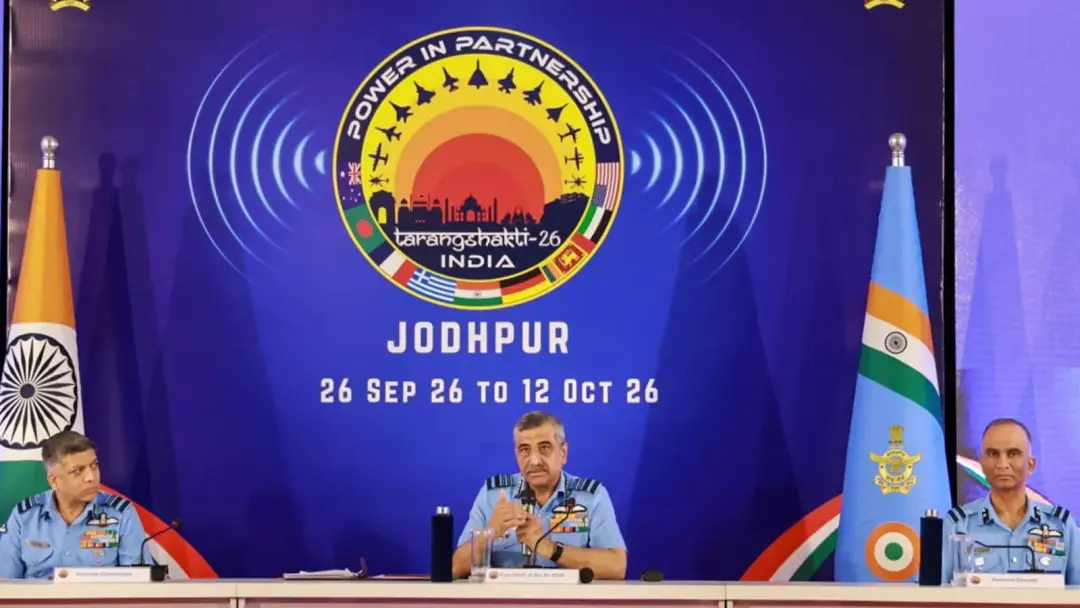
IAF to hold multinational exercise Tarang Shakti-26 in Jodhpur
The Indian Air Force will host the second edition of its multinational air exercise, Tarang Shakti-26, from September 26 to October 12 at Air Force Station, Jodhpur, and adjoining air bases. Around 40 countries are expected to take part. Eight forces — India, Australia, Bangladesh, France, the US, Germany, Sri Lanka and the UAE — will fly assets, while 32 countries attend as observers. US F-35s, French Rafales, UAE F-16s and India's Rafale, Tejas and Su-30 MKI will participate. The first edition was held in 2024.
Source
Indian Express — India · read the original report ↗
Desk check · compared with the source
What the desk checked (5)
- Tarang Shakti-26 will be held September 26 to October 12 at Air Force Station Jodhpur and adjoining air bases. — Dates and venue appear in source as IAF plan; no separate document cited.
- Eight forces will participate with air assets — India, Australia, Bangladesh, France, US, Germany, Sri Lanka and UAE — while 32 countries attend as observers and around 40 countries are expected overall. — Figures appear in source; the 'around 40 countries' total is an expectation, and 8 plus 32 equals 40, internally consistent.
- Aircraft including US F-35s, French Rafales, UAE F-16s, Bangladesh C-130J and Indian Rafale, Mirage-2000, Jaguar, Tejas, MiG-29 and Su-30 MKI will take part. — Listed in source without individual attribution; consistent with the IAF briefing.
- Around 10 Air Chiefs or equivalents are likely to attend. — Stated as a likelihood in source; no named source given.
- Operation Sindoor reinforced lessons on precision, integrated air and missile defence and counter-UAS. — Direct quote attributed to Air Marshal Dixit.
Analysts’ view opinion
Tarang Shakti-26 is not just a military drill — it is a political stage for India's diplomatic reach. By putting US F-35s, French Rafales and UAE F-16s under the same sky as Bangladeshi and Sri Lankan assets, Delhi is signalling that it is tied to no single camp yet able to attract partners from all of them. The jump from 11 countries flying in 2024 to roughly 40 participating now gives the government a growth story that is easy to showcase diplomatically.
- Moving from bilateral drills to a multinational platform shifts India from being a participant to being a convenor — a status signal that carries real diplomatic value.
- The mix of the US, France, Germany, Australia and the UAE on one hand and Bangladesh and Sri Lanka on the other is likely to be presented as a working example of India's multi-alignment doctrine.
- Neighbourhood participation by Bangladesh and Sri Lanka is politically useful for regional diplomacy, though the story says nothing about the domestic politics in those countries.
- The official invocation of lessons from Operation Sindoor folds recent operational experience into the government's wider security narrative.
- The air force's framing that self-reliance and international cooperation are complementary — with indigenous Tejas parked beside foreign F-35s and Rafales — serves the political goal of promoting India's defence industry and export ambitions.
What to watch — Watch whether the presence of around 10 air chiefs or equivalents produces fresh defence conversations or interest in Indian-made platforms, and how the region reacts to neighbours joining an India-hosted exercise.
The story sets out the exercise itself; it does not establish the political calculations behind it, any electoral dimension, or that any agreement or export outcome will follow.
Deep dive
Research brief · 8 facts · 3 dates · exam-readyThe brief
Context
The Indian Air Force is hosting the second edition of Tarang Shakti, described as its largest-ever multinational air exercise, at Air Force Station Jodhpur and adjoining bases from September 26 to October 12. The maiden edition was held in August-September 2024 in two phases, with 11 countries flying their air assets. The IAF frames Tarang Shakti as a shift from mainly bilateral engagements with foreign air forces to planning and operating with multiple air forces simultaneously. Vice Chief of Air Staff Air Marshal Ashutosh Dixit briefed the media on Tuesday, linking the exercise's objectives to lessons from Operation Sindoor.
Key facts
- Tarang Shakti-26 will be held from September 26 to October 12 at Air Force Station, Jodhpur, and adjoining air bases.
- Around 40 countries are expected to participate in the exercise.
- Eight forces will fly assets: India, Australia, Bangladesh, France, the US, Germany, Sri Lanka and the UAE.
- Thirty-two countries will attend as observers; around 10 Air Chiefs or equivalents are likely to attend.
- Aircraft include US F-35s, French Rafales, UAE F-16s, Bangladesh's C-130J, and India's Rafale, Mirage-2000, Jaguar, Tejas, MiG-29 and Su-30 MKI.
- The maiden edition took place in August-September 2024 in two phases, with 11 countries participating with their air assets.
- Drills will cover Beyond Visual Range and within Visual Range combat missions, air mobility operations, dynamic targeting, air-to-air refuelling and combat search and rescue.
- Vice Chief of Air Staff Air Marshal Ashutosh Dixit said the exercise has three aims: operational learning, greater interoperability and stronger partnerships.
Timeline
- August-September 2024Maiden edition of Tarang Shakti held in two phases, with 11 countries participating with air assets.
- Tuesday (ahead of the exercise)Vice Chief of Air Staff Air Marshal Ashutosh Dixit briefs mediapersons on the exercise's aims and lessons from Operation Sindoor.
- September 26 to October 12Tarang Shakti-26 to be conducted at Air Force Station, Jodhpur, and adjoining air bases.
Who has a stake
- Indian Air Force — Host force seeking operational learning, interoperability with multiple air forces simultaneously, and stronger partnerships.
- Eight participating forces (India, Australia, Bangladesh, France, US, Germany, Sri Lanka, UAE) — Flying assets in joint aerial operations, tactical training and interoperability drills.
- 32 observer countries and around 10 Air Chiefs or equivalents — Exposure to multinational air operations and defence diplomacy engagement with India.
- India's defence industry — Exercise will display indigenous platforms, sensors, weapons and unmanned systems.
- Air warriors, airmen, airwomen and technicians from participating countries — Described by the Vice Chief as the central story: working, learning and flying together.
Why it matters
Tarang Shakti-26 marks the IAF's shift from largely bilateral drills to integrating with many air forces at once, at a time when the Vice Chief says warfare is being reshaped by precision, integrated air defence, unmanned systems, information dominance and space-based capabilities. Hosting around 40 countries, including US F-35s and French Rafales, is also an exercise in defence diplomacy and a showcase for India's indigenous defence industry. The stated aim of testing assumptions against partners' operational experience, alongside lessons from Operation Sindoor, links the drill directly to India's combat readiness.
UPSC angle
Prelims pointers
- Tarang Shakti-26: IAF's multinational air exercise, September 26-October 12, at Air Force Station Jodhpur and adjoining bases.
- First edition of Tarang Shakti: August-September 2024, held in two phases, 11 countries with air assets.
- Eight forces flying assets in 2026 edition: India, Australia, Bangladesh, France, US, Germany, Sri Lanka, UAE; 32 observer countries.
- Aircraft on display: US F-35, French Rafale, UAE F-16, Bangladesh C-130J; Indian Rafale, Mirage-2000, Jaguar, Tejas, MiG-29, Su-30 MKI.
- Vice Chief of Air Staff: Air Marshal Ashutosh Dixit.
- Three stated aims of Tarang Shakti-26: operational learning, greater interoperability, stronger partnerships.
Mains framing
Tarang Shakti-26 reflects a deliberate evolution in India's air power engagement: from bilateral exercises with individual partners to multinational drills that require planning, operating and integrating with several air forces simultaneously. The drivers, as articulated by the Vice Chief of Air Staff, are the changing nature of warfare - precision strike, integrated air and missile defence, unmanned systems and counter-UAS, information dominance, space-based capabilities and multi-domain jointness - realities the IAF says Operation Sindoor reinforced. The exercise content, spanning Beyond Visual Range and within Visual Range combat, air mobility, dynamic targeting, air-to-air refuelling and combat search and rescue, is designed to analyse tactical employment philosophy against modern air-to-air and surface-to-air weapons and to identify best practices. Strategically, the presence of around 40 countries, including advanced platforms like the F-35, serves defence diplomacy while the showcasing of indigenous platforms, sensors, weapons and unmanned systems supports the argument that, as Air Marshal Dixit put it, "Atmanirbharta and international cooperation are not contradictory." The way forward implied by the IAF's own framing is continuity: using such multinational settings to test assumptions, absorb partners' operational experience, and institutionalise interoperability rather than merely demonstrate existing capability.
Key terms
- Tarang Shakti
- The IAF's multinational air exercise, first held in August-September 2024; second edition Tarang Shakti-26 at Jodhpur.
- Interoperability
- Ability of different air forces to operate together using compatible procedures, systems and tactics.
- Beyond Visual Range (BVR) combat
- Air combat engagements conducted at ranges where the target is not visible to the pilot; part of the exercise missions.
- Operation Sindoor
- Indian operation cited by the Vice Chief as reinforcing lessons on intelligence-led operations, precision, integrated air and missile defence and counter-UAS.
- Counter-UAS
- Measures to detect and defeat unmanned aerial systems, flagged as a key lesson from recent conflicts.
- Atmanirbharta
- Self-reliance in defence; the exercise will display indigenous platforms, sensors, weapons and unmanned systems.
Practice questions
- Multinational exercises like Tarang Shakti-26 serve both military and diplomatic objectives. Discuss with reference to India's shift from bilateral to multilateral air exercises.
- How have recent conflicts, including Operation Sindoor, reshaped the IAF's emphasis on precision, integrated air defence, unmanned systems and multi-domain operations?
- "Atmanirbharta and international cooperation are not contradictory." Examine this statement in the context of India's defence industry and joint exercises.
Grounded only in the source report — figures and dates are the source's, not inferred.