
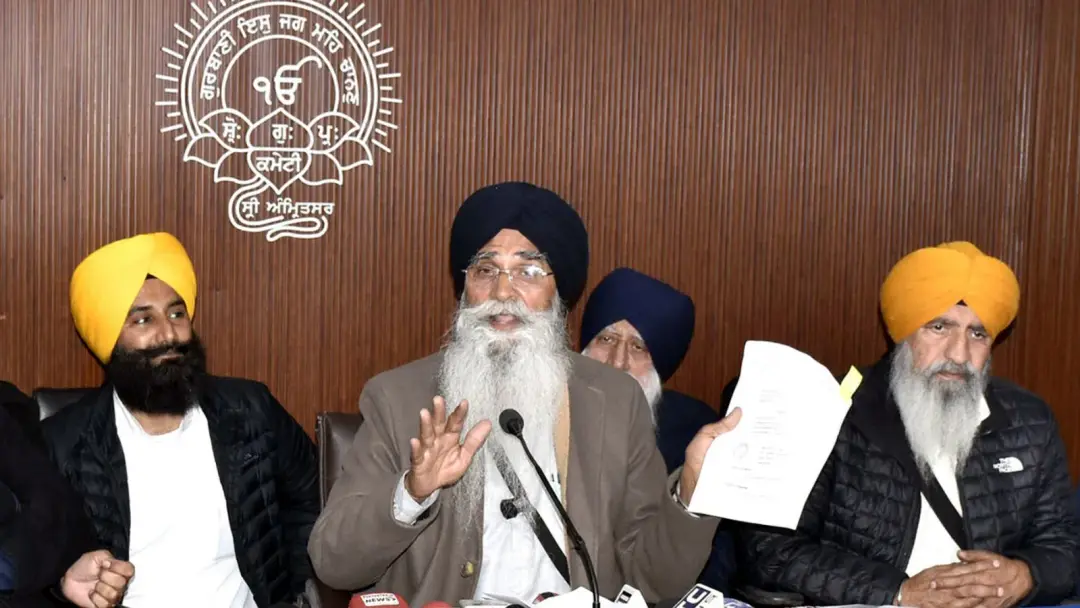
SGPC forms four-member panel to probe Anandpur Sahib allegation
SGPC president Harjinder Singh Dhami said he has constituted a four-member committee to investigate the rape charge against former SGPC member Amarjit Singh Chawla at Anandpur Sahib. Secretary Balwinder Singh Kahlwan was tasked with a preliminary inquiry and is coordinating with the panel. Dhami rejected claims that he had prior knowledge of the woman's arrival. Following an Akal Takht edict, additional head granthi Malkit Singh was relieved of duties and Chawla's resignation was accepted.
Source
Indian Express — Cities · read the original report ↗
Desk check · some claims need care
What the desk checked (4)
- SGPC president Harjinder Singh Dhami has constituted a four-member committee to investigate the rape charge against former SGPC member Amarjit Singh Chawla in Anandpur Sahib. — Attributed directly to Dhami in the source; panel members named.
- Secretary Balwinder Singh Kahlwan was tasked with a preliminary inquiry that is underway and is coordinating with the panel. — Attributed to Dhami; no independent confirmation in source.
- Dhami denied prior knowledge of the woman's arrival at the sarai or any involvement in bringing her there, and denied she approached him with complaints. — Direct quotes from Dhami; the underlying allegations themselves are unattributed in the source.
- Following an Akal Takht edict, additional head granthi Malkit Singh was relieved of duties and Chawla's resignation was accepted. — Attributed to Dhami; edict referenced but its text not quoted in source.
Analysts’ view opinion
For now this is entirely an institutional, internal process — not a criminal one. The four-member SGPC panel, the secretary-level preliminary inquiry and the administrative steps taken in compliance with the Akal Takht edict all sit in the space of departmental and religious discipline, and none of them substitutes for a legal determination on a rape allegation. Since allegations of this nature fall within the category of cognisable offences, the story's silence on the status of any police investigation is the significant gap here.
- An inquiry panel set up by a private or religious body ordinarily has no power to compel witnesses or take evidence on oath; its report can ground disciplinary action, not a judicial finding.
- Relieving an official of duties and accepting a resignation pursuant to an Akal Takht edict are employment and religious consequences only — they should not be read as findings of guilt or as exoneration.
- Even where a person named in an allegation has left office, the presumption of innocence and the right to a fair hearing continue to apply in full.
- On the other side, complainant confidentiality, protection from intimidation and preservation of evidence become central concerns whenever an internal inquiry runs parallel to a possible criminal process.
- The SGPC president's denial of prior knowledge is a statement of position, not a tested fact, and the story does not clarify whether the internal panel or an investigating agency is meant to test it.
What to watch — Watch for whether a police complaint or FIR exists, when the committee reports, whether that report is made public, and how the internal inquiry is sequenced so as not to cut across any statutory investigation.
The story establishes no allegation as proven and says nothing about any FIR, arrest or court process, nor about the committee's terms of reference, deadline or disclosure norms.
Deep dive
Research brief · 8 facts · 4 dates · exam-readyThe brief
Context
The Shiromani Gurdwara Parbandhak Committee (SGPC), the elected body that manages historical Sikh gurdwaras, is facing a controversy over a "rape" allegation involving former SGPC member Amarjit Singh Chawla at Anandpur Sahib. SGPC president Harjinder Singh Dhami says he ordered departmental action as soon as he learnt of the alleged incident and has now set up a four-member probe panel. Separately, an Akal Takht edict led to the excommunication of additional head granthi Malkit Singh and Chawla, with Dhami confirming administrative compliance. Dhami has also denied allegations that he knew in advance about the woman's arrival at the sarai (inn) at Anandpur Sahib or that she had brought complaints to him.
Key facts
- SGPC president Harjinder Singh Dhami has constituted a four-member committee to investigate the "rape" charge against former SGPC member Amarjit Singh Chawla in Anandpur Sahib.
- The panel comprises SGPC members Baldev Singh Kaimpuri, Gurmeet Singh Buh, Bibi Gurinder Kaur Bholuwala and Gurbakhsh Singh Khalsa.
- SGPC secretary Balwinder Singh Kahlwan was tasked with a preliminary inquiry, which is under way, and is coordinating with the four-member panel.
- Dhami said he would answer questions only once the committee submits its report.
- Dhami rejected claims of prior knowledge of, or involvement in, bringing the woman concerned to the sarai (inn) at Anandpur Sahib.
- Dhami denied the allegation that the woman had approached him with specific complaints, saying he would not have tolerated it or remained silent.
- Following the Akal Takht edict on excommunication, additional head granthi Malkit Singh was immediately relieved of duties and his services terminated.
- Chawla's resignation from his posts was formally accepted, Dhami confirmed.
Timeline
- Not dated in the source (when the alleged incident came to light)Dhami says he immediately initiated departmental action and tasked secretary Balwinder Singh Kahlwan with a preliminary inquiry.
- Recently (date not stated in the source)Akal Takht issued an edict excommunicating additional head granthi Malkit Singh and former SGPC member Amarjit Singh Chawla.
- After the edictMalkit Singh relieved of duties and his services as additional head granthi terminated; Chawla's resignation formally accepted.
- Latest developmentDhami announces a high-level four-member probe panel and says he will respond to queries after its report.
Who has a stake
- Harjinder Singh Dhami, SGPC president — Faces allegations of prior knowledge and inaction, which he denies; his handling of the inquiry affects his credibility.
- Amarjit Singh Chawla, former SGPC member — Faces the "rape" charge; excommunicated by Akal Takht edict and his resignation from posts accepted.
- Malkit Singh, additional head granthi — Excommunicated under the Akal Takht edict; relieved of duties and services terminated.
- The woman concerned — Complainant in the alleged incident at the sarai at Anandpur Sahib; outcome of the inquiries affects her pursuit of justice.
- SGPC as an institution — Credibility of gurdwara management and its internal accountability mechanisms is in question.
- Akal Takht — Its edict of excommunication tests the enforcement of religious authority over SGPC functionaries.
- Probe panel members (Kaimpuri, Buh, Bholuwala, Khalsa) and secretary Kahlwan — Responsible for a comprehensive, credible investigation and report.
Why it matters
The allegation strikes at the heart of institutional trust in the SGPC, which administers the most revered Sikh shrines and their sarais where pilgrims stay. How the four-member panel, the preliminary inquiry and the Akal Takht edict are followed through will shape perceptions of accountability in religious institutions and of safety for women visiting them.
UPSC angle
Prelims pointers
- SGPC = Shiromani Gurdwara Parbandhak Committee, the body managing historical Sikh gurdwaras; its president is Harjinder Singh Dhami.
- Four-member SGPC probe panel: Baldev Singh Kaimpuri, Gurmeet Singh Buh, Bibi Gurinder Kaur Bholuwala, Gurbakhsh Singh Khalsa.
- SGPC secretary Balwinder Singh Kahlwan conducted the preliminary inquiry and coordinates with the panel.
- Akal Takht edict led to excommunication of additional head granthi Malkit Singh and former SGPC member Amarjit Singh Chawla.
- Anandpur Sahib is where the alleged incident occurred, at a sarai (inn).
- Malkit Singh's services as additional head granthi stand terminated; Chawla's resignation was accepted.
Mains framing
The Anandpur Sahib allegation illustrates the tension between religious self-governance and the demands of transparent accountability. A grave criminal allegation against a former SGPC member has triggered parallel responses: an internal departmental inquiry by the secretary, a four-member high-level probe panel of SGPC members, and an Akal Takht edict of excommunication that the SGPC says it has administratively implemented by terminating the additional head granthi's services and accepting Chawla's resignation. The SGPC president has simultaneously had to rebut allegations of prior knowledge and of ignoring the woman's complaints, and has deferred answers until the panel reports, which raises questions about the independence of an in-house inquiry into the institution's own functionaries. The way forward, as suggested by the facts in the source, lies in the probe panel completing a comprehensive investigation and making its findings public, coupled with administrative compliance with the Akal Takht's directions and clear, verifiable safeguards for women in pilgrim accommodation such as sarais.
Key terms
- SGPC
- Shiromani Gurdwara Parbandhak Committee, the body that manages historical Sikh gurdwaras; headed here by president Harjinder Singh Dhami.
- Akal Takht
- The highest Sikh temporal authority, whose edict in this case ordered excommunication of Malkit Singh and Amarjit Singh Chawla.
- Sarai
- An inn or pilgrim lodging attached to a gurdwara; the woman concerned was at a sarai at Anandpur Sahib.
- Additional head granthi
- A senior religious functionary/scripture reader post; Malkit Singh's services in this role were terminated.
- Preliminary inquiry
- The initial fact-finding exercise tasked to SGPC secretary Balwinder Singh Kahlwan, ongoing alongside the four-member panel.
Practice questions
- Internal inquiries by religious bodies into their own office-bearers often face questions of credibility. Discuss with reference to the SGPC's four-member probe into the Anandpur Sahib allegation.
- Examine the relationship between the Akal Takht's religious authority and the SGPC's administrative powers, using the excommunication and termination actions in this case.
- What institutional safeguards are needed to protect women in pilgrim accommodation attached to places of worship? Discuss.
Grounded only in the source report — figures and dates are the source's, not inferred.