
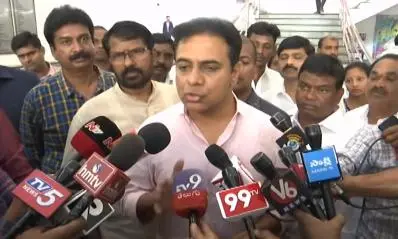
KTR, Harish Rao demand water release from Jurala for farmers
The BRS on Monday alleged the Telangana government was denying irrigation water to farmers. Working president K.T. Rama Rao said farmers under the Jurala project, which holds 8.4 tmc of water, were being arrested for seeking water release, and said the state faced 'El Congo', not El Nino. Harish Rao termed the arrests of former ministers Singireddy Niranjan Reddy, Lakshma Reddy and Srinivas Goud atrocious, and asked why Palamuru reservoirs with 50 TMC capacity were not filled.
Source
KTR (BRS) · read the original report ↗
Desk check · some claims need care
What the desk checked (5)
- Jurala project holds 8.4 tmc of water and farmers are demanding its release — Figure appears in source, attributed to BRS working president K.T. Rama Rao; not independently verified.
- Farmers and BRS leaders, including former ministers Singireddy Niranjan Reddy, Lakshma Reddy and Srinivas Goud, were arrested — Attributed to Rama Rao and T. Harish Rao; no police or government confirmation in source.
- Police have blockaded the Jurala project and deployed large forces around the dam — Claim by Harish Rao; unverified, no official source given.
- Narlapur, Edula, Karivena and Vattem reservoirs of the Palamuru project have a total capacity of 50 TMC and were not filled — Figure stated by Harish Rao; no independent data cited in source.
- AP government is transporting Krishna water from Srisailam to Kuppam, 738 km away in the Penna basin — Assertion made by Harish Rao in a rhetorical question; no supporting documentation in source.
Analysts’ view opinion
The BRS is converting the Jurala water-release issue into a farmers' cause, using it to rebuild its footing as an opposition party. KTR's "El Congo" coinage and the framing of Revanth Reddy as the "first enemy of Palamuru farmers" — turning the Chief Minister's own "son of Palamuru" identity against him — reads as a deliberate strategy to squeeze the government in its leader's home region. The arrests of former ministers have handed the BRS a ready-made grievance narrative; the government's account of actual water availability and of law-and-order conditions at the dam is not recorded in this story.
- Out of power, irrigation and farmer distress is the safest and most emotive political ground available to the BRS.
- The choice of Palamuru as the battleground is not incidental — pressure applied in the Chief Minister's own region carries a higher political return.
- The arrests cut both ways for the government: defensible on law-and-order grounds, but easy to portray as punishing leaders who stood with farmers.
- By invoking Krishna water being moved by the AP government, Harish Rao links the issue to inter-state water politics and the older BRS plank of "defending Telangana's share".
- The "this is not politics, this is about farmers" framing is an attempt to present the agitation as a public movement rather than a party fight.
What to watch — Watch whether the arrested leaders are released, whether the police deployment at Jurala continues, and how the government answers on water availability — that will decide if this stays a local flashpoint or becomes a statewide BRS campaign.
The story does not establish how much water at Jurala is actually releasable, whether any crop loss has occurred, or the reasons police cited for the arrests, and it carries no government rebuttal to the BRS allegations.
Deep dive
Research brief · 8 facts · 2 dates · exam-readyThe brief
Context
The Bharat Rashtra Samithi (BRS), now in opposition in Telangana, has accused the Congress state government of denying irrigation water to farmers in the Palamuru (erstwhile Mahbubnagar) region. The immediate trigger is a demand for release of water from the Jurala project on the Krishna, where farmers and BRS leaders agitating for water release have been arrested and police have been deployed around the dam. BRS working president K.T. Rama Rao and senior leader T. Harish Rao raised the issue at a press conference on Monday, coining the phrase "El Congo" to blame the Congress government rather than El Nino for farm distress.
Key facts
- BRS alleged on Monday that the Telangana government was denying irrigation water to farmers.
- K.T. Rama Rao said the Jurala project holds 8.4 tmc of water and farmers under it have been demanding water release but are being arrested.
- BRS leaders who expressed support to the agitating farmers were also arrested; BRS demanded immediate release of all arrested persons and release of water.
- Rama Rao said if even one acre of crop under Jurala dries up, the Congress government would be held responsible.
- He said Chief Minister Revanth Reddy, who calls himself the 'son of Palamuru', had become the 'first enemy of Palamuru farmers'.
- Harish Rao called the arrests of former ministers Singireddy Niranjan Reddy, Lakshma Reddy and Srinivas Goud, former MLAs and other BRS leaders 'atrocious'.
- Harish Rao said police had blockaded the Jurala project and deployed a large number of forces around the dam.
- He asked why the Narlapur, Edula, Karivena and Vattem reservoirs of the Palamuru project, with a total capacity of 50 TMC, were not filled when there was a chance.
Timeline
- Monday (date not stated in the source)BRS working president K.T. Rama Rao and senior leader T. Harish Rao speak to reporters in Hyderabad, alleging denial of irrigation water and demanding release of water from Jurala.
- Before the press conference (exact dates not stated in the source)Farmers under the Jurala project demand water release; farmers, former ministers, former MLAs and other BRS leaders are arrested; police blockade the Jurala project.
Who has a stake
- Farmers under the Jurala project — Standing crops at risk if water is not released; some have been arrested for demanding release.
- BRS (K.T. Rama Rao, T. Harish Rao) — Leading the agitation; its former ministers and MLAs have been arrested, making it a political flashpoint.
- Telangana Congress government / CM Revanth Reddy — Accused of denying water to Palamuru farmers and of high-handed policing; blamed for any crop loss.
- Police in Telangana — Accused of blockading the Jurala dam and deploying large forces, and of arresting farmers and leaders.
- Former ministers Singireddy Niranjan Reddy, Lakshma Reddy, Srinivas Goud — Arrested while fighting on behalf of farmers, per Harish Rao.
- Andhra Pradesh government — Cited by BRS for transporting Krishna waters from Srisailam to Kuppam in the Penna basin, 738 km away.
Why it matters
Water release decisions on the Krishna directly determine whether standing crops in the drought-prone Palamuru region survive, making irrigation a central political battleground in Telangana. The arrest of farmers and former ministers turns an administrative water-sharing question into a law-and-order and democratic-protest issue. The reference to Andhra Pradesh moving Krishna water 738 km to the Penna basin also raises inter-state river water questions.
UPSC angle
Prelims pointers
- Jurala project: irrigation project on the Krishna in Telangana; storage cited as 8.4 tmc in the source.
- Palamuru project reservoirs named in the source: Narlapur, Edula, Karivena and Vattem, with a total capacity of 50 TMC.
- Srisailam is on the Krishna; Kuppam lies in the Penna basin, stated as 738 km away.
- K.T. Rama Rao is BRS working president; T. Harish Rao is a senior BRS leader.
- Telangana Chief Minister named in the source: Revanth Reddy (Congress).
- 'El Congo' is a political coinage by BRS, contrasted with the climate phenomenon El Nino.
Mains framing
The Jurala row illustrates how irrigation water allocation in a semi-arid, politically sensitive region like Palamuru becomes a proxy for wider contestation between government and opposition. The BRS case rests on three claims: that Jurala holds 8.4 tmc that could be released to save standing crops, that Palamuru reservoirs with 50 TMC capacity were left unfilled when the opportunity existed, and that Andhra Pradesh is moving Krishna water 738 km from Srisailam to the Penna basin while Telangana farmers go without. The government's response is not stated in the source, but the reported arrests of farmers, former ministers and MLAs and the police blockade of the dam shift the debate from water management to the handling of agrarian protest. A way forward suggested by the facts on record would involve transparent, published reservoir-operation and release schedules, timely filling of storages when inflows permit, grievance redress for farmers before crops reach distress, and restraint in using policing powers against agitations over irrigation entitlements. Claims about inter-state diversion would need adjudication through the established river-water mechanisms rather than competing press conferences.
Key terms
- Jurala project
- Irrigation project serving Telangana farmers; the source says it holds 8.4 tmc of water and is now under police blockade.
- tmc / TMC
- Thousand million cubic feet, the standard unit for reservoir storage; Jurala is cited at 8.4 tmc and Palamuru reservoirs at 50 TMC total.
- Palamuru project reservoirs
- Narlapur, Edula, Karivena and Vattem reservoirs with a combined capacity of 50 TMC, which BRS says were not filled.
- El Nino
- Climate phenomenon commonly blamed for rainfall deficits; BRS says Telangana's distress is due to 'El Congo' instead.
- 'El Congo'
- BRS's political coinage blaming the Congress government, not climate, for farmers' water distress.
- BRS
- Bharat Rashtra Samithi, the opposition party in Telangana; K.T. Rama Rao is its working president.
Practice questions
- Discuss how irrigation water allocation becomes a site of political contestation in Indian federal politics, using the Jurala water release dispute in Telangana as an illustration.
- Examine the tension between maintaining public order and protecting the right to protest, with reference to the arrests of farmers and former ministers agitating for water release.
- What institutional mechanisms exist for resolving disputes over the sharing and diversion of inter-state river waters, and why do political allegations often precede formal adjudication?
Grounded only in the source report — figures and dates are the source's, not inferred.