
Narayana Guru's vision core to Kerala's social reform: Satheesan
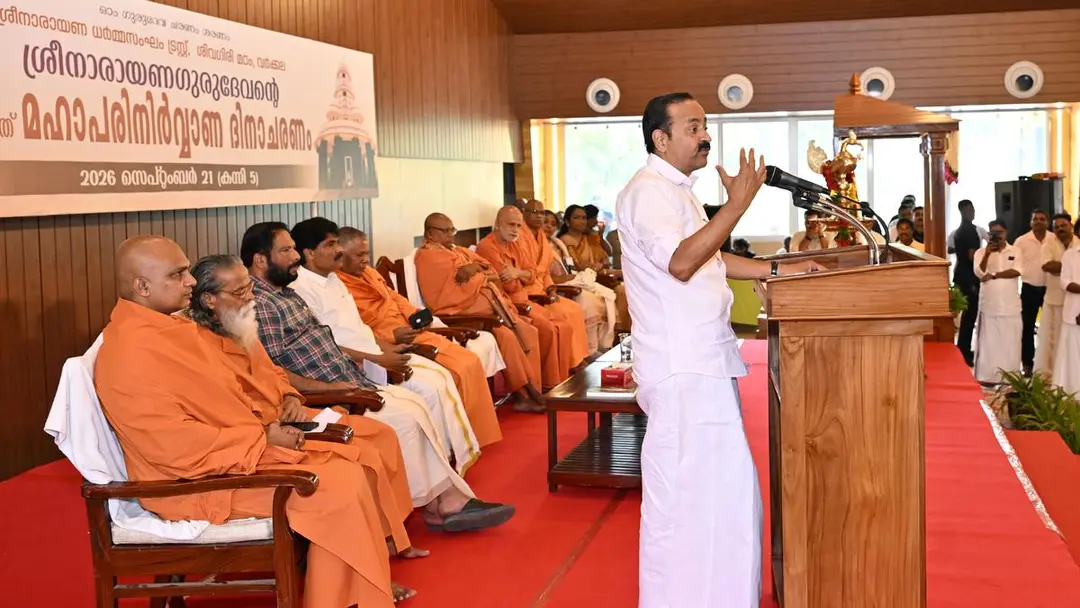
Chief Minister V.D. Satheesan on Monday inaugurated a public conference organised by the Sivagiri Madhom in Varkala to mark the death anniversary of Sree Narayana Guru. Every Keralite should embrace the Guru's teachings and vision as part of their heritage, he said, adding that the entire credit for Kerala being secular goes to Narayana Guru, who sowed its seeds. His government's actions would always reflect Guru's teachings, he said. Sivagiri Madhom president Swami Sathchidananda presided; Agriculture Minister T. Siddique attended.
Source
The Hindu — National · read the original report ↗
Desk check · compared with the source
What the desk checked (4)
- Chief Minister V.D. Satheesan inaugurated a public conference at Sivagiri Madhom in Varkala marking Sree Narayana Guru's death anniversary. — Stated in source as the event being reported; attributed to the report itself.
- Satheesan said the entire credit for Kerala being secular goes to Narayana Guru, who sowed the seeds for it. — Direct quote attributed to the Chief Minister in the source.
- Satheesan said his government's actions would always reflect Guru's teachings. — Paraphrased statement attributed to the Chief Minister.
- Sivagiri Madhom president Swami Sathchidananda presided and Agriculture Minister T. Siddique was present. — Named attendees listed in source; no further sourcing given.
Analysts’ view opinion
Chief Minister V.D. Satheesan calling Sree Narayana Guru's legacy the heritage of "every Keralite" from the Sivagiri Madhom platform is more than a commemorative gesture — it is a deliberate political framing. By crediting Kerala's secular character entirely to the Guru, he roots secularism in the State's own social reform history rather than presenting it as an imported idea. His assurance that his government's actions will always reflect the Guru's teachings reads as an effort to firm up ties with the socially influential constituency that reveres the Guru.
- The Sivagiri platform is one of Kerala's most significant socio-political venues, and the Chief Minister inaugurating it himself signals an unwillingness to cede that space to rivals.
- Attributing Kerala's secularism to Narayana Guru shifts the secularism debate away from religious polarisation and towards the State's indigenous reform tradition.
- The line that government actions will reflect the Guru's teachings carries more weight as a social-justice political statement than as a specific governance commitment.
- The presence of Agriculture Minister T. Siddique on the same platform can be read as a display of broader social and communal balance.
- Because ownership of Kerala's social reform legacy is contested across political camps, counter-claims from rivals asserting the same inheritance would be a natural response.
What to watch — Watch how rival camps respond to this framing, and whether the government translates the rhetoric into concrete measures on social justice and representation.
The story records only a speech at a death anniversary conference and establishes no new policy announcement, electoral strategy or measurable shift in community support.
Deep dive
Research brief · 8 facts · 1 dates · exam-readyThe brief
Context
Sree Narayana Guru (1856-1928, dates not stated in the source) is the social reformer widely credited with Kerala's anti-caste and social renaissance movement; the Sivagiri Madhom at Varkala, founded in his name, is the principal institutional centre associated with him. Each year the Madhom marks his death anniversary with a public conference. At the 2026 observance, Chief Minister V.D. Satheesan inaugurated the conference and said Kerala's secular character owes its origins entirely to the Guru. He added that his government's actions would always reflect the Guru's teachings.
Key facts
- Kerala Chief Minister V.D. Satheesan inaugurated a public conference at the Sivagiri Madhom, Varkala, on Monday, marking Sree Narayana Guru's death anniversary; report published September 21, 2026.
- Satheesan said every Keralite should embrace the Guru's teachings and vision and consider them part of their heritage.
- He said that if Kerala can be called secular today, "the entire credit for it goes to Narayana Guru. It was he who sowed the seeds for it."
- He said the Guru's vision forms the core of Kerala's progressive thought and social reformation.
- He said the ideas the Guru implanted in people's minds transcend time and no one can erase them.
- He said that in an age of darkness, the Guru held Keralites by their hand and taught them to walk forward, not backward.
- The Chief Minister said his government's actions would always reflect the Guru's teachings.
- Sivagiri Madhom president Swami Sathchidananda presided; Agriculture Minister T. Siddique was among those present.
Timeline
- Monday (report published September 21, 2026)Chief Minister V.D. Satheesan inaugurates the Sivagiri Madhom's public conference at Varkala marking Sree Narayana Guru's death anniversary; Swami Sathchidananda presides.
Who has a stake
- Chief Minister V.D. Satheesan — Positions his government as guided by Sree Narayana Guru's teachings and credits the Guru for Kerala's secular character.
- Sivagiri Madhom, Varkala — Custodian institution of the Guru's legacy; organiser of the death anniversary public conference.
- Swami Sathchidananda, Sivagiri Madhom president — Presided over the conference; leads the Madhom's stewardship of the Guru's message.
- Agriculture Minister T. Siddique — Represented the government at the commemoration as an attendee.
- Keralites / general public — Urged to treat the Guru's teachings and vision as part of their own heritage.
Why it matters
Sree Narayana Guru's legacy remains a central reference point in Kerala's political and social discourse, and the Chief Minister's remarks tie the state's secular identity directly to that reform tradition. A sitting government publicly committing that its actions will reflect the Guru's teachings signals the continuing political salience of Kerala's social renaissance heritage.
UPSC angle
Prelims pointers
- Sree Narayana Guru is associated with Kerala's social reform and renaissance movement.
- Sivagiri Madhom is located at Varkala in Kerala and is linked to Sree Narayana Guru's legacy.
- Swami Sathchidananda is the president of the Sivagiri Madhom (as per the source).
- V.D. Satheesan is referred to as Chief Minister of Kerala in the source; T. Siddique as Agriculture Minister.
- The Guru's death anniversary is marked annually by a public conference at Sivagiri Madhom.
Mains framing
Kerala's reputation for secularism and social equity is routinely traced to its 19th-20th century social reform movements, of which Sree Narayana Guru's work is the most cited strand; the Chief Minister's statement at Sivagiri that \"the entire credit\" for Kerala's secular character belongs to the Guru reflects how reform-era legacies are invoked as the moral foundation of present-day governance. The causes lie in a caste-stratified social order that reformers challenged through education, worship rights and dignity movements, producing what the Chief Minister called Kerala's \"progressive thought and social reformation\". The implication is twofold: commemorative platforms like the Sivagiri conference function as sites where political authority seeks legitimacy from reform heritage, and governments are publicly held to the standard of that heritage - as in the pledge that \"his government's actions would always reflect Guru's teachings\". The way forward, on the source's own terms, is translating commemoration into practice: treating the Guru's teachings as shared civic heritage rather than sectional property, and measuring policy against the inclusive, forward-looking ethic the Chief Minister invoked. The source does not detail any specific programme or scheme, so substantive policy commitments are not stated in the source.
Key terms
- Sree Narayana Guru
- Social reformer whose vision, per the source, forms the core of Kerala's progressive thought and social reformation.
- Sivagiri Madhom
- Institution at Varkala, Kerala, associated with Sree Narayana Guru, which organised the death anniversary public conference.
- Varkala
- Town in Kerala where the Sivagiri Madhom is located and where the conference was held.
- Secularism (as invoked in the story)
- Kerala's plural, non-sectarian social character, which the Chief Minister credited entirely to seeds sown by Narayana Guru.
- Social reformation
- The movement to reshape caste-bound social practice; described in the source as central to the Guru's enduring influence in Kerala.
Practice questions
- Discuss the contribution of Kerala's social reform movement, particularly Sree Narayana Guru, to the state's secular and progressive character.
- Commemorative events for social reformers often become platforms for political messaging. Critically examine with reference to recent instances in India.
- How far can the legacy of 19th-20th century social reformers serve as a guide for contemporary governance and public policy? Illustrate your answer.
Grounded only in the source report — figures and dates are the source's, not inferred.