
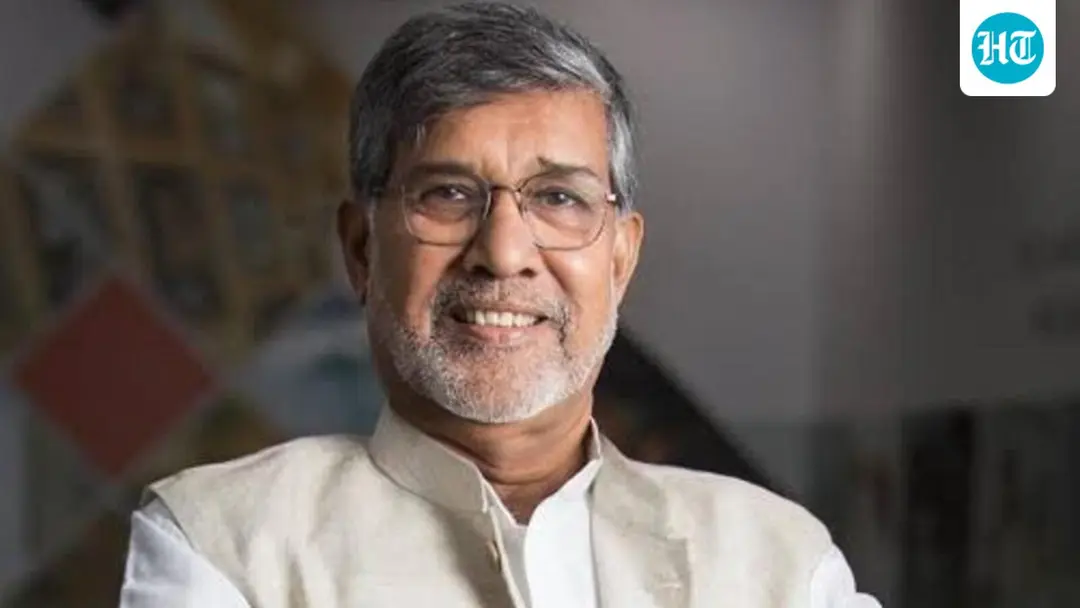
Compassionate AI should be technology's future: Kailash Satyarthi
Nobel laureate Kailash Satyarthi has proposed a framework he calls Compassionate AI for the future of artificial intelligence. In an exclusive interview with Hindustan Times, he said compassion should be the guiding principle in design, development and deployment, and suggested engineers live for a time in villages in Africa, South Asia and Latin America. Satyarthi said algorithms are biased and that the technology is controlled by eight or nine companies.
Source
Hindustan Times — India · read the original report ↗
Desk check · compared with the source
What the desk checked (5)
- Satyarthi proposes a framework called 'Compassionate AI' with compassion as a principle in design, development and deployment. — Directly attributed to Satyarthi in the HT interview.
- He was a keynote speaker at the UN 'AI for Good' summit in Geneva in July. — Stated by Satyarthi in the interview; no independent documentation in the source.
- Dozens of companies and the heads of state of two countries — one prime minister and one president — approached him after his Geneva talk. — Satyarthi's own account; the leaders are unnamed and the claim is unverified in the source.
- AI technologies are controlled by eight or nine companies whose profits and wealth exceed the GDP of countries. — Approximate figure given by Satyarthi without a source or named companies.
- He declined to disclose details of discussions with Anthropic, OpenAI and Google. — Appears in source as his explicit refusal to comment.
Analysts’ view opinion
Satyarthi's pitch is an attempt to open a third lane between the two camps that dominate AI discourse — fear and evangelism — by insisting that ethics belong inside the engineering pipeline of design, development and deployment rather than in sermons around it. In industry terms the underlying concerns are not new: algorithmic bias, unrepresentative training data and the distance between builders and users are already live debates. What is new is the framing — "compassion" as a design principle, with the unusually concrete suggestion that engineers spend time living in rural communities in Africa, South Asia and Latin America. The sharper point in the interview is structural: if the technology sits with eight or nine companies, individual empathy only goes so far.
- His question "AI for good — good for whom?" is really a product question: whose world the training data and evaluation benchmarks reflect largely determines who the system serves.
- The proposal that engineers live in rural communities echoes field-based user research culture, but risks staying symbolic unless it becomes a measurable, auditable process.
- The concentration of the technology in a handful of firms — across compute, data and capital — reframes this as a competition issue, captured in his own questions about how to democratise data and technology.
- Linking AI-driven unemployment and inequality to a possible resurgence of child labour shifts the risk conversation from speculative long-term harms to near-term socioeconomic effects.
- The argument fits a broader trend in AI governance: movement from voluntary principles towards mandated process, transparency and audit requirements.
What to watch — The real test is whether "compassionate AI" stays a conference slogan or gets translated into measurable engineering practice — evaluation benchmarks, data representativeness audits and field testing.
The story does not establish that any company has adopted the framework; Satyarthi declined to detail his conversations with leading AI firms, and the enthusiastic responses he describes are his own account, not independently verified.
Deep dive
Research brief · 8 facts · 4 dates · exam-readyThe brief
Context
Nobel Peace laureate Kailash Satyarthi, known for his decades-long campaign against child labour, has proposed a framework he calls "Compassionate AI" as a third path between fear of artificial intelligence and uncritical embrace of it. He first set out the idea as a keynote speaker at the United Nations "AI for Good" summit in Geneva in July, and has since taken it to engineers, investors and universities in San Francisco, including Stanford and the SAP Institute. In an exclusive interview with Hindustan Times, he argued that algorithms carry the biases of their engineers and that the technology is concentrated in the hands of eight or nine companies.
Key facts
- Satyarthi calls his framework "Compassionate AI", with compassion as the guiding principle in the design, development and deployment of the technology.
- He delivered the idea as a keynote speaker at the inaugural ceremony of the UN "AI for Good" summit in Geneva in July, where he asked: "you say AI for good, but good for whom?"
- He says dozens of companies and the heads of state of two countries - one prime minister and one president - approached him in the hall after his Geneva talk calling it a great idea.
- Satyarthi says he met dozens, possibly hundreds, of engineers, scientists, developers and investors over three days in San Francisco; he also spoke at Stanford and the SAP Institute.
- His concrete proposal: engineers and code writers should go and live for some time in villages and rural communities in Africa, South Asia and Latin America to understand people's problems.
- He says algorithms are biased because the biases and mindset of engineers are built into them, resulting in larger harms.
- He states AI technologies are controlled by eight or nine companies whose profits and wealth exceed the GDP of countries, noting some have already crossed the $5 trillion mark India aspires to as an economy.
- He declined to disclose the reaction of frontier AI firms such as Anthropic, OpenAI and Google to his proposal.
Timeline
- July (year not stated in the source)Satyarthi introduces the idea of Compassionate AI as keynote speaker at the UN "AI for Good" summit in Geneva.
- Recently, before the interviewThe "HuggingFace attack" referred to in the source adds to public fears about AI risk.
- Three days before the interviewSatyarthi meets engineers, developers, deployers and investors in San Francisco.
- The day before the interviewSatyarthi speaks at Stanford, having earlier addressed engineers at the SAP Institute.
Who has a stake
- Kailash Satyarthi — Nobel laureate and anti-child-labour campaigner seeking to shape AI norms through the Compassionate AI framework.
- The eight or nine companies controlling AI — Named among frontier developers are Anthropic, OpenAI and Google; their design choices and concentration of wealth are the target of his critique.
- Engineers, code writers, developers and investors — Asked to embed compassion in their work and to live in rural communities in Africa, South Asia and Latin America to understand intended beneficiaries.
- "Invisible people" in villages and rural communities — Billions who may never be customers of AI products yet are claimed as beneficiaries; they bear the harms of biased algorithms.
- Governments and heads of state — Some embrace AI as a "magic wand"; two heads of state endorsed his Geneva proposal, and states must decide how to democratise data and technology.
- United Nations — Convener of the "AI for Good" summit in Geneva, the platform where the framework was launched.
- Children at risk of child labour — Rising unemployment and inequality from AI could worsen child labour and undo decades of progress.
Why it matters
As nations and firms race to dominate AI, the debate is largely polarised between fear and hype; Satyarthi offers a third framing that treats bias as an engineering problem rooted in who builds the systems and who they never meet. His warning that AI is controlled by eight or nine companies richer than many national economies raises the governance question of how to democratise data and technology. For India and the Global South, the link he draws between AI-driven unemployment, inequality and a possible resurgence of child labour makes this a development issue, not just a technology one.
UPSC angle
Prelims pointers
- Kailash Satyarthi: Nobel laureate and child rights campaigner; proponent of the "Compassionate AI" framework.
- "AI for Good": United Nations summit held in Geneva in July, where Satyarthi was an inaugural keynote speaker.
- Satyarthi's core proposition: compassion as the principle in AI design, development and deployment.
- Algorithmic bias, per Satyarthi, reflects the mindset and biases of the engineers who write the code.
- Satyarthi says AI technologies are controlled by eight or nine companies whose wealth exceeds the GDP of countries.
- Institutions and firms named in the interview: Stanford, SAP Institute, Anthropic, OpenAI, Google.
Mains framing
Satyarthi's intervention reframes AI governance as a question of whose values are encoded in the technology. He identifies two failures: an epistemic distance between developers and the \"invisible people\" they claim to serve, producing biased algorithms and \"larger harms\"; and a structural concentration of power, with eight or nine companies controlling the technology and commanding wealth exceeding the GDP of countries, raising the question of whether humans will control machines or machines human decisions. The developmental implication is direct - if AI deepens unemployment and inequality, gains against child labour could be reversed. His proposed remedies are deliberately practical rather than moralistic: embedding compassion as a principle across design, development and deployment, and immersing engineers in rural communities in Africa, South Asia and Latin America so that lived realities inform code. At the systemic level he poses, without prescribing answers, the questions of how to democratise data and technology. He also argues that public fear is not itself harmful, since it can drive creative thinking; the task is to address real risks through human conscience, wisdom and intelligence rather than opposition. His own precedent - reshaping global policy and corporate conduct in chocolate, carpet and sports goods supply chains - suggests norm entrepreneurship backed by treaties and laws as a plausible path.
Key terms
- Compassionate AI
- Satyarthi's framework placing compassion as the guiding principle in the design, development and deployment of AI.
- AI for Good
- United Nations summit on AI and technology held in Geneva in July, where Satyarthi delivered an inaugural keynote.
- Algorithmic bias
- Satyarthi's description of how engineers' own mindsets and biases get embedded in code, producing larger harms.
- Democratising data and technology
- The question Satyarthi raises of dispersing control of AI away from the eight or nine dominant companies.
- "Invisible people"
- Those in rural and poor communities whom AI claims to benefit but who may never be customers or be consulted.
- $5 trillion economy
- India's economic target, which Satyarthi notes some AI companies have already surpassed in scale.
Practice questions
- Critically examine the argument that algorithmic bias is primarily an engineering and design problem rather than a regulatory one. How far can immersion of developers in affected communities address it?
- "The biggest threat is who controls whom." Discuss the implications of AI being concentrated in eight or nine corporations whose wealth exceeds the GDP of nations, and suggest ways to democratise data and technology.
- Examine the linkage between AI-driven unemployment, inequality and the risk of resurgent child labour in the Global South.
Grounded only in the source report — figures and dates are the source's, not inferred.