
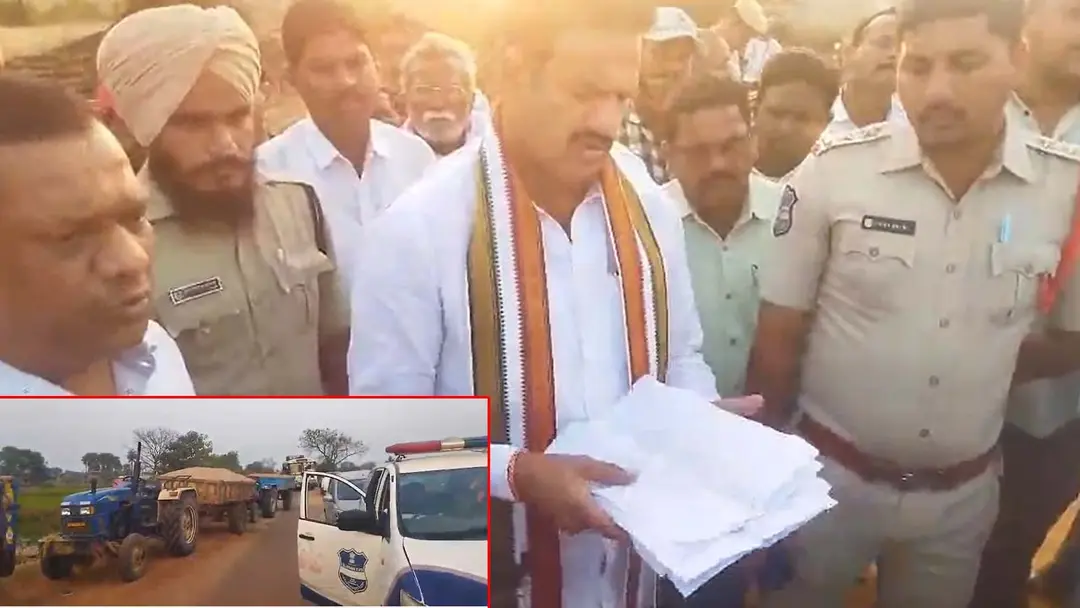
MLA stops illegal sand transport in Narsimhulapet mandal
MLA Ramachandru Naik stopped illegal sand transportation in Narsimhulapet mandal of Mahabubabad district. While travelling to Kousalyadevipalli, he halted his convoy at the Akeru Vagu bridge, examined the coupons issued to sand tractors and questioned drivers about the destination. Finding the coupon listed one location while the sand was being moved to another, he summoned Tahsildar Ramesh Babu, inspected coupon issue records and expressed anger at the MRO. He directed the SI and revenue officials to set up check posts in the Akeru Vagu catchment.
Source
Mahabubabad — MLA & నియోజకవర్గం · read the original report ↗
Desk check · some claims need care
What the desk checked (4)
- MLA Ramachandru Naik stopped sand tractors at the Akeru Vagu bridge while travelling to Kousalyadevipalli and checked their coupons. — Described as a sequence of events in the source; no named official or document is cited as the source of the account.
- The coupons showed one destination while the sand was being transported elsewhere. — Central allegation of the story; appears in source without attribution to an official record or statement.
- The MLA summoned Tahsildar Ramesh Babu, examined coupon issue records and expressed anger at the MRO. — Name and designation appear in the source; no direct quote or official response included.
- The MLA directed the SI and revenue officials to set up check posts in the Akeru Vagu catchment in Narsimhulapet mandal. — Stated in the source headline points and body; consistent internally, but no written order referenced.
Analysts’ view opinion
Politically this reads as decisive action against illegal sand transport, but legally the central question is jurisdiction. Stopping vehicles, inspecting coupons, summoning records and directing that check posts be set up are functions the law assigns to revenue, mining and police authorities; an MLA's role is legislative and oversight-based, not executive. If sand was indeed moving to a destination different from the one on the coupon, that could be prima facie evidence of a violation — but establishing and acting on it is for the competent authority.
- Sand transport and mineral movement are governed by specific statutes and rules under which only designated officers may seize, penalise or register cases.
- A mismatch between the coupon's stated destination and the actual route may ground reasonable suspicion, but it is not a finding of guilt absent inquiry, notice and an opportunity to explain.
- An elected representative summoning officials, examining records and issuing directions raises questions about the boundary between legislative and executive functions.
- Drivers and tractor owners retain natural-justice rights to be heard; the story does not record any formal case being registered against anyone.
- If there is an allegation of lapse at the Tahsildar/MRO level, the proper route is departmental inquiry or review by superiors rather than a public expression of displeasure.
What to watch — Watch whether an official audit of the coupon-issuing records follows, whether any FIR or seizure proceedings are initiated, and whether the check posts are ordered in writing by the competent authority.
The story does not establish that any offence was proven, that cases were registered, that vehicles were seized, or that any official faced action — nor does it record the drivers' or officials' explanation for the coupon mismatch.
Deep dive
Research brief · 7 facts · 5 dates · exam-readyThe brief
Context
Sand mining and transport in Telangana are regulated through official coupons that specify the quantity, source and destination for each load. In Narsimhulapet mandal of Mahabubabad district, some individuals were allegedly moving sand in violation of these coupons. On February 20, 2026, local MLA Ramachandru Naik personally intercepted sand tractors at the Akeru Vagu bridge while on his way to Kousalyadevipalli and found mismatches between the coupon details and the actual destination. He summoned the Tahsildar, inspected coupon issue records and ordered check posts in the Akeru Vagu catchment.
Key facts
- Report published February 20, 2026 at 10:08 am says illegal sand transportation was under way in Narsimhulapet mandal, Mahabubabad district, Telangana.
- MLA Ramachandru Naik halted his convoy at the Akeru Vagu bridge while travelling to Kousalyadevipalli and inspected coupons issued to sand tractors.
- The MLA questioned tractor drivers directly about where the sand was being taken.
- The coupons named one destination while the sand was actually being moved elsewhere, indicating violation.
- Tahsildar Ramesh Babu was summoned to the spot and sand coupon issue records were examined.
- The MLA expressed anger at the MRO (Mandal Revenue Officer) over the coupon issue records.
- The MLA directed the Sub-Inspector (SI) and revenue officials to set up check posts in the Akeru Vagu catchment area.
Timeline
- Before the interceptionSome individuals allegedly began illegal sand transportation in Narsimhulapet mandal of Mahabubabad district.
- On the day reportedMLA Ramachandru Naik, travelling to Kousalyadevipalli, stopped his convoy at the Akeru Vagu bridge and checked sand tractor coupons.
- Immediately afterCoupon destination mismatch found; Tahsildar Ramesh Babu called to the spot, coupon issue records inspected, anger expressed at the MRO.
- Same occasionDirections issued to SI and revenue officials to establish check posts in the Akeru Vagu catchment.
- February 20, 2026, 10:08 amNews report on the incident published.
Who has a stake
- MLA Ramachandru Naik — Elected representative who intercepted the tractors and issued directions to police and revenue officials on curbing illegal sand movement.
- Tahsildar Ramesh Babu — Mandal revenue head summoned to produce and explain sand coupon issue records.
- MRO (Mandal Revenue Officer) — Faced the MLA's displeasure over the issuance of sand coupons.
- Sub-Inspector and revenue officials — Directed to set up check posts in the Akeru Vagu catchment to prevent illegal transport.
- Sand tractor drivers and operators — Questioned on the spot; their loads and coupons were found inconsistent with the actual destination.
- Residents of Narsimhulapet mandal and the Akeru Vagu ecosystem — Bear the environmental and revenue cost of unregulated sand extraction from the stream's catchment.
Why it matters
Illegal sand transport drains state mineral revenue and damages stream beds and catchments, and coupon misuse shows how paper permits can be bent at the mandal level. The episode also highlights that enforcement often depends on an elected representative's personal intervention rather than routine checks by police and revenue staff. The ordered check posts in the Akeru Vagu catchment are a test of whether local machinery can sustain monitoring on its own.
UPSC angle
Prelims pointers
- Narsimhulapet mandal is in Mahabubabad district, Telangana; Akeru Vagu is the stream involved in the sand case.
- Sand transport is regulated through coupons specifying the destination of each tractor load.
- Tahsildar/MRO is the mandal-level revenue officer responsible for sand coupon records.
- Sub-Inspector (SI) is the police officer directed, along with revenue officials, to set up check posts.
- MLA named in the incident: Ramachandru Naik; Tahsildar named: Ramesh Babu.
- Date of report: February 20, 2026.
Mains framing
Illegal sand transport is a classic case of a low-visibility, high-value resource crime where the regulatory instrument itself, the transport coupon, becomes the loophole: as the Narsimhulapet episode shows, a coupon issued for one destination can be used to ferry sand elsewhere, defeating the purpose of route and quantity control. The causes lie in weak field verification, the absence of fixed check posts along stream catchments such as the Akeru Vagu, and possible laxity in coupon issuance at the mandal revenue office, which is why the MLA's anger was directed at the MRO after inspecting the records. The implications are threefold: loss of state revenue, ecological damage to stream beds and catchment areas, and an erosion of public trust when enforcement appears to depend on a politician stopping his convoy rather than on institutional routine. The way forward suggested by the source itself is preventive infrastructure, that is, check posts manned jointly by police and revenue officials in the catchment, backed by periodic audit of coupon issue records and accountability for officials whose records do not match ground reality.
Key terms
- Sand coupon
- Official permit issued for a sand load specifying details such as the destination; its misuse indicates illegal transport.
- Tahsildar
- Mandal-level revenue officer, here Ramesh Babu, who holds the sand coupon issue records.
- MRO (Mandal Revenue Officer)
- Revenue official at mandal level responsible for coupon issuance; faced the MLA's displeasure in this case.
- Akeru Vagu
- Stream in Narsimhulapet mandal whose catchment is the site of sand movement and where check posts were ordered.
- Check post
- Fixed monitoring point to be set up by police and revenue staff to verify sand loads and coupons in transit.
- SI (Sub-Inspector)
- Police officer at station level directed, with revenue officials, to enforce checks on sand transport.
Practice questions
- Illegal sand mining and transport persist despite permit systems. Examine the institutional weaknesses that allow coupon misuse and suggest enforcement reforms.
- Discuss the environmental consequences of unregulated sand extraction from stream catchments and the role of district revenue and police machinery in preventing it.
- Should elected representatives undertake direct enforcement action as seen in the Narsimhulapet case? Analyse the implications for administrative accountability.
Grounded only in the source report — figures and dates are the source's, not inferred.