
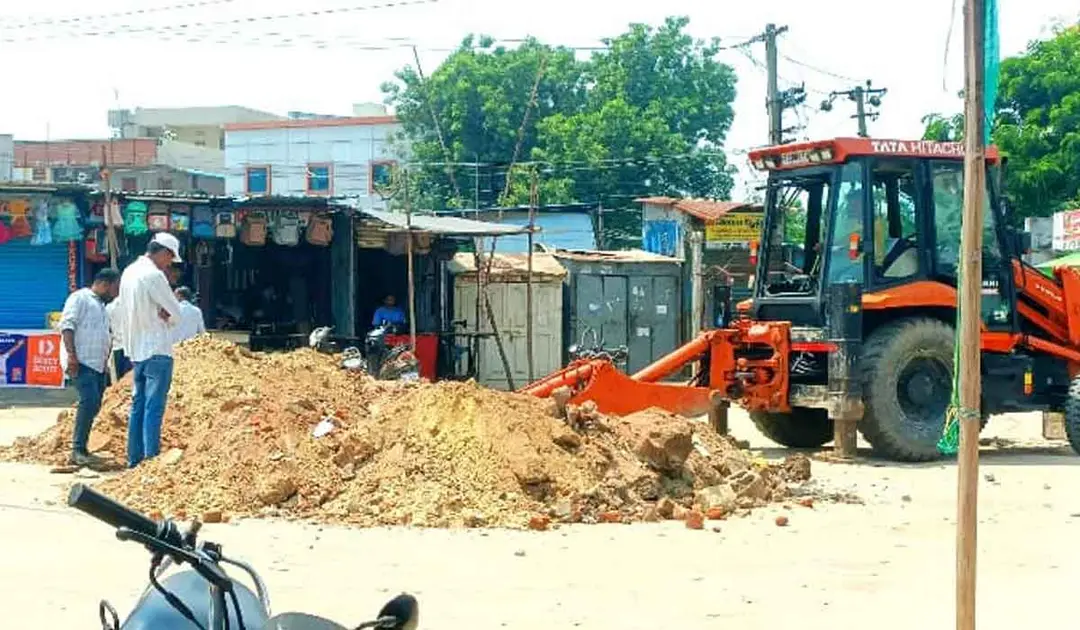
Soil tests at Godavarikhani bazaar unsettle shop traders
Soil tests were carried out on Thursday at Old Ashok Bazaar in Lakshminagar, Godavarikhani's main trade centre, under the Ramagundam Municipal Corporation. Proposals for an integrated commercial complex worth about Rs 25 crore under the Urban Challenge Fund were recently approved at a council meeting. Executive engineer Shanti Swaroop said soil samples were drilled, collected and sent to a Hyderabad laboratory. Mobile and cloth shop traders, whose shops were demolished a year ago, expressed concern.
Source
హైదరాబాద్ — Hyderabad · read the original report ↗
Desk check · compared with the source
What the desk checked (5)
- Soil tests were conducted Thursday at Old Ashok Bazaar, Lakshminagar, under the Ramagundam Municipal Corporation. — Stated in source as reported fact; no document cited, but consistent with engineer's confirmation.
- Proposals for modern integrated commercial complexes worth about Rs 25 crore under the Urban Challenge Fund were approved at a recent municipal council meeting. — Figure and approval appear in source; no council resolution number or date given.
- Soil samples were drilled, collected and sent to a laboratory in Hyderabad for the commercial complex construction. — Attributed to municipal executive engineer Shanti Swaroop.
- Mobile and cloth shops in Lakshminagar were demolished a year ago for road development, and temporary rooms were later provided at Old Ashok Centre. — Background stated in source without attribution or official figures.
- Cement roads were recently built in Lakshminagar with TUFIDC funds and could be damaged again by the new works. — Funding claim unattributed; the damage risk is presented as local residents' opinion.
Analysts’ view opinion
On paper the Rs 25 crore commercial complex in Godavarikhani is a routine development project; politically it is far more delicate, because the traders now fearing displacement are largely the same ones hit by demolitions a year ago. With the council having cleared the proposal and soil testing now underway, a scheme meant to earn credit for the ruling side risks becoming a local protest flashpoint. The mobile and clothing shopkeepers may be few in number, but their location in the town's main market gives their grievance unusual visibility.
- Council approval has attached clear political ownership to the project, so the ruling group will carry the blame as well as any credit.
- The sequence of last year's demolitions, temporary rooms and an unfinished complex at the main crossroads feeds a narrative of poor planning that is hard for officials to shake off.
- Residents' complaint that newly laid cement roads may be dug up again hands the opposition a ready-made 'waste of public money' line.
- The counter-argument is strong too: modernising a congested market and offering permanent shops could defuse anger if rehabilitation is spelt out early.
- No party or elected representative reaction is recorded in the story, so for now this remains a clash between an official explanation and trader anxiety.
What to watch — Watch whether the municipal body offers traders a clear rehabilitation and allotment commitment before the lab report leads to tendering — or whether protests and opposition agitation take shape first.
The story does not establish whether a rehabilitation plan exists, whether the shops will actually be removed, or which political side is driving the proposal.
Deep dive
Research brief · 8 facts · 5 dates · exam-readyThe brief
Context
Old Ashok Bazaar in Lakshminagar is the main trading hub of Godavarikhani, a coal-belt town in Telangana's Peddapalli/Karimnagar region, administered by the Ramagundam Municipal Corporation. The corporation's council recently approved proposals for a modern integrated commercial complex costing about Rs 25 crore under the Urban Challenge Fund, and engineering officials selected a vacant plot in the Old Ashok area for it. On Thursday, municipal officials drilled and collected soil samples there and sent them to a Hyderabad laboratory, triggering anxiety among mobile phone and cloth shop traders who had already lost their shops to demolitions a year ago and were given temporary rooms at Old Ashok Centre.
Key facts
- Soil (soil quality) tests were conducted on Thursday at Old Ashok Bazaar, Lakshminagar, Godavarikhani, under the Ramagundam Municipal Corporation.
- Proposals for a modern integrated commercial complex of about Rs 25 crore under the Urban Challenge Fund were approved at a recent municipal council meeting.
- Municipal engineering officials selected a vacant plot in the Old Ashok area as the site for the commercial complex building.
- Hole drilling was done deep into the ground, soil was collected and transported to a laboratory in Hyderabad.
- Executive Engineer Shanti Swaroop confirmed that soil samples were collected and sent to the Hyderabad lab specifically for the commercial complex construction.
- A year ago, mobile phone shops and cloth shops in Lakshminagar were demolished in the name of road development; traders lost livelihoods for a year.
- Temporary rooms were built at Old Ashok Centre and handed over to the displaced traders.
- Complexes promised at the main crossroads after earlier demolitions have not yet been completed.
Timeline
- About a year agoMobile and cloth shops in Lakshminagar demolished for road development; traders lost livelihood.
- After the demolitionTemporary rooms built at Old Ashok Centre and handed over to affected traders.
- RecentlyCement roads laid in Lakshminagar with crores of rupees of TUFIDC funds.
- RecentlyRs 25 crore integrated commercial complex proposal under Urban Challenge Fund approved at the municipal council meeting.
- Thursday (reported October 1)Soil tests done at Old Ashok Bazaar; samples drilled, collected and sent to a Hyderabad laboratory.
Who has a stake
- Mobile and cloth shop traders of Lakshminagar — Already demolished once and shifted to temporary rooms; fear losing their relocated shops and livelihoods again if the complex comes up on the same site.
- Ramagundam Municipal Corporation (Baldia) — Implementing the Rs 25 crore commercial complex; must manage trader resettlement and justify site selection.
- Executive Engineer Shanti Swaroop — Official explaining that the soil sampling was done solely for the commercial complex construction.
- Municipal council — Approved the commercial complex proposals; accountable for the decision and its effects on traders.
- Local residents of Lakshminagar — Fear newly built cement roads will be destroyed and public money wasted through unplanned works.
- Hyderabad laboratory — Testing the soil samples that will determine the feasibility of construction at the site.
Why it matters
The episode shows how urban infrastructure funding can collide with the livelihoods of small traders when sequencing and resettlement are not planned in advance. Traders displaced once for road widening now face displacement again from the very plot where temporary shops were provided, while newly laid cement roads built with TUFIDC funds may be dug up for the new complex. For readers, it is a case study in whether centrally or state-funded urban projects deliver value or duplicate spending.
UPSC angle
Prelims pointers
- Godavarikhani's Old Ashok Bazaar in Lakshminagar falls under the Ramagundam Municipal Corporation, Karimnagar region, Telangana.
- The proposed integrated commercial complex is worth about Rs 25 crore, funded under the Urban Challenge Fund.
- Soil samples from the site were sent to a laboratory in Hyderabad after hole drilling.
- Cement roads in Lakshminagar were recently built using TUFIDC funds.
- Ramagundam Municipal Corporation's Executive Engineer in the story is Shanti Swaroop.
- Earlier demolitions in Lakshminagar were carried out in the name of road development, about a year before the report.
Mains framing
The Godavarikhani case illustrates a recurring governance failure in Indian urban local bodies: project-wise decision-making without an integrated plan for land use, resettlement and sequencing of works. The Ramagundam Municipal Corporation demolished mobile and cloth shops a year ago for road development, housed traders in temporary rooms at Old Ashok Centre, and has now cleared a Rs 25 crore integrated commercial complex under the Urban Challenge Fund on the same vacant land, with soil testing already under way. The implications are threefold: repeated loss of livelihood for informal and small traders who have no assured alternative space; incomplete delivery of earlier promises, as complexes at the main crossroads remain unfinished; and possible waste of public money if newly laid TUFIDC-funded cement roads are dug up for construction. The way forward, as suggested by the concerns voiced in the story, lies in transparent consultation with affected traders before site finalisation, a firm rehabilitation guarantee with allotment in the new complex, completing pending works before starting new ones, and coordinating road and building works so that one department's asset is not destroyed by another's project.
Key terms
- Urban Challenge Fund
- The funding route under which the roughly Rs 25 crore integrated commercial complex at Old Ashok Bazaar was proposed and approved; further details not stated in the source.
- TUFIDC
- The fund referred to in the story with whose crores of rupees cement roads were recently laid in Lakshminagar; full expansion not stated in the source.
- Ramagundam Municipal Corporation (Baldia)
- The urban local body carrying out the soil tests and the proposed commercial complex at Godavarikhani.
- Soil quality test / hole drilling
- Geotechnical sampling by drilling into the ground to check whether the soil can bear the proposed building; samples sent to a Hyderabad lab.
- Integrated commercial complex
- A modern multi-use market building proposed to replace scattered shops at the Old Ashok area site.
Practice questions
- Repeated demolition and relocation of small traders for urban infrastructure projects reflects weak planning in municipal governance. Discuss with reference to the Godavarikhani commercial complex case.
- How can urban local bodies ensure that funds such as the Urban Challenge Fund and TUFIDC are used without duplication of works and wastage of public money?
- What institutional safeguards should exist to protect the livelihoods of small and informal traders displaced by municipal construction projects?
Grounded only in the source report — figures and dates are the source's, not inferred.