
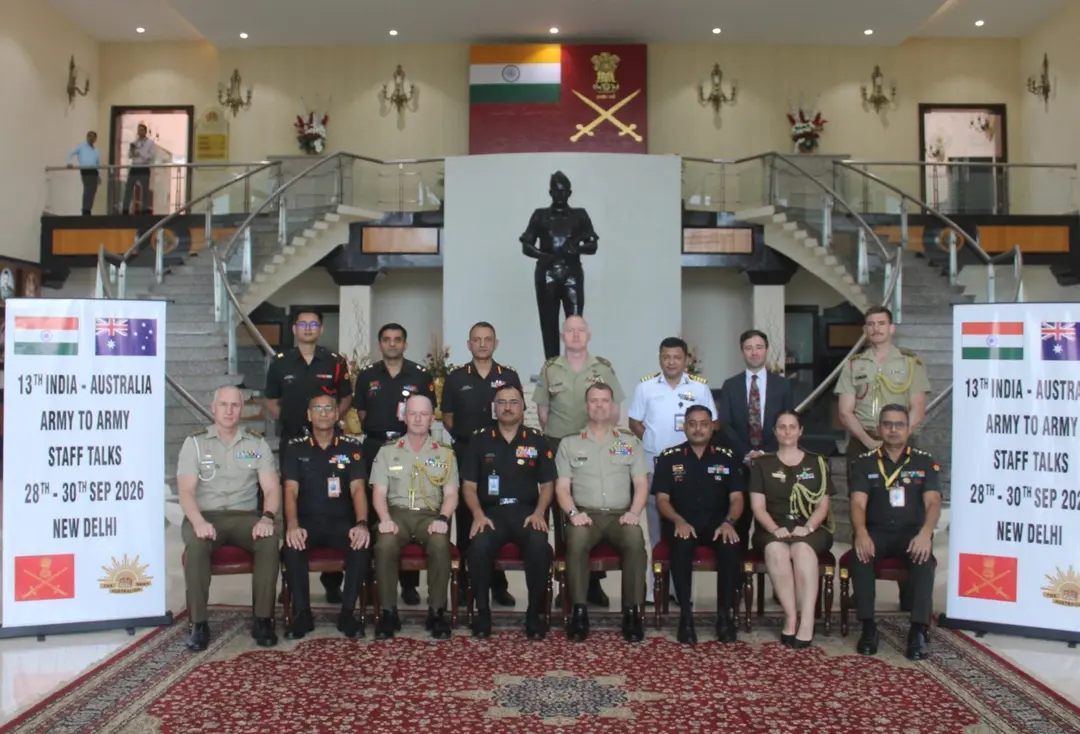
India, Australia hold 13th Army Staff Talks in New Delhi
India and Australia held the 13th round of Army-to-Army Staff Talks in New Delhi over three days from September 28 to 30, discussing defence cooperation and areas of mutual interest. The Indian Army's Additional Directorate General of Public Information said the talks reaffirmed partnership and mutual trust. The Australian delegation also visited the Centre for Land Warfare Studies and the National War Memorial. In June, Richard Marles and Rajnath Singh held the second Defence Ministers' Dialogue.
Source
Indian Army (ADGPI) · read the original report ↗
Desk check · compared with the source
What the desk checked (5)
- The 13th round of India-Australia Army-to-Army Staff Talks was held in New Delhi from September 28 to 30. — Dates and round number appear in source; attributed to the Indian Army's Additional Directorate General of Public Information.
- The Australian delegation visited the Centre for Land Warfare Studies and the National War Memorial in New Delhi. — Stated in source without named official attribution; consistent with the rest of the report.
- Richard Marles and Rajnath Singh held the second India-Australia Defence Ministers' Dialogue in June. — Figure and names appear in source; no document or statement directly cited.
- PMs Anthony Albanese and Narendra Modi issued a Joint Declaration on Defence and Security Cooperation at the third Annual Summit in Melbourne in July. — Appears in source as background; no link to the declaration text provided.
- Ministers looked ahead to enhanced Indian participation in Exercise Talisman Sabre 2027. — Forward-looking intention reported in source, not a confirmed commitment.
Analysts’ view opinion
Taken alone, a 13th round of Army staff talks is routine military housekeeping; placed alongside June's second Defence Ministers' Dialogue and the July Modi–Albanese Joint Declaration in Melbourne, it reads as part of a deliberate political strategy. For Delhi, widening Indo-Pacific partnerships is a way to preserve strategic autonomy by diversifying rather than aligning; for Canberra, it is about institutionally locking in a heavyweight Asian partner. Politically this is low-cost, decent-return territory for both governments, since neither faces significant domestic opposition to the relationship.
- The emphasis on recurring machinery — staff talks, ministerial dialogues, annual summits — suggests both sides want a relationship that survives changes of government rather than one resting on personalities.
- Running the relationship on two tracks, ministerial and military-to-military, spreads the political credit and insulates progress from any single diplomatic setback.
- The focus on defence industry, research and materiel cooperation dovetails neatly with India's domestic self-reliance narrative, giving the government a usable political framing.
- Deepening engagement of this kind will be read regionally against China's rise, though the story names no target country — that silence looks like calculated diplomatic caution.
- By keeping cooperation at the exercises-and-information-sharing level rather than alliance level, Delhi protects its traditional non-aligned posture at home.
What to watch — Watch India's scale of participation in Exercise Talisman Sabre 2027 and how quickly the proposed memorandum on defence articles and services is finalised.
The story does not establish what specific decisions or agreements came out of these talks, which security concerns drove them, or how domestic political actors in either country have reacted.
Deep dive
Research brief · 8 facts · 3 dates · exam-readyThe brief
Context
India and Australia have been steadily institutionalising their defence relationship through senior-level dialogues, exercises and information sharing. The latest step was the 13th round of India-Australia Army-to-Army Staff Talks, held in New Delhi, which brought senior officers of the Indian Army and Australian Army together on defence cooperation and areas of mutual interest. These Army-level talks sit within a wider architecture that includes the Defence Ministers' Dialogue and the Australia-India Annual Summit, both of which met this year and produced fresh defence commitments.
Key facts
- The 13th round of India-Australia Army-to-Army Staff Talks was held in New Delhi over three days, from September 28 to 30.
- The Indian Army's Additional Directorate General of Public Information (ADGPI) said the discussions reaffirmed the partnership and mutual trust between the two forces.
- The Australian delegation visited the Centre for Land Warfare Studies in New Delhi for discussions on contemporary security issues.
- The delegation also visited the National War Memorial in New Delhi to pay tribute to soldiers who died in service.
- In June, Australian Deputy Prime Minister and Defence Minister Richard Marles and Indian Defence Minister Rajnath Singh held the second India-Australia Defence Ministers' Dialogue.
- The June ministerial dialogue looked ahead to enhanced Indian participation in Exercise Talisman Sabre 2027.
- In June, the two defence ministers agreed to begin developing a memorandum covering the provision of defence articles and defence services.
- At the third Australia-India Annual Summit in Melbourne in July, Prime Ministers Anthony Albanese and Narendra Modi issued a Joint Declaration on Defence and Security Cooperation.
Timeline
- June (year as per source context)Second India-Australia Defence Ministers' Dialogue held by Richard Marles and Rajnath Singh; covered maritime security, information sharing, defence industry collaboration and exercises; agreed to develop a memorandum on defence articles and services.
- JulyThird Australia-India Annual Summit in Melbourne; PMs Albanese and Modi issue Joint Declaration on Defence and Security Cooperation.
- September 28-3013th round of India-Australia Army-to-Army Staff Talks held in New Delhi; Australian delegation visits Centre for Land Warfare Studies and National War Memorial.
Who has a stake
- Indian Army — Host of the Staff Talks; seeks deeper interoperability, professional exchanges and regular military-to-military communication with the Australian Army.
- Australian Army / Australian delegation — Expanding engagement with India through exercises, exchanges and operational engagement; participated in talks and institutional visits.
- Additional Directorate General of Public Information (ADGPI), Indian Army — Official channel communicating the outcome of the talks and the reaffirmed partnership.
- Defence Ministers Rajnath Singh and Richard Marles — Drive the ministerial-level agenda on maritime security, information sharing, defence industry and exercises.
- Prime Ministers Narendra Modi and Anthony Albanese — Issued the Joint Declaration on Defence and Security Cooperation at the Melbourne summit, setting the political framework.
- Centre for Land Warfare Studies (CLAWS), New Delhi — Think-tank venue for exchange of perspectives on contemporary security issues with visiting Australian officers.
Why it matters
Regular Army-to-Army Staff Talks turn political declarations into working-level military contact, building the interoperability both countries say they want across land, maritime and air domains. With defence industry memoranda, maritime security cooperation and expanded Indian participation in Exercise Talisman Sabre 2027 on the agenda, the India-Australia partnership is becoming one of India's more structured security relationships in the Indo-Pacific.
UPSC angle
Prelims pointers
- 13th India-Australia Army-to-Army Staff Talks: held in New Delhi, September 28-30, three days.
- ADGPI = Additional Directorate General of Public Information, the Indian Army's information wing.
- Second India-Australia Defence Ministers' Dialogue (June): Rajnath Singh and Richard Marles, who is also Australia's Deputy Prime Minister.
- Third Australia-India Annual Summit held in Melbourne in July; Joint Declaration on Defence and Security Cooperation issued by Modi and Albanese.
- Exercise Talisman Sabre 2027: enhanced Indian participation welcomed at the June ministerial dialogue.
- Centre for Land Warfare Studies and National War Memorial, both in New Delhi, were visited by the Australian delegation.
Mains framing
The 13th India-Australia Army-to-Army Staff Talks illustrate how a strategic partnership is being operationalised through layered institutional contact rather than a single agreement. The drivers are a shared interest in the Indo-Pacific security environment, the push for interoperability across land, maritime and air capabilities, and the search for defence-industrial complementarity, visible in the June decision to develop a memorandum on the provision of defence articles and services and in cooperation on defence research and technology. The implications are twofold: regular staff talks create predictable channels for communication and planning between two armies that increasingly exercise together, while the political framework set by the Melbourne Joint Declaration on Defence and Security Cooperation commits both to more complex exercises and stronger strategic coordination. Institutional engagements such as the delegation's visit to the Centre for Land Warfare Studies add an intellectual dimension by widening exchange on contemporary security issues. The way forward, as suggested by the source, lies in converting these dialogues into concrete deliverables: enhanced Indian participation in Exercise Talisman Sabre 2027, maritime information sharing and capacity building, mutual personnel and aircraft deployments, and finalising the defence-industrial memorandum, so that frequency of contact translates into genuine interoperability.
Key terms
- Army-to-Army Staff Talks
- Institutionalised senior-officer level dialogue between two armies on cooperation, exercises and areas of mutual interest; India and Australia held the 13th round.
- ADGPI
- Additional Directorate General of Public Information, the Indian Army's official information and media arm.
- Centre for Land Warfare Studies (CLAWS)
- New Delhi-based institution for land warfare and security studies; hosted discussions with the visiting Australian officers.
- National War Memorial
- Memorial in New Delhi honouring soldiers who died in service; visited by the Australian delegation.
- Exercise Talisman Sabre
- Multinational military exercise in which enhanced Indian participation is planned for the 2027 edition.
- Joint Declaration on Defence and Security Cooperation
- Document issued by PMs Modi and Albanese at the third Australia-India Annual Summit in Melbourne in July, committing to stronger coordination and interoperability.
Practice questions
- Examine how institutional mechanisms such as Army-to-Army Staff Talks and Defence Ministers' Dialogues contribute to operationalising India's strategic partnerships in the Indo-Pacific.
- "Interoperability, not just interaction, is the test of a defence partnership." Discuss with reference to recent India-Australia defence engagement.
- Discuss the significance of defence-industrial and maritime security cooperation in the evolving India-Australia relationship.
Grounded only in the source report — figures and dates are the source's, not inferred.