
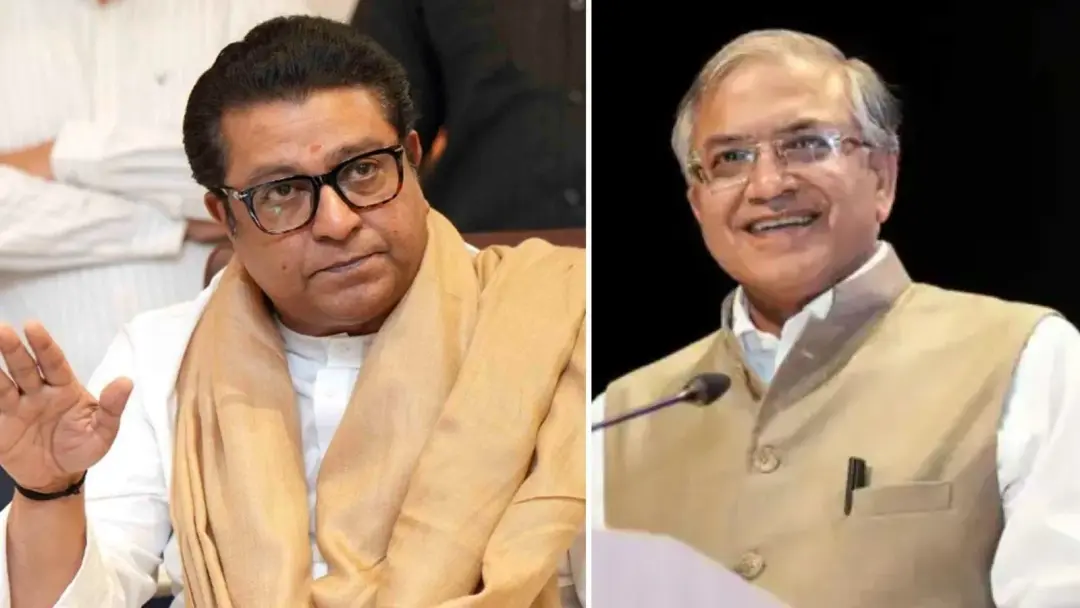
Raj Thackeray demands CEC Gyanesh Kumar's resignation
MNS chief Raj Thackeray on Thursday demanded the resignation of Chief Election Commissioner Gyanesh Kumar and an investigation into what he called "match-fixing" in the Election Commission. He cited an Indian Express report saying Election Commissioners Sukhbir Singh Sandhu and Vivek Joshi recorded written objections to poll panel decisions 14 times in 10 months. The report said orders on voter registration, deletion of names and voter list software were issued without the Commission's approval. Thackeray urged Opposition parties to launch a movement seeking ballot papers instead of EVMs.
Source
Indian Express — Cities · read the original report ↗
Desk check · some claims need care
What the desk checked (5)
- Two Election Commissioners, Sukhbir Singh Sandhu and Vivek Joshi, formally objected to poll panel decisions 14 times in 10 months — Attributed in source to an Indian Express report; figure appears in source, though Thackeray elsewhere refers to a 14-month period, an internal inconsistency.
- Orders on voter registration, deletion of names and voter list software were issued without Election Commission approval — Attributed to the cited Indian Express report; not independently verified in the source text.
- In Goa, 97 individuals were found eligible by local officials but were left out of the final list due to software limitations — Stated by Thackeray; figure appears in source with no separate official confirmation.
- 16.10 lakh appeals were filed in West Bengal against voters added by local officials — Figure cited by Thackeray; no independent sourcing given in the text.
- Gyanesh Kumar was appointed Chief Election Commissioner in February 2025 — Stated by Thackeray in the source; date appears twice consistently.
Analysts’ view opinion
This is Raj Thackeray turning a single news report into a full-blown political weapon. By citing a report on internal dissent within the Election Commission as "validation" of his earlier allegations, he is hunting for a national-level agenda for a party weakened after Maharashtra's local body results. Going beyond a resignation demand to call for a ballot-paper movement against EVMs is an attempt to position himself as the one setting the opposition's agenda.
- Attributing electoral defeats to institutional failure is a familiar opposition playbook — it keeps cadre morale up but is not, by itself, a programme to win voters back.
- Anchoring the attack in a published report rather than his own claims gives Thackeray a credibility shield; rebutting him now means rebutting the report.
- The demand that the government which came to power also resign is not practically achievable — it is political messaging, not an administrative proposal.
- The anti-EVM, pro-ballot call is potentially divisive within the opposition itself, since parties that have won on the same machines find it harder to embrace it wholeheartedly.
- No response from the Election Commission or the BJP is recorded in this story; they could argue that internal differences are normal in a multi-member body and that majority decisions remain lawful.
What to watch — Whether the Congress and other major opposition parties pick up Thackeray's ballot-paper call or confine themselves to demanding accountability from the CEC — that will decide if this becomes a national campaign.
The story cites written objections by two Commissioners but does not establish that "match-fixing" occurred, that results were altered, or that there was outside pressure, and it carries no response from the Election Commission or the government.
Deep dive
Research brief · 8 facts · 5 dates · exam-readyThe brief
Context
Maharashtra Navnirman Sena (MNS) chief Raj Thackeray has demanded the resignation of Chief Election Commissioner Gyanesh Kumar, alleging "match-fixing" inside the Election Commission of India. His demand follows an Indian Express report that Election Commissioners Sukhbir Singh Sandhu and Vivek Joshi formally recorded objections to poll panel decisions 14 times in 10 months, saying orders on voter registration, deletion of names and voter list software were issued without the Commission's approval. Thackeray says this validates the Opposition's long-standing charge that the EC is not functioning autonomously, and he has called for a movement to replace EVMs with ballot papers.
Key facts
- Raj Thackeray on Thursday demanded CEC Gyanesh Kumar's resignation and an investigation into alleged "match-fixing" in the Election Commission.
- An Indian Express report said Election Commissioners Sukhbir Singh Sandhu and Vivek Joshi formally objected to poll panel decisions 14 times in 10 months.
- Per the report, orders on voter registration, deletion of names and voter list software were issued without the Election Commission's approval.
- Thackeray said Gyanesh Kumar was appointed CEC in February 2025; he also referred to the objections spanning a 14-month period.
- On Form 6 (SIR), the two Commissioners argued the Commission lacks authority to ask whether an applicant's or family's name was in the previous SIR without a legislative amendment.
- Thackeray said in Goa local officials verified documents and found 97 individuals eligible, but software lacked a timely provision to re-include their names, so they were left off the final list.
- He questioned who authorised 16.10 lakh appeals filed in West Bengal on the Commission's behalf against voters added by local officials.
- Thackeray said since February 2025, Assembly elections were held in Bihar, Assam, Kerala, Tamil Nadu, Puducherry and West Bengal, and municipal/local body polls in Maharashtra.
Timeline
- February 2025Gyanesh Kumar assumes office as Chief Election Commissioner, per Thackeray's account.
- After February 2025Assembly elections held in Bihar, Assam, Kerala, Tamil Nadu, Puducherry and West Bengal; municipal and local body polls held in Maharashtra.
- Towards the end of 2025Ahead of Maharashtra municipal elections, Opposition leaders meeting the State Chief Electoral Officer found he held "no real authority", Thackeray says.
- Over 10 months (per the report)Election Commissioners Sandhu and Joshi record written objections to poll panel decisions 14 times.
- Thursday (story date)Thackeray posts on X demanding the CEC's resignation, an inquiry, and an Opposition movement for ballot papers.
Who has a stake
- Chief Election Commissioner Gyanesh Kumar — Faces a resignation demand and the charge that decisions were taken arbitrarily or at the behest of others.
- Election Commissioners Sukhbir Singh Sandhu and Vivek Joshi — Said to have recorded 14 written objections in 10 months; Thackeray says they were sidelined and kept in the dark.
- Election Commission of India — Its institutional autonomy and internal decision-making process are under public question.
- Raj Thackeray and the MNS — Claims vindication of its allegations against the EC and seeks to lead an Opposition movement against EVMs.
- BJP and the government — Accused by Thackeray of winning elections by misusing the Commission; he says the government too should resign.
- Electoral Registration Officers (EROs) and state machinery — Thackeray alleges their powers to make changes to voter lists were completely stripped away.
- Voters in Goa and West Bengal — 97 Goa voters found eligible were allegedly left off the final roll; 16.10 lakh appeals were filed in West Bengal.
- The Indian Express — Its report is the evidentiary basis of the political controversy; praised by Thackeray for its journalism.
Why it matters
The allegation is not merely of administrative error but of decisions being taken inside the Election Commission without the full Commission's approval, touching the credibility of the body that conducts India's elections. If roll revision and voter-list software decisions bypassed two of three Commissioners and stripped local EROs of authority, the integrity of recently concluded Assembly and local body polls becomes contested. It also revives the Opposition demand to return from EVMs to ballot papers.
UPSC angle
Prelims pointers
- The Election Commission of India is a multi-member body; the story names CEC Gyanesh Kumar and Election Commissioners Sukhbir Singh Sandhu and Vivek Joshi.
- Gyanesh Kumar became Chief Election Commissioner in February 2025, per the story.
- Form 6 is the form referred to in the story in the context of SIR (Special Intensive Revision) of electoral rolls.
- Electoral Registration Officers (EROs) are the local officials responsible for changes to voter lists.
- Thackeray cited 97 eligible voters left off Goa's final list and 16.10 lakh appeals filed in West Bengal.
- Assembly elections after February 2025 were held in Bihar, Assam, Kerala, Tamil Nadu, Puducherry and West Bengal, per the story.
Mains framing
The controversy raises the classic question of whether constitutional independence of the Election Commission is procedural or substantive. Thackeray's charge, built on the Indian Express report, is that decisions on voter registration, deletion of names and voter-list software were pushed through without the approval of the full Commission, with two Election Commissioners recording objections 14 times in 10 months; that Form 6 under SIR sought information the Commission allegedly lacks statutory power to demand without a legislative amendment; and that EROs and states were left with no authority over rolls, illustrated by 97 verified-eligible Goa voters being dropped because software offered no timely re-inclusion route, and 16.10 lakh appeals in West Bengal filed on the Commission's behalf. The implication is a legitimacy deficit: if the electoral roll is the foundation of the franchise, opaque internal process erodes trust in outcomes, as Thackeray argues while extending the demand to replacing EVMs with ballot papers. A grounded way forward, on the story's own terms, would be transparency about how and by whom Commission-level orders are approved, restoring the recorded role of EROs and state machinery, legislative clarity where the Commissioners say statutory authority is absent, and an inquiry credible enough to answer Thackeray's own question of who would conduct it.
Key terms
- Chief Election Commissioner (CEC)
- Head of the Election Commission of India; the post held by Gyanesh Kumar since February 2025, per the story.
- Election Commissioner
- Member of the multi-member Election Commission; Sandhu and Joshi are named as having recorded written objections.
- SIR
- The electoral roll revision exercise referred to in the story, in connection with which Form 6 sought details of names in the previous SIR.
- Electoral Registration Officer (ERO)
- Local officer empowered to make additions, deletions and corrections in the voter list; Thackeray alleges these powers were stripped.
- EVM
- Electronic Voting Machine; Thackeray wants Opposition parties to demand a return to ballot papers instead.
- MNS
- Maharashtra Navnirman Sena, the party led by Raj Thackeray.
Practice questions
- Does the reported disagreement among Election Commissioners indicate a weakness in the internal decision-making design of a multi-member Election Commission? Discuss with reference to the objections attributed to Sandhu and Joshi.
- "The autonomy of the Election Commission is now confined to textbooks." Critically examine this claim in the light of the allegations around voter registration, roll deletions and voter-list software.
- Examine the argument that centralising control over electoral rolls at the cost of Electoral Registration Officers and state machinery risks disenfranchisement, using the Goa and West Bengal instances cited in the story.
Grounded only in the source report — figures and dates are the source's, not inferred.