
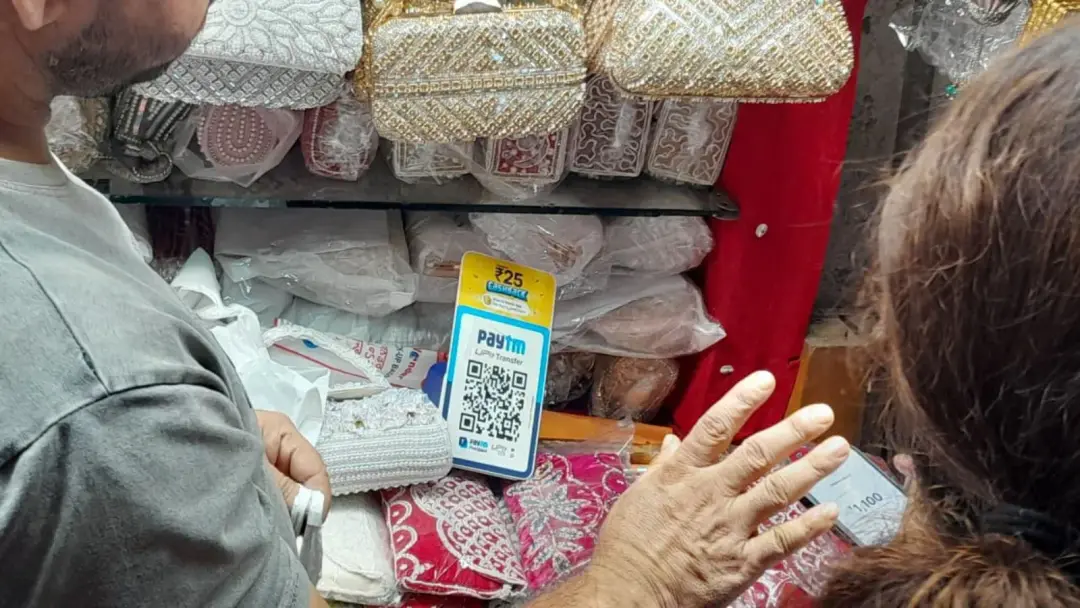
Chandni Chowk traders object to 0.4% UPI transaction fee
Traders in Delhi's Chandni Chowk have objected to the National Payments Corporation of India's announcement that UPI transactions above Rs 2,000 will attract a 0.4% fee from October 15. Rohit Khanna of Novelty Creations said all his products cost more than Rs 2,000 and customers pay by UPI, so he must bear the charge. Ajay Kumar Mittal said traders were first pushed to UPI and charged later. Trade body president Sanjay Bhargava called the timing unfortunate.
Source
Indian Express — Cities · read the original report ↗
Desk check · some claims need care
What the desk checked (5)
- From October 15, UPI transactions above Rs 2,000 will attract a 0.4% fee, announced by the National Payments Corporation of India. — Attributed in source to NPCI; figure and date appear in source but no document or official quote cited.
- Rohit Khanna of Novelty Creations says all his products cost above Rs 2,000 and most customers pay by UPI, so he will bear the MDR cost. — Direct quote attributed to a named proprietor.
- Ajay Kumar Mittal says traders were pushed to UPI and charges came 10 years later. — Direct quote attributed to a named store owner; the 10-year timeline is his characterisation.
- Sanjay Bhargava, President of Chandni Chowk Sarv Vyapar Mandal, says the market has been in a slump since the Red Fort blast last year. — Attributed to a named trade body head; the blast reference is unverified in the source.
- Traders say customers rarely carry cash and few working ATMs exist in Chandni Chowk. — Attributed to Rakesh, a store manager; anecdotal, no data given.
Analysts’ view opinion
A 0.4% merchant fee on UPI payments above Rs 2,000 is small in percentage terms but lands squarely on high-ticket, thin-margin retail — exactly the profile of Chandni Chowk's wedding and garment trade, where items start well above the threshold. Because these merchants say customers now pay almost entirely by UPI, the cost is hard to avoid: it must be absorbed into margins or passed into prices. The bigger economic issue is the timing and the shift in the bargain — digital payments were adopted on the promise of low or zero cost to merchants, and a fee introduced just ahead of the festive and wedding season concentrates the pinch in their peak revenue weeks.
- The fee is levied on transaction value, so its burden rises with ticket size — a wedding store selling from Rs 10,000 upwards pays far more per sale than a low-value retailer.
- With customers paying overwhelmingly by UPI, merchants have little practical ability to steer buyers to cheaper channels, which weakens their bargaining position on who absorbs the cost.
- Reverting to cash is largely theoretical for high-value purchases — traders point to low cash-carrying habits and limited local ATM access, and cash carries its own handling and security costs.
- Merchants frame this as a cumulative cost story — inflation, GST and income tax already squeezing margins — so the marginal charge matters more than 0.4% suggests.
- Traders argue a mid-year start ahead of the festive-wedding peak is worse than a fiscal-year or budget-linked rollout, which would have allowed pricing and contracts to adjust in advance.
What to watch — Watch whether trade bodies secure any deferral, threshold change or carve-out before October 15, and whether merchants respond by quietly raising prices, adding surcharges or nudging customers toward cards and cash.
The story does not establish the scheme's full design — who ultimately bears the charge, which merchant categories or payment types are covered, or whether any exemptions or offsets exist — and reflects the views of a handful of Chandni Chowk traders rather than measured market-wide impact.
Deep dive
Research brief · 8 facts · 4 dates · exam-readyThe brief
Context
The National Payments Corporation of India (NPCI) has announced that from October 15, UPI transactions above Rs 2,000 will attract a fee of 0.4%, described by traders as a Merchant Discount Rate (MDR). UPI had grown over roughly a decade as a largely charge-free digital payment route, and merchants in high-value markets adopted it widely. Traders in Delhi's Chandni Chowk, Old Delhi's wedding shopping hub where garments often start at Rs 10,000, say almost every sale will cross the Rs 2,000 threshold and the cost will fall on them. The objection comes just as the festive and wedding season approaches.
Key facts
- From October 15, UPI transactions above Rs 2,000 will attract a fee of 0.4%, as announced by the National Payments Corporation of India.
- Novelty Creations, a Chandni Chowk wedding store, sells lehengas, sherwanis and sarees starting at Rs 10,000.
- Proprietor Rohit Khanna said all his products cost more than Rs 2,000 and most customers pay by UPI, so his business will bear the Merchant Discount Rate (MDR).
- Ajay Kumar Mittal, of a Lucknowi Chikankari store, said traders were first pushed to UPI and charges came 10 years later; in aggregate 0.4% is 'a huge number' for small traders.
- Khanna said business income growth has been 'severely disproportionate' to expenses, citing inflation, personal income tax and GST before this charge.
- Rakesh, a manager at a wedding garment store, said switching customers back to cash is impractical as few carry cash and the area's few working ATMs have long queues.
- Anoop Goyal of Anand Garments said the one month before the directive takes effect is enough for trade associations and the government to reach a consensus.
- Sanjay Bhargava, President of Chandni Chowk Sarv Vyapar Mandal, called the timing 'unfortunate' and said the market has been in a slump since the Red Fort blast last year.
Timeline
- About 10 years ago (per trader Ajay Kumar Mittal)Traders say they were pushed to shift to UPI-based digital payments.
- Last yearChandni Chowk market slumped after the Red Fort blast, per trade body president Sanjay Bhargava.
- Announcement date not stated in the sourceNPCI announced a 0.4% fee on UPI transactions above Rs 2,000.
- October 15The 0.4% fee on UPI transactions above Rs 2,000 is to take effect.
Who has a stake
- National Payments Corporation of India (NPCI) — Announced the 0.4% fee on UPI transactions above Rs 2,000 effective October 15.
- Chandni Chowk traders (e.g. Novelty Creations, Anand Garments, a Chikankari store) — High-value sales mean nearly all transactions cross Rs 2,000, so the MDR becomes an added business cost.
- Chandni Chowk Sarv Vyapar Mandal (President Sanjay Bhargava) — Trade body seeking a rethink; says timing is unfortunate amid a post-Red Fort blast slump and festive recovery.
- Customers — May face pressure to pay in cash, which traders say is impractical given low cash use and few working ATMs.
- Government — Faces trader demands for consensus or deferral, possibly to the next financial year with the budget.
Why it matters
UPI's mass adoption rested on payments being effectively free for merchants and users; a 0.4% charge on transactions above Rs 2,000 shifts costs onto small and mid-sized traders whose average ticket size is high. In markets like Chandni Chowk, where garments start at Rs 10,000, the levy lands just before the festive and wedding season and after a slump the trade body links to the Red Fort blast. How the government and trade associations respond in the month before October 15 will shape merchant trust in digital payments.
UPSC angle
Prelims pointers
- NPCI has announced a 0.4% fee on UPI transactions above Rs 2,000, effective October 15.
- Merchant Discount Rate (MDR) is the fee a merchant bears on a digital payment transaction.
- National Payments Corporation of India (NPCI) is the body that operates and issues directives on UPI.
- Chandni Chowk Sarv Vyapar Mandal is the Chandni Chowk traders' body; its president is Sanjay Bhargava.
- Traders cite inflation, personal income tax and GST as existing cost pressures before the new UPI charge.
Mains framing
The NPCI decision to levy a 0.4% fee on UPI transactions above Rs 2,000 from October 15 reopens the question of who pays for India's digital payments infrastructure. Traders in Chandni Chowk argue that the burden is regressive in practice: because their goods start at around Rs 10,000, virtually every transaction crosses the threshold, so what politicians describe as a marginal 0.4% becomes a large aggregate cost for small businesses already squeezed by inflation, income tax and GST. Their sense of grievance is amplified by sequencing — they say they were pushed to adopt UPI a decade ago and are being charged only now — and by timing, coming ahead of the festive and wedding season and after a market slump the trade body attributes to the Red Fort blast last year. Reverting to cash is not a realistic escape valve, since customers rarely carry cash and the market has few functioning ATMs, which means the cost is likely to be absorbed or passed into prices. The way forward suggested by traders themselves is dialogue: they hope the month before implementation allows trade associations and the government to reach a consensus, with the levy, if unavoidable, introduced in the next financial year alongside the budget so businesses can plan for it.
Key terms
- UPI
- The digital payments system on which NPCI has announced a 0.4% fee for transactions above Rs 2,000 from October 15.
- NPCI
- National Payments Corporation of India, which announced the 0.4% fee on high-value UPI transactions.
- Merchant Discount Rate (MDR)
- The transaction charge borne by the merchant on a digital payment; traders say the 0.4% fee is an added business cost.
- Chandni Chowk Sarv Vyapar Mandal
- Chandni Chowk trade association, headed by Sanjay Bhargava, which called the fee's timing unfortunate.
- Chandni Chowk
- Old Delhi market and wedding shopping hub where garment prices commonly start at Rs 10,000.
Practice questions
- Examine the implications of levying a Merchant Discount Rate on high-value UPI transactions for small traders and for the wider adoption of digital payments in India.
- "Digital payments infrastructure cannot remain free forever, but the cost must not fall disproportionately on small merchants." Discuss with reference to the 0.4% fee on UPI transactions above Rs 2,000.
- Why do traders in markets like Chandni Chowk find a shift back to cash impractical? What does this reveal about the depth of digital payment adoption?
Grounded only in the source report — figures and dates are the source's, not inferred.