
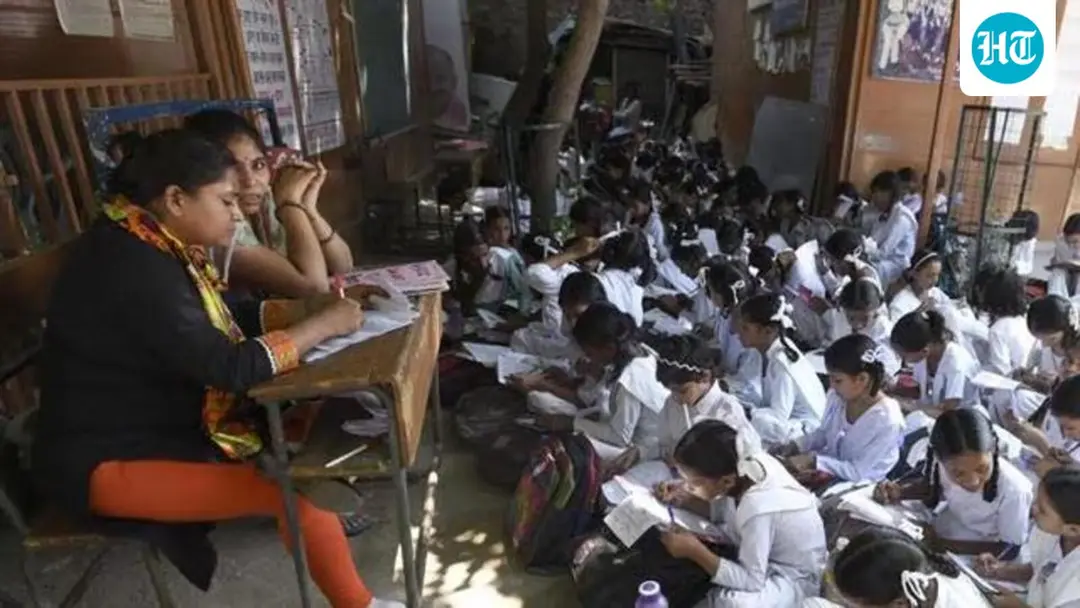
CBSE rejects Class 6 exemption; SC suggests 2027 rollout
CBSE told the Supreme Court on Thursday it cannot grant a one-time exemption from its three-language requirement to current Class 6 students, saying it would create learning gaps and prompt similar demands from later batches. A bench of CJI Surya Kant and Justices Joymalya Bagchi and V Mohana suggested mandatory implementation instead begin from January 2027, with the present batch allowed to take the third language voluntarily. The matter will be heard on September 23.
Source
Hindustan Times — India · read the original report ↗
Desk check · compared with the source
What the desk checked (5)
- CBSE told the Supreme Court it cannot grant a one-time exemption from the three-language rule to current Class 6 students. — Attributed to CBSE's submission in court; source quotes the note directly.
- Bench of CJI Surya Kant, Justices Joymalya Bagchi and V Mohana suggested mandatory implementation from January 2027. — Attributed to the bench, with a direct quote from Justice Bagchi in the source.
- Only 1.05% of about 28,195 CBSE schools have Class 6 students who opted for more than one non-indigenous language. — Figure appears in source, attributed to CBSE's note; not independently verifiable.
- Of 20,777 schools, 19,386 (about 93.3%) already have teachers for at least two indigenous languages. — Figures appear in source as CBSE data; internally consistent.
- A five-member committee headed by Bhagwati Prasad Kalal was constituted on September 16 to monitor implementation. — Attributed to CBSE's submission; names and date as given in source.
Analysts’ view opinion
This is less a fight about the three-language formula itself — which the CBSE traces back to the 1968 and 1986 policies — than about transition design: who absorbs the cost when a framework conceived in 2020 lands in classrooms only in 2026. The Board's case is one of cohort integrity and precedent control; the bench's counter-suggestion of mandatory rollout from January 2027, with voluntary uptake in the interim, is a classic sequencing fix aimed at families and schools caught mid-stream. The awkwardness for the CBSE is that it has already conceded transitional relief to Classes 7, 8 and 9, which makes a firm 'no' for Class 6 look like a line drawn by convenience rather than pedagogy.
- The substantive shift under the current framework, per the Board, is that at least two of the three languages must be Indian languages and that Classes 9-10 also carry three languages — a design change with real staffing implications, not merely a restatement of an old formula.
- CBSE's strongest argument is precedent management: an exemption for one batch invites the same claim from every following batch, which can convert a phased rollout into indefinite deferral.
- The petitioners' strongest argument is internal inconsistency: relief has been extended to Classes 7, 8 and 9 but withheld from Class 6, weakening the equity logic of the Board's position.
- The Board's readiness data — textbooks in 22 scheduled languages, about 93.3% of surveyed schools with teachers for at least two Indian languages, and only 1.05% of schools with affected Class 6 students — frames this as a narrow problem, though system-wide averages can mask concentrated stress in specific schools and languages.
- Setting up a five-member monitoring committee only on September 16, months into implementation, suggests the bottleneck-mapping came after the mandate rather than before it — the recurring sequencing weakness in Indian education rollouts.
What to watch — Watch the September 23 hearing for whether the CBSE returns with instructions accepting a January 2027 mandatory date plus voluntary interim uptake, which would let both sides claim the framework was preserved and the transition softened.
The story does not establish what the CBSE will finally decide, whether the court will go beyond suggestion to direction, or how many students in absolute terms are actually affected by the Class 6 requirement.
Deep dive
Research brief · 8 facts · 9 dates · exam-readyThe brief
Context
The CBSE has moved to enforce a three-language requirement for Classes 6 to 10 in which at least two of the three languages must be indigenous Indian languages, drawing on NEP 2020 and the National Curriculum Framework for School Education (NCF-SE) 2023. Petitioners in the Supreme Court sought relief for students currently in Class 6, who must follow the revised framework from 2026-27, unlike Classes 7, 8 and 9 which already received transitional relief. On Thursday the Board filed a note refusing a one-time exemption, while the bench pressed for mandatory rollout only from January 2027 with voluntary uptake in the interim. The matter is listed for September 23.
Key facts
- CBSE told the Supreme Court it cannot grant a one-time exemption from the three-language requirement to students currently in Class 6.
- Bench of CJI Surya Kant and Justices Joymalya Bagchi and V Mohana suggested mandatory implementation for Class 6 from January 2027, with voluntary third language in the interim.
- Only 1.05% of approximately 28,195 CBSE schools have Class 6 students who opted for more than one non-indigenous language, per the Board's note.
- Class 6 third-language textbooks in all 22 scheduled Indian languages are on the NCERT website, covering choices of 98.36% of schools; SCERT material for the rest.
- Data from 20,777 schools showed 19,386 (about 93.3%) already had teachers for at least two distinct indigenous languages; 3,523 had teachers for three or more.
- A five-member implementation committee was constituted on September 16, headed by education ministry director Bhagwati Prasad Kalal.
- Classes 7, 8 and 9 students studying two non-indigenous languages may keep their combination and add an Indian language, assessed at school level, not in the Class 10 board exam.
- The current Class 6 batch must follow the revised framework from the 2026-27 academic year.
Timeline
- 1968Three-language formula adopted under the National Policy on Education, 1968.
- 1979-80Scheme of studies expressly provided for students studying three languages up to Class 8.
- 1986, as modified in 1992Three-language formula reiterated under the National Policy on Education.
- 2020NEP 2020 envisaged the language framework; NCF-SE followed in 2023.
- August 20Supreme Court first asked CBSE to consider a one-time reprieve for the current Class 6 batch.
- September 16CBSE informs court a five-member committee was constituted to monitor implementation in Classes 6 to 10.
- Thursday (latest hearing)CBSE files note rejecting exemption; court suggests January 2027 rollout; ASG agrees to take instructions.
- September 23Court to hear CBSE's response to the suggestion.
- 2026-27 academic yearCurrent Class 6 batch required to follow revised framework, as per CBSE.
Who has a stake
- Current Class 6 students and their families — Whether they must take a third language now or get time to adjust; risk of pedagogical disadvantage either way.
- CBSE — Wants uninterrupted, progressive implementation; fears cascading exemption demands and indefinite delay.
- Supreme Court bench (CJI Surya Kant, Justices Bagchi and Mohana) — Balancing policy implementation with fairness and 'elbow space' for students, families and schools.
- Petitioners (senior advocate Anand Grover) — Seek extension to Class 6 of the transitional relief already given to Classes 7, 8 and 9.
- CBSE schools (approx. 28,195) — Must arrange teachers, textbooks and digital resources for a third, indigenous language.
- NCERT, SCERTs, KVS, NVS — Supplying textbooks/resources and represented on the five-member implementation committee.
- Additional Solicitor General Aishwarya Bhati — Conveying the court's suggestion to the Board and returning with instructions on September 23.
Why it matters
The case tests how quickly a policy conceived in 2020 can be imposed on a cohort already mid-schooling, and whether courts can secure a transition period without derailing implementation. Its outcome will decide the language load of lakhs of Class 6 students across roughly 28,195 CBSE schools and set the template for later batches. It also clarifies that the three-language formula is not new, but the requirement that two of the three be indigenous Indian languages is the real change.
UPSC angle
Prelims pointers
- Three-language formula was adopted under the National Policy on Education, 1968; reiterated in 1986 policy as modified in 1992.
- NCF-SE 2023 and NEP 2020 underpin the current CBSE three-language framework for Classes 6 to 10.
- New element: at least two of the three languages must be indigenous Indian languages; Classes 9 and 10 also study three languages.
- NCERT has Class 6 third-language textbooks in all 22 scheduled Indian languages, covering 98.36% of schools.
- Five-member CBSE implementation committee constituted on September 16, headed by education ministry director Bhagwati Prasad Kalal.
- Bench: CJI Surya Kant, Justice Joymalya Bagchi, Justice V Mohana; next hearing September 23.
Mains framing
The dispute over CBSE's three-language requirement for Class 6 illustrates the friction between policy continuity and transitional fairness in education reform. CBSE's case rests on pedagogy and administration: Class 6 is the designated entry point under NEP 2020 and NCF-SE 2023, exempting this cohort would push students into Classes 7 and 8 without the contemplated learning continuity, and any relaxation would invite similar claims from every later batch, causing indefinite delay. It buttresses this with readiness data — only 1.05% of about 28,195 schools have Class 6 students with more than one non-indigenous language, NCERT textbooks exist in all 22 scheduled languages covering 98.36% of schools, and 93.3% of 20,777 surveyed schools already have teachers for two indigenous languages — plus a five-member monitoring committee set up on September 16. The petitioners' counter is one of equity: Classes 7, 8 and 9 already received transitional relief, so excluding Class 6 is arbitrary. The Court's middle path — mandatory rollout from January 2027 with voluntary uptake now — offers a way forward that preserves the framework while giving schools and families adjustment time; sustaining it will require closing residual teacher and material gaps through SCERT support and the new committee's bottleneck-removal mandate.
Key terms
- Three-language formula
- Requirement that students study three languages, adopted under the 1968 education policy and carried through later frameworks.
- NEP 2020
- National Education Policy 2020, under which Class 6 is the starting point for the revised language scheme for this cohort.
- NCF-SE 2023
- National Curriculum Framework for School Education, 2023, operationalising NEP's language and curricular design.
- Indigenous language
- An Indian language; the new framework requires at least two of a student's three languages to be indigenous.
- Transitional relief
- CBSE concession letting Classes 7, 8 and 9 keep two non-indigenous languages while adding an Indian language assessed at school level.
- SCERT
- State Council of Educational Research and Training, whose textbooks will cover languages not available on the NCERT website.
Practice questions
- Should courts intervene to grant transitional relief in the rollout of curricular policy, or is that purely an executive and expert domain? Discuss with reference to the CBSE three-language case.
- Examine the evolution of the three-language formula from the National Policy on Education, 1968 to NEP 2020 and NCF-SE 2023. What is genuinely new in the current framework?
- Evaluate CBSE's readiness data on teachers and textbooks. What implementation bottlenecks must be resolved before a mandatory three-language requirement in Classes 6 to 10?
Grounded only in the source report — figures and dates are the source's, not inferred.