
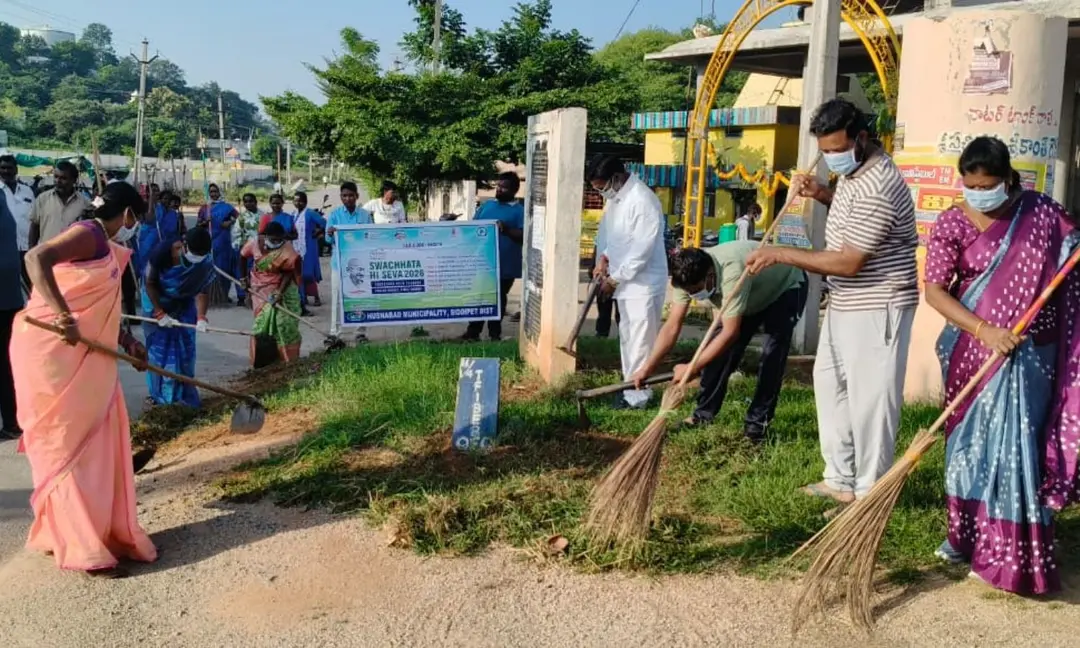
Sanitation drive held at Yellamma temple in Husnabad
Husnabad Municipality in Siddipet district conducted a special sanitation drive at Sri Yellamma Temple on World Tourism Day as part of Swachhata Hi Seva (SHS) 2026. Chairperson Dandi Lakshmi, who attended as chief guest, said the temple was an important spiritual and tourism site for the town and urged devotees to keep the premises clean and use designated bins. Vice Chairperson Chittari Padma, councillors, co-option members and municipal staff later cleaned the temple surroundings.
Source
Husnabad — స్థానికం · read the original report ↗
Desk check · compared with the source
What the desk checked (4)
- A special sanitation drive was held at Sri Yellamma Temple in Husnabad by the municipality on World Tourism Day under Swachhata Hi Seva (SHS) 2026. — Stated in the source as the central event; organiser named as Husnabad Municipality.
- Municipal Chairperson Dandi Lakshmi attended as chief guest and appealed to devotees to keep temple surroundings clean and use designated bins. — Attributed directly to the chairperson in the source.
- Vice Chairperson Chittari Padma, councillors, co-option member and municipal staff took part in cleaning the temple premises. — Names listed in the source; no independent confirmation possible.
- The programme is described as part of 'Swachhata Hi Seva (SHS) 2026'. — Figure appears in source as written; year designation unverified externally.
Analysts’ view opinion
On the surface this is a routine municipal clean-up; in local-politics terms it is a small but well-chosen piece of visible governance. By tying a temple, tourism and sanitation into one event, Chairperson Dandi Lakshmi placed her leadership directly in front of devotees and townspeople. The fact that the vice-chairperson, councillors and co-option members all turned out together also signals internal cohesion in the municipal council.
- Umbrella campaigns like Swachhata Hi Seva give local elected representatives a low-cost, high-visibility platform to demonstrate activity.
- Choosing temple premises allows outreach to a broad, sentiment-linked public in a way that is politically uncontroversial.
- Framing the temple as an "important spiritual and tourism site" can lay early groundwork for later demands for development or tourism funds.
- The appeal to devotees to use designated bins is a politically careful message that shares responsibility with the public rather than resting it only on the civic body.
- The joint participation of the chairperson, vice-chairperson and multiple councillors projects a council without visible factional friction.
What to watch — Watch whether this converts into durable waste-management and tourist-amenity proposals around the temple, or remains a one-off photo opportunity.
The story establishes no party affiliations, election timeline or funding details, so the political motivations read here are interpretation, not reported fact.
Deep dive
Research brief · 8 facts · 3 dates · exam-readyThe brief
Context
Husnabad Municipality in Telangana's Siddipet district organised a special sanitation drive at the Sri Yellamma Temple to mark World Tourism Day, carrying it out as part of the Swachhata Hi Seva (SHS) 2026 programme. Municipal Chairperson Dandi Lakshmi attended as chief guest and framed the temple as both a spiritual centre and a tourism draw for the town. Elected representatives and municipal staff themselves cleaned the temple surroundings, and residents were asked to join the effort for a clean Husnabad.
Key facts
- The sanitation drive was held at Sri Yellamma Temple in Husnabad town, Siddipet district, under the aegis of Husnabad Municipality.
- The drive was conducted on World Tourism Day as part of the Swachhata Hi Seva (SHS) 2026 programme.
- Municipal Chairperson Dandi Lakshmi attended as chief guest.
- The Chairperson described the Yellamma temple as an important spiritual and tourism site for Husnabad town.
- Devotees were asked not to throw garbage at random but to use only the designated spots arranged by temple managers.
- The Chairperson appealed to every resident of the town to become a participant in making Husnabad clean.
- After the speeches, the Chairperson, Vice Chairperson, councillors, co-option members and municipal staff cleaned the temple surroundings.
- Participants included Vice Chairperson Chittari Padma; councillors Pilli Tirupathi, Bolishetti Raju, Sampath, Ramesh, Srinivas, Vaidyam Kiran Prasad and Swaroopa; co-option member Sarojana; SI Bala Yellam; EE Ravi Kumar; and jawans Sarayya, Prabhakar and Srikanth.
Timeline
- World Tourism Day (exact date not stated in the source)Husnabad Municipality holds a special sanitation programme at Sri Yellamma Temple under Swachhata Hi Seva (SHS) 2026.
- Same day, at the eventChairperson Dandi Lakshmi, as chief guest, calls on devotees to keep temple premises clean and use designated garbage points.
- Same day, after the speechesChairperson, Vice Chairperson, councillors, co-option members and municipal staff clean the temple surroundings.
Who has a stake
- Husnabad Municipality — Led and organised the drive; responsible for town sanitation and for delivering Swachhata Hi Seva 2026 activities locally.
- Chairperson Dandi Lakshmi — Chief guest who set the agenda of clean temple premises and public participation for a clean Husnabad.
- Vice Chairperson Chittari Padma, councillors and co-option members — Elected representatives who joined the physical cleaning, signalling political ownership of sanitation work.
- Municipal officials and sanitation staff (SI Bala Yellam, EE Ravi Kumar, jawans Sarayya, Prabhakar, Srikanth) — Carry out day-to-day cleaning and waste management at the site.
- Devotees and temple management — Asked to dispose of waste only at designated spots; temple's appeal as a spiritual and tourism destination depends on cleanliness.
- Residents of Husnabad — Called upon to participate; beneficiaries of a cleaner town and of tourism linked to the temple.
Why it matters
The drive links three agendas that usually run separately at the local level — urban sanitation, religious tourism and citizen participation — at a single heritage site. It shows how national cleanliness campaigns such as Swachhata Hi Seva are localised by urban local bodies, with elected representatives visibly joining the work. For a small town, the cleanliness of its main temple directly shapes visitor experience and the town's identity as a destination.
UPSC angle
Prelims pointers
- Swachhata Hi Seva (SHS) 2026 — cleanliness campaign under which the Husnabad drive was conducted.
- World Tourism Day — the occasion chosen for the temple sanitation programme.
- Husnabad Municipality lies in Siddipet district, Telangana; Sri Yellamma Temple is its noted spiritual and tourism site.
- Municipal leadership structure named: Chairperson (Dandi Lakshmi), Vice Chairperson (Chittari Padma), councillors and co-option members.
- Co-option members are nominated members of a municipal council, distinct from elected councillors.
Mains framing
Sanitation at religious tourism sites is a governance challenge that sits at the intersection of urban local body capacity, pilgrim behaviour and temple administration. The Husnabad episode illustrates the standard model used by Indian urban local bodies: national campaign branding (Swachhata Hi Seva 2026), a symbolic occasion (World Tourism Day), a focal site (Sri Yellamma Temple), and participation by elected functionaries to build behavioural legitimacy. The Chairperson's specific ask — that devotees use designated disposal points rather than dumping waste at will — points to the core problem, namely that waste generation at pilgrimage sites is episodic and crowd-driven while municipal collection is routine. Implications include reputational and tourism costs for small towns whose principal attraction is a temple, and recurring pressure on a limited sanitation workforce. A credible way forward, on the evidence of the source, lies in sustaining such drives beyond single-day events, coordinating municipal staff with temple management on bin placement and collection, and converting citizen appeals into continuous public participation rather than ceremonial involvement.
Key terms
- Swachhata Hi Seva (SHS) 2026
- The cleanliness campaign under which the Husnabad temple sanitation drive was organised; further details not stated in the source.
- World Tourism Day
- The observance on which the drive was held, used to link cleanliness with the town's tourism profile.
- Husnabad Municipality
- The urban local body in Siddipet district, Telangana, that conducted the drive.
- Co-option member
- A nominated (not directly elected) member of a municipal council; co-option member Sarojana took part in the drive.
- Sri Yellamma Temple
- Husnabad's temple described by the Chairperson as an important spiritual and tourism site for the town.
Practice questions
- Examine how national cleanliness campaigns such as Swachhata Hi Seva are operationalised by urban local bodies, using the Husnabad temple sanitation drive as an example.
- Religious tourism sites generate episodic waste loads that routine municipal systems struggle to absorb. Discuss with reference to coordination between temple management and municipalities.
- What role do elected municipal functionaries — chairpersons, councillors and co-option members — play in driving behavioural change on sanitation? Illustrate with the Husnabad case.
Grounded only in the source report — figures and dates are the source's, not inferred.