
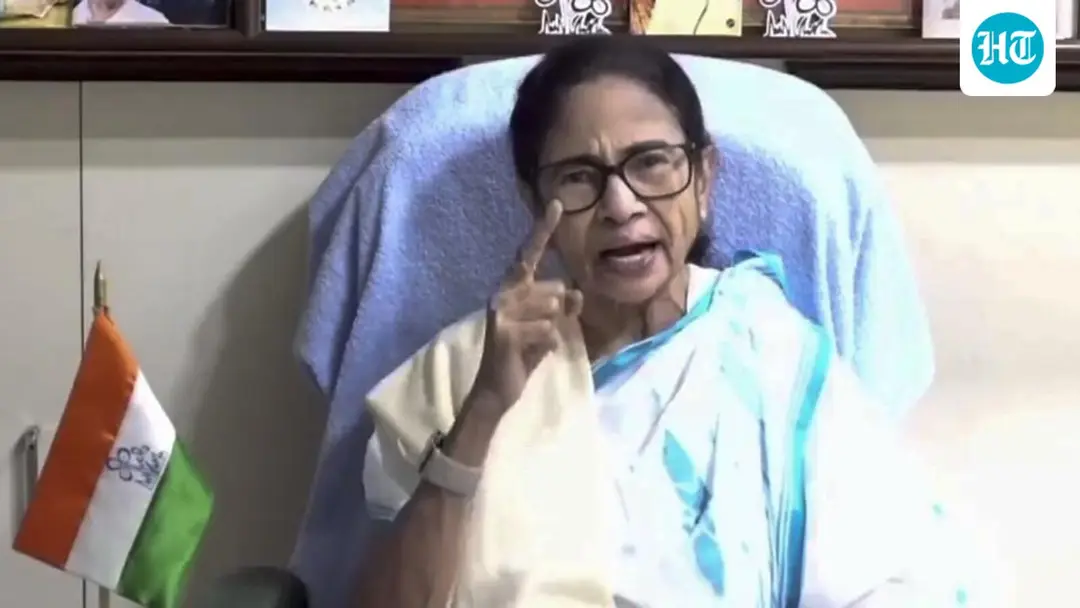
Mamata demands CEC's arrest, calls for mass movement over ECI row
A political row erupted on Wednesday after an Indian Express report said two of the three election commissioners objected to decisions on the Special Intensive Regulation (SIR) process. In a 17-minute video message, former West Bengal chief minister Mamata Banerjee demanded the arrest of CEC Gyanesh Kumar and fresh state polls based on pre-SIR electoral data, saying INDIA-bloc allies would meet soon. She is scheduled to address a rally in Hooghly on Saturday.
Source
Hindustan Times — India · read the original report ↗
Desk check · some claims need care
What the desk checked (5)
- Two of three poll commissioners objected to decisions on the Special Intensive Regulation (SIR) process — Attributed to an Indian Express news report; not independently confirmed within the source.
- Banerjee demanded the arrest of CEC Gyanesh Kumar and fresh West Bengal polls on pre-SIR electoral data — Attributed to Banerjee's 17-minute video message on social media; quotes reproduced in source.
- BJP swept the assembly polls winning 208 seats and the AITC has split into multiple factions — Figure appears in source with no attribution or date given.
- ECI has temporarily frozen the party's original name and symbol ahead of Nandigram and Rejinagar by-elections — Stated in source as fact, no document or official statement cited.
- Banerjee would not gain a second wind even if she took to the streets — Opinion attributed to political analyst Biswanath Chakraborty; BJP's Samik Bhattacharya makes similar partisan claims.
Analysts’ view opinion
This looks like an attempt to convert a national controversy into personal political oxygen. After the BJP's sweep of 208 assembly seats, with her party splintered and its name and symbol temporarily frozen, the ECI row hands Mamata Banerjee a common enemy and a common platform. Demanding the CEC's arrest and fresh polls on pre-SIR rolls may be legally unattainable, but as slogans they can get cadres onto the streets and restore her visibility within the INDIA bloc.
- The reported objection by two of three commissioners is politically potent because it lets the opposition argue the doubt came from inside the Commission itself.
- Banerjee is playing on two boards at once: consolidating her own ranks in Bengal and reclaiming agenda-setting status nationally.
- Her weakness is visible — a split party and a frozen name and symbol ahead of the Nandigram and Rejinagar by-elections will test her mobilising capacity.
- The BJP's counter-line is already framed: that this is a survival bid by a leader who has lost relevance, having earlier demanded the PM's resignation and now the CEC's arrest.
- Saturday's Hooghly rally is less a speech than a strength test of how much crowd she can still command.
What to watch — Watch the protest roadmap she outlines at Hooghly, and whether INDIA-bloc allies actually meet and let her front the campaign rather than fighting separately.
The story does not establish the internal ECI objections independently — the Commission has issued a rebuttal — nor does it show any legal route to an arrest or to fresh elections on pre-SIR rolls.
Deep dive
Research brief · 8 facts · 6 dates · exam-readyThe brief
Context
A national political row broke out on Wednesday after an Indian Express report claimed that two of the three election commissioners had objected to decisions taken on the contentious Special Intensive Regulation (SIR) process. Opposition leaders accused the Election Commission of India (ECI) and Chief Election Commissioner Gyanesh Kumar of trying to hijack the electoral process. Former West Bengal chief minister Mamata Banerjee responded with a 17-minute video message demanding Kumar's arrest, fresh West Bengal polls on pre-SIR electoral data and a mass movement with INDIA-bloc allies. The row comes as her AITC, founded in 1998, has split into factions after the BJP swept the assembly polls with 208 seats, and the ECI has temporarily frozen the party's original name and symbol.
Key facts
- An Indian Express report on Wednesday said two of the three poll commissioners objected to decisions taken on the Special Intensive Regulation (SIR) process.
- Mamata Banerjee released a 17-minute video message demanding the arrest of CEC Gyanesh Kumar and announcing that INDIA-bloc allies will meet very soon.
- Banerjee demanded fresh polls in West Bengal based on pre-SIR electoral data.
- Banerjee now heads the Mamata All India Trinamool Congress action after a split in the party she founded in 1998.
- The BJP swept the West Bengal assembly polls, winning 208 seats, after which rebel MPs and MLAs led multiple factions.
- The ECI has temporarily frozen the party's original name and symbol ahead of by-elections in Nandigram and Rejinagar due to a dispute among rival factions.
- Banerjee is scheduled to address a rally in Hooghly on Saturday, for which the Calcutta High Court has given permission.
- TMC MP Mahua Moitra wrote on X: "Beware - the revolution is coming! Everyone is going to hit the streets till we reclaim our democracy from the clutches of this Chor."
Timeline
- 1998Mamata Banerjee founds the All India Trinamool Congress (AITC).
- After the recent assembly pollsBJP sweeps West Bengal winning 208 seats; AITC splits into multiple factions led by rebel MPs and MLAs.
- Ahead of Nandigram and Rejinagar by-electionsECI temporarily freezes the party's original name and symbol owing to the dispute between rival factions.
- WednesdayIndian Express report on two of three commissioners objecting to SIR decisions triggers a national row; Opposition accuses ECI of hijacking the electoral process.
- Hours later on WednesdayBanerjee releases a 17-minute video demanding CEC Gyanesh Kumar's arrest and a fresh mass movement.
- Saturday (scheduled)Banerjee to address a Hooghly rally, expected to lay out a roadmap for protests.
Who has a stake
- Election Commission of India and CEC Gyanesh Kumar — Institutional credibility, with reported internal dissent among commissioners over SIR decisions and Opposition demands for the CEC's removal and arrest.
- Mamata Banerjee and the Mamata All India Trinamool Congress faction — Seeking fresh political momentum after the split and electoral defeat; demands fresh polls on pre-SIR data.
- INDIA-bloc and other regional parties — Planning a joint meeting and a combined campaign against the ECI over the SIR process.
- BJP (Samik Bhattacharya) — Argues Banerjee has lost relevance and is only trying to stay afloat; benefits from the AITC split and its 208-seat assembly win.
- Voters of West Bengal, including Nandigram and Rejinagar — By-elections are due while the party name and symbol are frozen; electoral rolls are affected by the SIR process.
- Calcutta High Court and Supreme Court — High Court has permitted the Hooghly rally; Supreme Court has asked the ECI for a timeline on the Trinamool symbol row.
Why it matters
The reported dissent of two of three election commissioners over SIR decisions strikes at the perceived neutrality of the constitutional body that runs India's elections, and has handed the Opposition a national rallying point. In West Bengal, it intersects with a frozen party symbol, imminent by-elections and a fractured Trinamool, making the row both an institutional question and a test of Mamata Banerjee's residual political strength.
UPSC angle
Prelims pointers
- Special Intensive Regulation (SIR): the contentious electoral roll process at the centre of the ECI row.
- Gyanesh Kumar is the Chief Election Commissioner; the ECI has three poll commissioners in all.
- AITC was founded by Mamata Banerjee in 1998; it has since split into multiple factions.
- BJP won 208 seats in the West Bengal assembly polls, per the source.
- ECI has temporarily frozen the Trinamool's original name and symbol ahead of the Nandigram and Rejinagar by-elections.
- The Supreme Court has asked the ECI for a timeline on the Trinamool symbol row.
Mains framing
The controversy illustrates how disputes over electoral roll revision can escalate into a crisis of confidence in the Election Commission of India. The immediate trigger was a report that two of the three commissioners objected to decisions on the Special Intensive Regulation process, prompting Opposition charges that the ECI was hijacking the electoral process and endangering democracy. Mamata Banerjee's demands - the CEC's arrest, fresh West Bengal polls on pre-SIR data and a joint INDIA-bloc mass movement - show how institutional doubts are absorbed into partisan mobilisation, especially when a party is weakened: her AITC has split after the BJP's 208-seat sweep, and the ECI has frozen its name and symbol ahead of the Nandigram and Rejinagar by-elections. Critics, including the BJP's Samik Bhattacharya and analyst Biswanath Chakraborty, counter that she herself misused state machinery in panchayat and civic polls and has lost legitimacy. The way forward, as suggested by the events in the source, lies in institutional channels - transparent explanation by the ECI, which has issued a point-by-point rebuttal on SIR deletions, Form 6 and the voter database, and judicial oversight, with the Supreme Court seeking a timeline on the symbol dispute - rather than only street protest.
Key terms
- Special Intensive Regulation (SIR)
- The contentious electoral process whose decisions two of three poll commissioners reportedly objected to.
- Chief Election Commissioner (CEC)
- Head of the Election Commission of India; currently Gyanesh Kumar, whose arrest Banerjee has demanded.
- INDIA bloc
- Opposition alliance whose allies, Banerjee says, will meet soon to fight the ECI row together.
- AITC / Trinamool Congress
- Party founded by Mamata Banerjee in 1998, now split into factions with its name and symbol temporarily frozen by the ECI.
- Form 6
- Electoral form referred to in the Election Commission's point-by-point rebuttal amid the SIR row.
- Symbol freeze
- ECI's temporary suspension of a party's name and symbol when rival factions dispute control.
Practice questions
- The reported dissent of two election commissioners over the SIR process has raised questions about the ECI's internal functioning. Discuss the implications for public confidence in the electoral process.
- Examine the powers of the Election Commission of India in disputes over a political party's name and symbol, with reference to the freeze ahead of the Nandigram and Rejinagar by-elections.
- "Institutional grievances in India are increasingly fought on the street rather than through constitutional channels." Critically evaluate in the light of the current ECI row.
Grounded only in the source report — figures and dates are the source's, not inferred.