
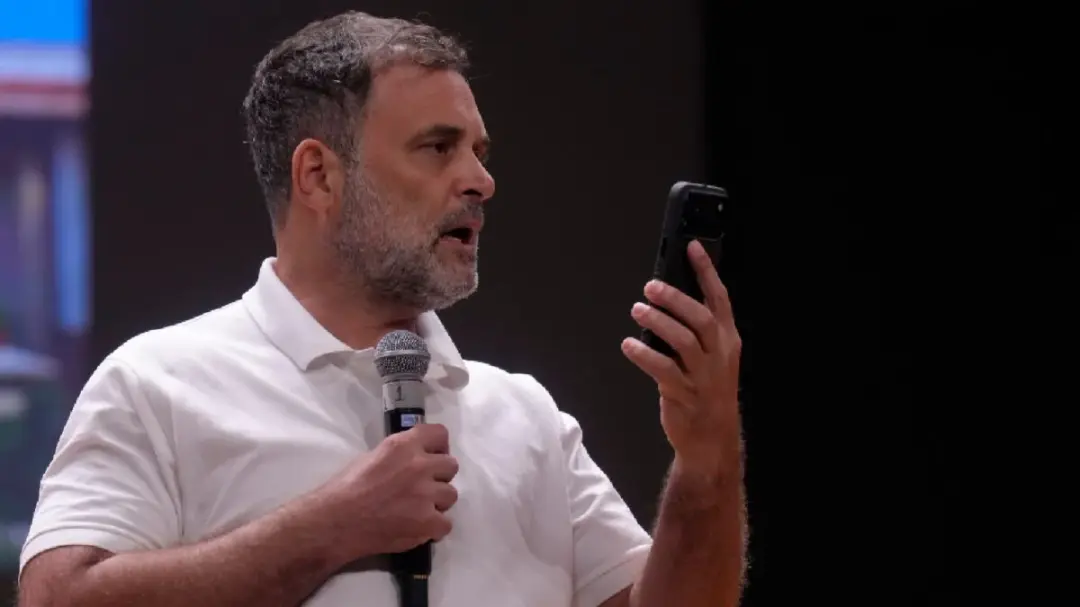
Rahul Gandhi demands CEC Gyanesh Kumar's resignation
Leader of Opposition in the Lok Sabha Rahul Gandhi on Thursday demanded the immediate resignation of Chief Election Commissioner Gyanesh Kumar and urged him to "turn approver", calling it an "act of nationalism" and warning of "consequences". His remarks followed an Indian Express report that Election Commissioners Sukhbir Singh Sandhu and Vivek Joshi objected at least 14 times over 10 months to Commission decisions. The ECI said differing views are part of institutional deliberations and its decisions, including on the Special Intensive Revision, were unanimous.
Source
News18 — India · read the original report ↗
Desk check · some claims need care
What the desk checked (5)
- Rahul Gandhi asked CEC Gyanesh Kumar to resign and "turn approver", calling it an "act of nationalism". — Directly attributed to Gandhi at a press conference, with quotes in the source.
- Election Commissioners Sukhbir Singh Sandhu and Vivek Joshi objected at least 14 times over 10 months to poll panel decisions. — Attributed to an Indian Express report; figure appears in source, not independently verified.
- The Summary Revision of electoral rolls for 2026-27 has remained stalled since the 2024 cycle. — Attributed to an Economic Times report; no official confirmation cited.
- Gandhi alleged Prime Minister Modi and Home Minister Amit Shah would face investigation over an electoral conspiracy. — Unproven allegation, attributed to Gandhi; no supporting evidence in source.
- The Election Commission said its decisions, including on the Special Intensive Revision, were unanimous. — Attributed to the ECI in the source.
Analysts’ view opinion
Rahul Gandhi has shifted his "vote chori" campaign from an institution to an individual — demanding that CEC Gyanesh Kumar resign and "turn approver" turns a procedural argument into a personalised accountability fight. Reports that two Election Commissioners logged objections give the Opposition what it can frame as internal corroboration, which explains the sharper pitch. The ECI, for its part, is trying to normalise the story as routine institutional deliberation, insisting decisions including the Special Intensive Revision were unanimous.
- A resignation demand gives the Opposition bloc a single, repeatable slogan that is far easier to mobilise around than complex allegations about electoral rolls.
- By stressing that the CEC was appointed by the Prime Minister, Gandhi is trying to route the issue upward from an official to the government's top leadership.
- The ECI's measured response — no breakdown, decisions unanimous — is aimed at protecting institutional credibility rather than engaging the political charge.
- The ruling side is likely to cast this as an Opposition that discredits institutions after unfavourable results; no treasury-bench response is recorded in this story.
- The reported stalling of the annual Summary Revision, with its bearing on new 18-year-old voters, could move the row from rhetoric to a concrete state-level electoral grievance.
What to watch — Watch how far Opposition parties push the parliamentary route against the CEC, and whether the two Commissioners or the ECI offer any further clarification.
The story records allegations, media reports and an ECI denial — it does not establish that electoral roll irregularities occurred or that the CEC committed any wrongdoing.
Deep dive
Research brief · 8 facts · 5 dates · exam-readyThe brief
Context
The Election Commission of India (ECI) is a three-member body — a Chief Election Commissioner (CEC) and two Election Commissioners — that takes decisions as a full Commission. Media reports have said that Election Commissioners Sukhbir Singh Sandhu and Vivek Joshi formally recorded objections at least 14 times over 10 months to decisions of the poll panel, on matters such as electoral rolls, new voters and the voter database. Against this backdrop, Leader of Opposition in the Lok Sabha Rahul Gandhi demanded the immediate resignation of CEC Gyanesh Kumar and asked him to "turn approver", linking the reported internal differences to the Congress's continuing "vote chori" campaign. The ECI has rejected the suggestion of a breakdown, saying differing views are part of institutional deliberations and that decisions, including on the Special Intensive Revision (SIR), were unanimous.
Key facts
- Rahul Gandhi, Leader of Opposition in the Lok Sabha, demanded CEC Gyanesh Kumar's immediate resignation and urged him to "turn approver", calling that an "act of nationalism".
- The Indian Express reported that Election Commissioners Sukhbir Singh Sandhu and Vivek Joshi formally objected at least 14 times over 10 months to decisions of the poll panel.
- The reported objections covered electoral rolls, new voters, voter registration, deletion and restoration of names and voter database management.
- The ECI said differing views and observations are part of institutional deliberations and that full Commission decisions over the past year, including on the Special Intensive Revision, were unanimous.
- The Economic Times reported that the annual Summary Revision of electoral rolls for 2026-27 has remained stalled and has not resumed since the 2024 cycle amid differences within the EC, potentially delaying inclusion of new 18-year-old voters.
- Gandhi referred to the Congress's "vote chori" programmes of August 16, September 1 and September 18, and called its Haryana presentation "the most devastating presentation".
- Gandhi alleged that Gyanesh Kumar was appointed CEC by the Prime Minister and had been protected by senior members of the government.
- Gandhi alleged that Prime Minister Narendra Modi and Union Home Minister Amit Shah would face investigation over what he described as a conspiracy relating to the electoral system.
Timeline
- 2024 cycleLast time the annual Summary Revision of electoral rolls was carried out; it has not resumed since, as per The Economic Times report.
- August 16, September 1 and September 18Congress programmes and presentations on alleged "vote chori", cited by Rahul Gandhi as building pressure on the Election Commission.
- Reported period of about 10 monthsElection Commissioners Sandhu and Joshi record at least 14 formal objections to Commission decisions, as reported by The Indian Express.
- Thursday (story published September 24, 2026)Rahul Gandhi, at a press conference in New Delhi, demands CEC Gyanesh Kumar's resignation and asks him to turn approver; warns of "consequences".
- After the reportsECI rejects suggestion of a breakdown, says decisions including on SIR were unanimous; Opposition parties demand action against Kumar.
Who has a stake
- Chief Election Commissioner Gyanesh Kumar — Faces demands for resignation and Opposition allegations; the source says he was appointed CEC by the Prime Minister.
- Election Commissioners Sukhbir Singh Sandhu and Vivek Joshi — Reported to have put at least 14 objections on record; praised by Gandhi for doing so.
- Election Commission of India — Institutional credibility under renewed scrutiny; maintains decisions, including SIR, were unanimous.
- Rahul Gandhi and the Congress — Pressing its "vote chori" campaign and seeking accountability over electoral rolls and alleged irregularities.
- Prime Minister Narendra Modi and Union Home Minister Amit Shah — Named by Gandhi as facing investigation over an alleged conspiracy relating to the electoral system.
- New 18-year-old voters — Timely inclusion in electoral rolls may be affected by the stalled 2026-27 Summary Revision, per The Economic Times report.
- Opposition parties — Demanding action against the CEC and greater scrutiny of the Election Commission.
Why it matters
The dispute goes beyond one election to the credibility of the institution that conducts India's elections and maintains its electoral rolls. If the annual Summary Revision remains stalled, new voters turning 18 could miss timely enrolment, directly affecting the right to vote. The confrontation also raises questions about how a multi-member Election Commission records and resolves internal dissent, and how its decisions are perceived as unanimous or contested.
UPSC angle
Prelims pointers
- The Election Commission of India is a multi-member body: the Chief Election Commissioner plus Election Commissioners; decisions are taken by the full Commission.
- Gyanesh Kumar is the Chief Election Commissioner; Sukhbir Singh Sandhu and Vivek Joshi are the Election Commissioners named in the story.
- Special Intensive Revision (SIR) — the ECI exercise on which the Commission says its decisions were unanimous.
- Summary Revision is the annual revision of electoral rolls; the 2026-27 exercise is reported stalled since the 2024 cycle.
- Rahul Gandhi is Leader of Opposition in the Lok Sabha; the Congress campaign on alleged electoral irregularities is termed "vote chori".
- "Turn approver" means to confess and testify against co-accused — the demand Gandhi made of the CEC.
Mains framing
The controversy pits Opposition allegations of systemic electoral manipulation against the Election Commission's assertion of institutional normalcy. Its immediate trigger is a report that two Election Commissioners formally objected at least 14 times over 10 months to decisions on electoral rolls, new voters, voter registration, deletion and restoration of names and database management, alongside a report that the 2026-27 Summary Revision has been stalled since the 2024 cycle. Rahul Gandhi frames this as proof that elections are "fundamentally broken" and an "attack on the Constitution of India", demanding the CEC's resignation, asking him to turn approver, and alleging that the CEC was appointed by the Prime Minister and shielded by senior government figures; he also says the Prime Minister and Home Minister would face investigation. The ECI counters that differing views are a normal part of deliberation and that all full Commission decisions of the past year, including on the SIR, were unanimous. The implications are twofold: procedural — whether roll revision timelines are being met so that new 18-year-old voters are enrolled — and institutional, concerning transparency in how dissent within a multi-member Commission is recorded and disclosed. A way forward, on the source's own terms, lies in the Commission publicly clarifying the status of roll revision exercises and the record of its deliberations, while political demands are pursued through constitutional and parliamentary channels rather than only through press conferences.
Key terms
- Chief Election Commissioner (CEC)
- Head of the Election Commission of India; the post held by Gyanesh Kumar, whose resignation the Opposition demands.
- Special Intensive Revision (SIR)
- An ECI electoral roll revision exercise; the Commission says its decisions on SIR were taken unanimously.
- Summary Revision
- The annual revision of electoral rolls; reportedly stalled for 2026-27 and not resumed since the 2024 cycle.
- Turn approver
- To confess and give evidence against others allegedly involved — what Gandhi urged the CEC to do.
- Leader of Opposition (LoP) in Lok Sabha
- Head of the largest opposition party in the Lok Sabha; the post held by Rahul Gandhi.
- "Vote chori"
- The Congress's term for its campaign alleging irregularities in electoral rolls and vote counts.
Practice questions
- Discuss the constitutional position of the Election Commission of India as a multi-member body. How should internal differences among Commissioners be recorded and resolved to preserve institutional credibility?
- Delays in the annual Summary Revision of electoral rolls can affect the enrolment of first-time voters. Examine the implications for electoral inclusiveness and suggest safeguards.
- Critically examine the impact of public confrontations between the Opposition and constitutional authorities on public trust in India's electoral process.
Grounded only in the source report — figures and dates are the source's, not inferred.