
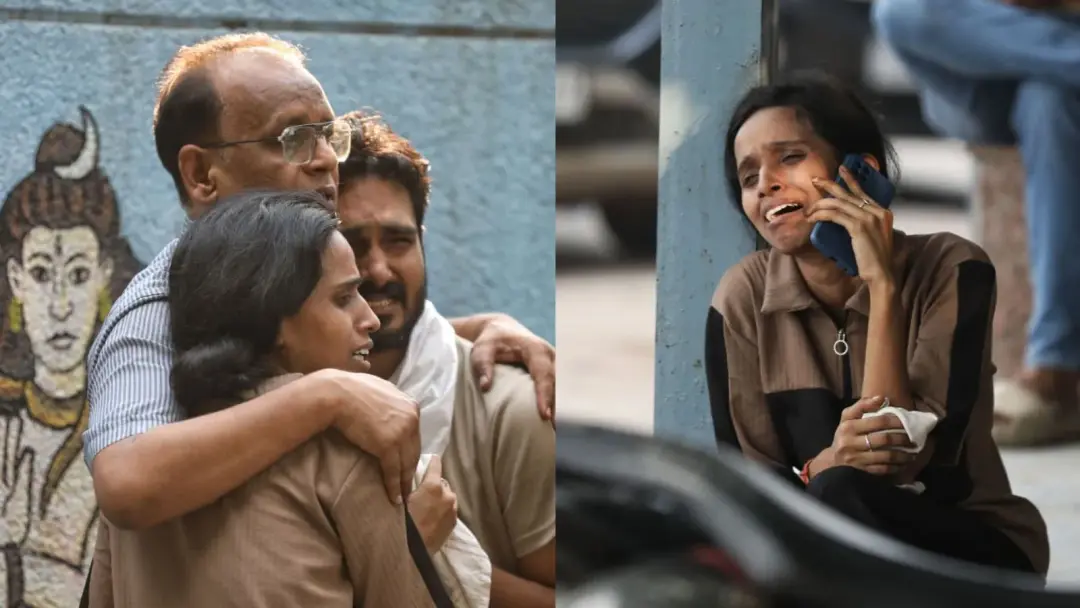
Noida bus fire: families wait outside mortuary to identify bodies
Nine people were killed when an AC sleeper bus travelling from Delhi to Mahoba caught fire around 11 pm on the Yamuna Expressway. Families waited for hours outside the post-mortem house in Noida Sector 94. Nancy Gupta waited nine hours for news of her mother Saroj Gupta, 52, and cousin Mayank Gupta, 28. A police officer said the bodies were charred beyond recognition and DNA samples would be collected.
Source
Indian Express — Cities · read the original report ↗
Desk check · compared with the source
What the desk checked (5)
- Nine people were killed when an AC sleeper bus from Delhi to Mahoba caught fire around 11 pm on the Yamuna Expressway. — Figure appears repeatedly in source; death toll also attributed to a police officer at the post-mortem house.
- Bodies were charred beyond recognition and DNA samples would be collected to establish identities. — Attributed to an unnamed police officer who spoke to waiting families.
- Nancy Gupta is searching for her mother Saroj Gupta, 52, and cousin Mayank Gupta, 28, who boarded the bus from Noida Sector 37 around 10 pm. — First-person account attributed to Nancy Gupta; names and ages appear in source.
- Injured passengers were taken to Kailash Hospital, which told callers that the missing persons were not admitted there. — Attributed to relatives' accounts; hospital not quoted directly in source.
- Sunita Gupta, 60, and her son Shashank are also missing. — Attributed to an unnamed relative from Delhi waiting outside the mortuary.
Analysts’ view opinion
At first glance this is a human tragedy, but politically it is a test of administrative competence. The story records families waiting nine hours outside a post-mortem house, unable to get information from the bus operator or the police — and that kind of information vacuum is usually what converts grief into political pressure on a government. Expressway safety and the regulation of private AC sleeper buses are the two natural lines of questioning that opposition voices could now pick up.
- Because the bodies are charred beyond recognition and DNA sampling is required, the crisis-management window stretches out, keeping official response under sustained scrutiny.
- The story suggests families got no clear answers from the operator, the police or the hospital — that gap in communication is the most likely focal point of any accountability debate.
- The victims were travelling on routes like Delhi–Mahoba and towards Auraiya, pointing to small-town, middle-class passengers whose dependence on interstate private buses raises broader transport-policy questions.
- Such incidents typically produce a standard political response — compensation announcements, an inquiry, fitness checks — and the test will be whether that becomes visible enforcement or stays on paper.
- No political leader features in the story, meaning the political narrative has not yet formed and will depend on who speaks, and how, over the coming days.
What to watch — Watch where responsibility is placed once DNA results and an official list of the dead emerge — on the bus operator, on transport-department oversight, or on expressway safety arrangements.
The story does not establish the cause of the fire, the bus's fitness or any regulatory failure, nor does it record any political reaction so far.
Deep dive
Research brief · 8 facts · 7 dates · exam-readyThe brief
Context
An air-conditioned sleeper bus travelling from Delhi to Mahoba caught fire around 11 pm on the Yamuna Expressway, killing nine passengers. The bodies were taken to the post-mortem house in Noida's Sector 94, where relatives waited through Thursday to identify them. Police said the bodies were charred beyond recognition and that DNA samples would be collected to establish identities, leaving families with no confirmation for hours. Injured passengers were taken to Kailash Hospital.
Key facts
- Nine people were killed when an AC sleeper bus travelling from Delhi to Mahoba caught fire around 11 pm on the Yamuna Expressway.
- Nancy Gupta waited nine hours on a stone slab outside the post-mortem house in Noida's Sector 94 for news of her family.
- Her mother Saroj Gupta, 52, and cousin Mayank Gupta, 28, were on the bus, returning to Rath in Uttar Pradesh.
- The family boarded the bus from Noida Sector 37 around 10 pm; Nancy's last conversation with them was before boarding.
- Nancy called at 7 am on Thursday, when the bus usually reaches; the calls went unanswered and online tracking showed the vehicle was not moving.
- A police officer said nine bodies had been brought to the mortuary but were charred beyond recognition, and DNA samples would be collected to establish identities.
- Injured passengers were taken to Kailash Hospital, which told callers that no one named Saroj or Mayank was admitted.
- Around 2.30 pm, families were finally allowed inside the post-mortem house to look for their relatives.
Timeline
- Three days before the fireNancy's family came to Noida to celebrate the first birthday of her sister's daughter.
- Around 10 pm (Wednesday night)Saroj Gupta and Mayank Gupta boarded the Delhi-Mahoba AC sleeper bus from Noida Sector 37; last conversation with Nancy.
- Around 11 pmThe bus caught fire on the Yamuna Expressway; nine people were killed.
- A few minutes past 11 pmAnother passenger called his sister to say the bus had caught fire; she took a cab and reached the spot in about an hour to find flames engulfing the bus.
- 7 am, ThursdayNancy called her mother at the bus's usual arrival time; no response, vehicle not moving on online tracking.
- Thursday afternoonPolice officers arrived at the post-mortem house and told families the nine bodies were charred beyond recognition.
- Around 2.30 pm, ThursdayFamilies entered the post-mortem house to attempt identification.
Who has a stake
- Families of the victims — Waited hours without information; face identification of charred bodies and a wait for DNA results before closure and formalities.
- Nancy Gupta and her brother — Searching for mother Saroj Gupta, 52, and cousin Mayank Gupta, 28; father repeatedly asking where his wife is.
- Other missing passengers' relatives — A woman searching for her father (brother safe) who was headed to Auraiya; relatives of Sunita Gupta, 60, and son Shashank, both untraced.
- Police — Responsible for recovering and identifying nine bodies, collecting DNA samples and informing families.
- Bus operator — Contacted by relatives but gave no information; operator of the AC sleeper bus that caught fire.
- Kailash Hospital — Received the injured; told inquiring families that the named persons were not admitted.
Why it matters
Nine deaths in a single night-time bus fire on a high-speed expressway point to how quickly a sleeper coach can become a death trap, and how little families are told in the hours that follow. When bodies are charred beyond recognition, identification shifts to DNA testing, prolonging uncertainty for relatives who move between hospital helplines, operators and mortuaries with no single source of information.
UPSC angle
Prelims pointers
- Nine killed in an AC sleeper bus fire on the Yamuna Expressway; bus was on the Delhi-Mahoba route.
- Bodies were taken to the post-mortem house in Noida Sector 94; injured to Kailash Hospital.
- The bus was boarded at Noida Sector 37 around 10 pm; fire broke out around 11 pm.
- Police said bodies were charred beyond recognition and DNA samples would be collected for identification.
- Victims named in the source: Saroj Gupta (52), Mayank Gupta (28), Sunita Gupta (60) and son Shashank reported missing.
- Destinations of passengers mentioned: Rath and Mahoba (UP) and Auraiya.
Mains framing
The Yamuna Expressway bus fire, in which nine passengers died after a Delhi-Mahoba AC sleeper coach caught fire around 11 pm, exposes two distinct failures: the vulnerability of sleeper bus design and night-time expressway travel to fire, and the absence of a reliable information and victim-identification system in the aftermath. The source shows relatives learning of the fire from online reports rather than from the operator or the police, tracking the vehicle themselves, being told by the hospital that their relatives were not admitted, and then waiting up to nine hours outside a mortuary before being allowed in at 2.30 pm. With bodies charred beyond recognition, identification depends on DNA sampling, which extends the wait for death certification, compensation and last rites. The way forward, as suggested by the facts reported, lies in prompt and centralised communication of passenger and casualty lists to families, single-window help desks at hospitals and mortuaries, and faster, dignified DNA-based identification protocols; questions of bus fire safety and emergency exits on sleeper coaches are not addressed in the source and would need separate examination.
Key terms
- AC sleeper bus
- Air-conditioned long-distance coach with berths instead of seats; the vehicle that caught fire on the Delhi-Mahoba route.
- Yamuna Expressway
- The access-controlled highway on which the bus caught fire around 11 pm.
- Post-mortem house
- Mortuary facility where bodies are kept and autopsied; here the one in Noida Sector 94 where nine bodies were brought.
- DNA sampling for identification
- Collection of biological samples to establish identity when bodies are charred beyond visual recognition, as stated by police.
- Rath
- A town in Uttar Pradesh where Saroj and Mayank Gupta were returning.
Practice questions
- Discuss the challenges of victim identification and family communication in mass-casualty road accidents, using the Yamuna Expressway bus fire as a case study.
- Long-distance sleeper bus travel in India raises distinct safety and emergency-response concerns. Examine, with reference to reported incidents.
- What institutional mechanisms can ensure that families of accident victims receive timely and verified information? Suggest measures.
Grounded only in the source report — figures and dates are the source's, not inferred.