
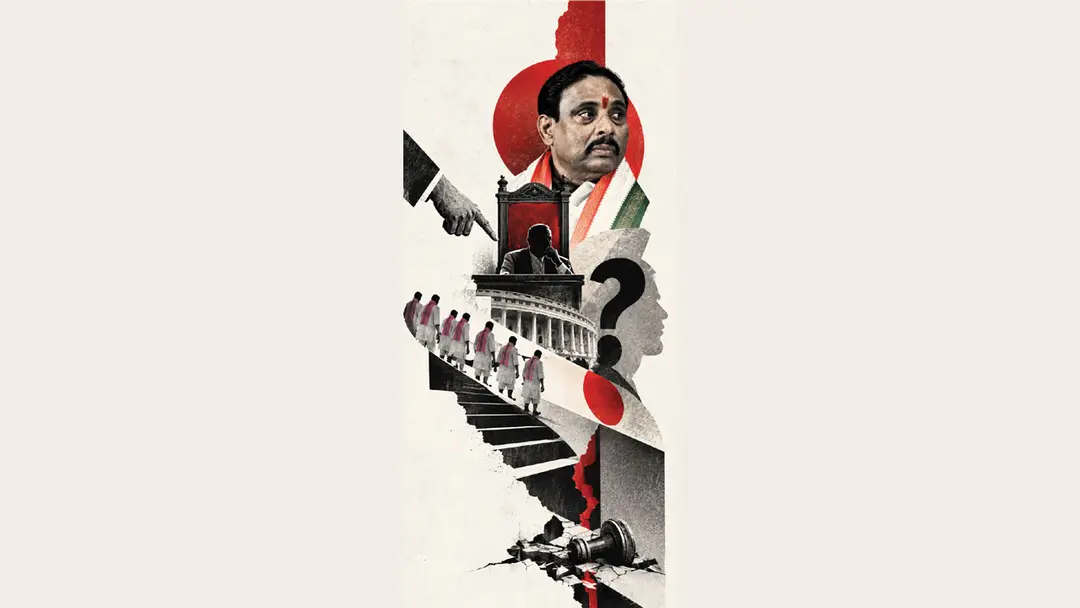
High Court ruling on Danam raises accountability questions
A High Court bench of Chief Justice Aparesh Kumar Singh and Justice GM Mohiuddin held in a 91-page verdict that Danam Nagender, elected BRS MLA from Khairatabad on December 3, 2023, stood disqualified from April 23, 2024, the day he filed his nomination as the Congress candidate for the Secunderabad Lok Sabha seat. It set aside the Speaker's March 11 order and declared Khairatabad vacant. The writer questions the accountability of the Speaker and the Chief Minister.
Source
Namasthe Telangana · read the original report ↗
Desk check · some claims need care
What the desk checked (5)
- High Court bench of Chief Justice Aparesh Kumar Singh and Justice GM Mohiuddin disqualified Danam Nagender as MLA in a 91-page verdict, effective immediately. — Attributed in source to the High Court ruling delivered on the 18th of the month, with the bench named; no independent verification possible.
- Disqualification applies from April 23, 2024, the day Nagender filed nomination as Congress candidate for Secunderabad Lok Sabha seat, and Khairatabad seat is deemed vacant from then. — Source states this as the key finding of the verdict, citing Supreme Court rulings in Subhash Desai and Shrimant Balasaheb Patil cases; figure appears in source.
- Speaker dismissed disqualification petitions of Padi Kaushik Reddy (filed March 18, 2024) and Eleti Maheshwar Reddy (July 1, 2024) on March 11 this year; High Court set aside that order. — Dates and names appear in the source; attributed to case record, not independently checked.
- Nagender said he would not appeal to the Supreme Court but filed an SLP on Saturday. — Stated by the author without direct quote or named source; treat as unverified.
- The Speaker and the Chief Minister should resign, and salaries paid to Nagender should be recovered. — Author's opinion, not a factual claim or official demand.
Analysts’ view opinion
The High Court declaring the Khairatabad seat vacant is more than a personal setback for Danam Nagender — it puts pressure on the whole defection playbook in Telangana. By fixing the disqualification from 23 April 2024, the day he filed as a Congress candidate, the ruling erodes the political cover that the Speaker's 11 March order had provided; both BRS and BJP, who were the petitioners, are likely to turn this into an accountability weapon. For the ruling Congress this is less a legal problem than a moral-political embarrassment.
- Backdating the disqualification to nomination day raises the political cost of the 'run out the clock until the term ends' strategy used by defectors.
- Questions over the Speaker's quasi-judicial role hand the opposition a shared line of attack, since BRS and BJP moved separately but in the same direction.
- Declaring the seat vacant opens a debate on a possible bypoll, which if held would be a prestige test for both sides.
- With the linked cases of other defector MLAs adjourned to 6 October, this verdict could function as a benchmark rather than a one-off.
- The demand that the Speaker and Chief Minister resign is the columnist's opinion, and the ruling side will most likely dismiss it as politically motivated.
What to watch — Watch how the Supreme Court treats the special leave petition Danam filed, and the direction the other defection cases take on 6 October — together they will define how far this ruling travels politically.
The story does not establish that the Speaker or the Chief Minister acted with deliberate intent, nor does it settle whether a bypoll will be held, whether salaries will be recovered, or how the other MLAs' cases will end.
Deep dive
Research brief · 8 facts · 10 dates · exam-readyThe brief
Context
Danam Nagender was elected MLA from Khairatabad on the BRS ticket on December 3, 2023, but filed his nomination as the Congress candidate for the Secunderabad Lok Sabha seat on April 23, 2024, while continuing as a BRS MLA. Disqualification petitions under the Tenth Schedule (anti-defection law) were filed with the Telangana Assembly Speaker, who dismissed them on March 11, 2025 (this year, per the source). A High Court bench of Chief Justice Aparesh Kumar Singh and Justice GM Mohiuddin, in a 91-page verdict delivered on the 18th of this month, set aside the Speaker's order, held Danam disqualified from April 23, 2024 and declared Khairatabad vacant. The opinion piece, by a legal expert, asks who is accountable for the delay — the Speaker or the Chief Minister as Leader of the House.
Key facts
- Danam Nagender was elected BRS MLA from Khairatabad on December 3, 2023.
- He filed his nomination as the Congress candidate for the Secunderabad Lok Sabha seat on April 23, 2024; the High Court held he was disqualified as MLA from that very date.
- The bench of Chief Justice Aparesh Kumar Singh and Justice GM Mohiuddin delivered a 91-page verdict, pronounced on the 18th of this month, effective immediately.
- The court set aside the Speaker's March 11 order dismissing the disqualification petitions and declared the Khairatabad Assembly seat vacant.
- BRS MLA Padi Kaushik Reddy filed his disqualification petition with the Speaker on March 18, 2024; BJP legislature party leader Yeleti Maheshwar Reddy on July 1, 2024.
- The bench reserved judgment on August 21 after hearing the writ petitions challenging the Speaker's decision.
- The Supreme Court on July 31, 2025 directed that the Speaker decide disqualification petitions within three months.
- Danam first said he would not appeal to the Supreme Court, but filed a Special Leave Petition on Saturday; petitions against eight other defecting MLAs stand adjourned to October 6.
Timeline
- December 3, 2023Danam Nagender elected MLA from Khairatabad on a BRS ticket.
- March 15, 2024Danam donned the Congress scarf, cited by petitioner Padi Kaushik Reddy as evidence of defection.
- March 18, 2024BRS MLA Padi Kaushik Reddy files disqualification petition before the Speaker.
- April 23, 2024Danam files Form-26 nomination as Congress candidate for Secunderabad Lok Sabha seat; date from which the High Court holds him disqualified.
- July 1, 2024BJP legislature party leader Yeleti Maheshwar Reddy files a disqualification petition before the Speaker.
- July 31, 2025Supreme Court directs the Speaker to decide disqualification petitions within three months.
- March 11 (this year)Speaker dismisses the disqualification petitions against Danam Nagender.
- August 21High Court bench reserves its verdict after hearing the writ petitions.
- 18th of this monthHigh Court delivers 91-page verdict disqualifying Danam and declaring Khairatabad vacant, with immediate effect.
- Saturday (after the verdict)Danam files a Special Leave Petition in the Supreme Court despite earlier saying he would not appeal.
Who has a stake
- Danam Nagender — Held disqualified as Khairatabad MLA from April 23, 2024; has filed an SLP in the Supreme Court; the writer argues salaries drawn since then should be refunded.
- Telangana Assembly Speaker — His March 11 order was set aside; the court called his reasoning a series of errors and unconstitutional acts, raising questions of quasi-judicial impartiality.
- Chief Minister (Leader of the House) — The writer asks whether the Speaker acted under CM's influence and says both the Speaker and CM should resign, along with the PCC president.
- Padi Kaushik Reddy (BRS MLA) and Yeleti Maheshwar Reddy (BJP) — Petitioners whose plea was upheld; Kaushik Reddy's counsel argued Danam unjustly held office for two and a half years.
- BRS — Lost an MLA to defection; the Speaker had cited BRS's failure to take disciplinary action against Danam as a ground to reject the petitions.
- Election Commission of India and Assembly Secretary — The bench ordered the Registry to send the verdict copy to both, triggering consequential steps for the vacant Khairatabad seat.
- Eight other defector MLAs (Prakash Goud, Arikepudi Gandhi, Tellam Venkat Rao, Bandla Krishna Mohan Reddy, Kale Yadaiah, Pocharam Srinivas Reddy, Kadiyam Srihari, M. Sanjay Kumar) — Face similar disqualification pleas, now listed for October 6.
Why it matters
The ruling fixes disqualification from the date of the defecting act itself — the day the nomination was filed — not from the date the Speaker or court decides, which strikes at the practice of defectors enjoying office while petitions gather dust. It also reaffirms that a Speaker acting under the Tenth Schedule functions as a tribunal whose orders are open to judicial review under Article 226. With eight more defection petitions pending till October 6, the verdict could reshape the arithmetic and the accountability debate in the Telangana Assembly.
UPSC angle
Prelims pointers
- Tenth Schedule Para 2(1)(a) read with Article 191(2): voluntarily giving up party membership attracts disqualification of an MLA.
- Article 226: High Court's writ power, used here to review the Speaker's quasi-judicial order under the Tenth Schedule.
- Supreme Court precedents cited: Dr. Mahachandra Prasad Singh v. Chairman, Bihar Legislative Council; Ravi S. Naik; R. Bhupathi Reddy; Konda Muralidhar Rao; Rajendra Singh Rana.
- Subhash Desai and Shrimant Balasaheb Patil cases: disqualification operates from the date of the act that caused it.
- Disqualification Rules, 1986 (Rules 6(6), 6(7)) held merely procedural; defective verification cannot be a ground to dismiss a petition.
- Supreme Court order of July 31, 2025: Speaker must decide anti-defection petitions within three months.
Mains framing
The Danam Nagender verdict exposes the structural weakness of India's anti-defection regime: the Tenth Schedule vests adjudication in the Speaker, who remains a party politician and, as the writer notes, is answerable within a House led by the Chief Minister. Here the evidentiary record was public and undisputed — the 2023 Form-26 and gazette notification of election as a BRS MLA, the Form-26 and B-Form filed as a Congress candidate on April 23, 2024, Form-7A carrying the 'hand' symbol, and the final candidate list — yet the Speaker dismissed the petitions on grounds that BRS had not expelled him, that there was no proof of Congress membership, and that annexures were not verified under the Civil Procedure Code. The High Court rejected each: conduct outside the House can establish voluntary relinquishment, the 1986 Rules are procedural, and the condonation logic applicable to whip-related defiance cannot cure voluntary abandonment of party membership. Implications follow for accountability — nearly three years of the Assembly's term have passed, the Supreme Court's three-month deadline of July 31, 2025 was not met, and the writer argues for restitution of salaries drawn since April 23, 2024 and resignations by the Speaker and the CM. The way forward the source supports is stricter, time-bound adjudication and readiness of courts to review Speakers' orders under Article 226, with the pending petitions against eight other defectors, listed for October 6, as the next test.
Key terms
- Tenth Schedule / Anti-defection law
- Constitutional provision under which a legislator who voluntarily gives up party membership or defies the whip can be disqualified.
- Para 2(1)(a)
- Clause covering voluntary relinquishment of party membership — the ground on which Danam was held disqualified; party condonation cannot save the member.
- Article 191(2)
- Provides for disqualification of a member of a State legislature under the Tenth Schedule.
- Quasi-judicial / tribunal role of Speaker
- When deciding Tenth Schedule petitions the Speaker acts as a tribunal chairman, so the decision is subject to judicial review.
- B-Form
- Party's authorisation naming its official candidate; Danam's Congress B-Form was treated as evidence of defection.
- Special Leave Petition (SLP)
- Plea seeking the Supreme Court's discretionary permission to appeal; filed by Danam on Saturday after the High Court verdict.
Practice questions
- The Tenth Schedule makes the Speaker the sole adjudicator of defection. In the light of the Telangana High Court's ruling in the Danam Nagender case, examine whether this design undermines the object of the anti-defection law.
- Discuss the significance of courts holding that disqualification takes effect from the date of the defecting act rather than the date of decision. Refer to the Subhash Desai and Shrimant Balasaheb Patil rulings.
- 'Conduct outside the House can establish voluntary relinquishment of party membership.' Analyse this proposition with reference to Dr. Mahachandra Prasad Singh and Ravi S. Naik.
Grounded only in the source report — figures and dates are the source's, not inferred.