
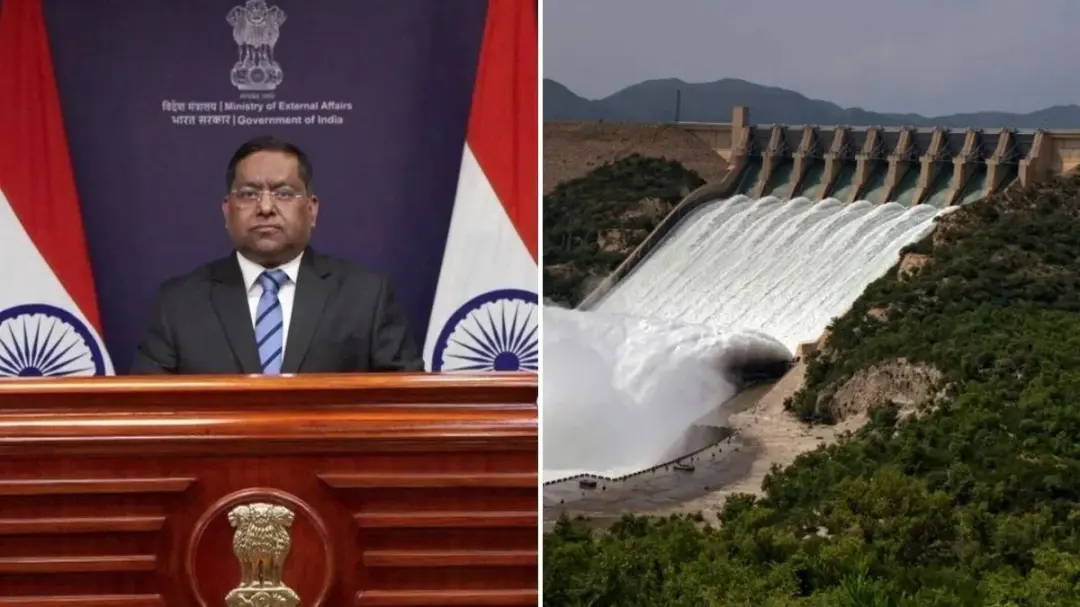
India rejects arbitration court ruling on Indus Waters Treaty abeyance
India on Monday rejected a World Bank Court of Arbitration (CoA) ruling on its decision to hold the Indus Waters Treaty with Pakistan in abeyance after the April 2025 Pahalgam massacre. In a statement issued from Bishkek, the MEA said the court was constituted in breach of the Treaty and that India has never appeared before it. A News18 report said the CoA found India's grounds inadequate to justify suspension. The court also curbed concreting work on the RHEP dam.
Source
World Bank · read the original report ↗
Desk check · compared with the source
What the desk checked (5)
- India rejected the World Bank's Court of Arbitration ruling on holding the Indus Waters Treaty in abeyance. — Attributed to a Ministry of External Affairs statement quoted in the source.
- MEA said the court was constituted in 'patent breach' of the Treaty and that India has never appeared before it. — Direct quote and paraphrase from the MEA statement as given in the source.
- The CoA said India's grounds did not justify suspension or termination of the Treaty. — Source cites a News18 report; secondary attribution, not independently confirmed.
- The court restricted concreting of the RHEP dam wall and power intake above certain levels until 90 days after the Neutral Expert's final decision, expected July 2027. — Figure and timeline appear in the source; no primary document cited.
- India in May 2026 called a CoA 'maximum pondage' award 'null and void'. — Stated in source and attributed to the MEA.
Analysts’ view opinion
India's position on the Indus Waters Treaty has now hardened from a legal argument into a settled political stance. By insisting the Court of Arbitration was constituted in breach of the treaty and that it has never appeared before it, the government has locked in a single line that lets it reject every future ruling on the same grounds. Unwinding a decision taken after the Pahalgam massacre would be politically costly for any government, which is why there is little sign of movement.
- Holding the treaty in abeyance has been framed domestically as toughness on terrorism, making any reversal a high-cost political move.
- Once the "illegally constituted court, we never appeared" argument is adopted, each new award can be dismissed on the same basis — as was done with the May 2026 ruling.
- Issuing the statement from Bishkek, the venue of the SCO Summit, signals that presence at multilateral forums will not soften India's bilateral positions.
- Rejecting a World Bank-backed mechanism carries reputational and diplomatic costs on treaty compliance, which the government appears to treat as an acceptable price.
- The restrictions on the RHEP dam are the practical test: how fast construction proceeds on the ground will itself be read as a political signal.
What to watch — Watch whether RHEP construction advances regardless of the restrictions, and what diplomatic moves the World Bank and Pakistan make ahead of the Neutral Expert's final decision expected in July 2027.
The story does not give the full text of the ruling, any official Pakistani or World Bank response, or what concrete consequences India actually faces for rejecting the award.
Deep dive
Research brief · 8 facts · 4 dates · exam-readyThe brief
Context
India placed the Indus Waters Treaty (IWT) with Pakistan "in abeyance" after the Pahalgam massacre of April 2025 and the hostilities that followed. Pakistan has pursued the dispute before a World Bank-backed Court of Arbitration (CoA), which India says was illegally constituted and before which it has never appeared. The CoA has now issued an "award" on Interim Measures and Status holding that India's grounds do not justify suspension or termination of the Treaty, and restricting concreting work on the RHEP dam. India, in a statement issued from Bishkek where the Shanghai Cooperation Organisation Summit is being held, rejected both the ruling and the court itself.
Key facts
- India on Monday rejected the World Bank Court of Arbitration's ruling (which the interim court terms an "award") on the IWT's Interim Measures and Status, and rejected the court itself.
- The MEA statement was issued from Bishkek, where the Shanghai Cooperation Organisation Summit runs till September 1.
- MEA said the court "was constituted by the World Bank in patent breach of the terms of the Treaty" and that India "categorically rejects its so-called award".
- India says it has never appeared before the body, holds that it has no jurisdiction over suspension of the IWT, and has never taken cognisance of its earlier rulings.
- The CoA held that India's grounds were not adequate to justify suspension or termination of the IWT and that India must observe its treaty obligations, including on design and operation of hydroelectric projects on the western rivers, per a News18 report.
- The CoA restricted India from concreting the RHEP dam wall and power intake structure above certain levels until 90 days after the Neutral Expert's final decision.
- The Neutral Expert's final decision is expected in July 2027.
- In May 2026 the MEA had rejected a CoA "maximum pondage" award on water storage in reservoirs or dams, calling it "null and void".
Timeline
- April 2025Pahalgam massacre, followed by hostilities; India holds the Indus Waters Treaty with Pakistan in abeyance.
- May 2026MEA rejects a CoA award on "maximum pondage" — the volume of live water India may store in upcoming reservoirs — calling it null and void.
- Monday (current development)India, in an MEA statement from Bishkek, rejects the CoA's award on IWT Interim Measures and Status, and the court itself.
- July 2027 (expected)Neutral Expert's final decision due; CoA curbs on concreting RHEP dam wall and power intake apply till 90 days after it.
Who has a stake
- Government of India / Ministry of External Affairs — Defends the abeyance decision and the legality of its position; rejects the CoA's jurisdiction and all its pronouncements.
- Pakistan — Relies on the Treaty and its dispute-settlement machinery for water flows from the western rivers and on design limits for Indian projects.
- World Bank — Constituted the Court of Arbitration and backs the interim process; India disputes the legality of that constitution.
- Court of Arbitration (CoA) — Its awards on Interim Measures and Status, and on maximum pondage, are being rejected outright by one party.
- Neutral Expert — Final decision expected in July 2027; CoA's restrictions on RHEP construction are tied to a 90-day window after it.
- RHEP project and Indian hydropower engineers — Concreting of dam wall and power intake structure above certain levels restricted; designs may need alteration for treaty-compliant pondage.
Why it matters
The dispute pits India's post-Pahalgam decision to hold a 1960s-era water treaty in abeyance against a World Bank-backed arbitral process whose legitimacy India refuses to accept. The rulings touch directly on the design, storage and construction timelines of Indian hydroelectric projects on the western rivers, including RHEP. It also raises a larger question of how a state engages with treaty dispute-settlement bodies it considers illegally constituted.
UPSC angle
Prelims pointers
- Indus Waters Treaty (IWT): India–Pakistan water-sharing pact; held in abeyance by India after the April 2025 Pahalgam massacre.
- World Bank constituted the Court of Arbitration; India says this was in "patent breach" of the Treaty and has never appeared before it.
- CoA award on Interim Measures and Status: held India's grounds inadequate to justify suspension or termination of the IWT.
- RHEP: CoA barred concreting of dam wall and power intake above certain levels till 90 days after the Neutral Expert's final decision (expected July 2027).
- May 2026: MEA called the CoA's "maximum pondage" award "null and void".
- MEA statement issued from Bishkek, venue of the SCO Summit running till September 1.
Mains framing
India's rejection of the Court of Arbitration's award on the Indus Waters Treaty's Interim Measures and Status turns a bilateral water-sharing arrangement into a contest over the legitimacy of treaty dispute settlement itself. New Delhi's position rests on two claims: that the World Bank constituted the court in patent breach of the Treaty's terms, and that the body has no jurisdiction to pronounce on the suspension of the Treaty — hence India has never appeared before it and has never taken cognisance of its rulings, including the May 2026 "maximum pondage" award it called null and void. The CoA, by contrast, holds that the grounds cited after the April 2025 Pahalgam massacre do not justify suspension or termination, and that India must continue to observe obligations on the design and operation of hydroelectric projects on the western rivers, while restricting concreting at RHEP until 90 days after the Neutral Expert's final decision expected in July 2027. The implications run along three tracks: the operational and cost consequences for run-of-river projects whose designs may need alteration; the credibility costs and precedent set by non-appearance before an internationally backed forum; and the parallel existence of two mechanisms — Neutral Expert and Court of Arbitration — producing overlapping processes. A way forward, on the source's own terms, would rest on clarifying which forum has jurisdiction over abeyance and awaiting the Neutral Expert's 2027 determination, since the source records no negotiated track.
Key terms
- Indus Waters Treaty (IWT)
- India–Pakistan treaty governing use of the Indus system, including design and operation of Indian hydroelectric projects on the western rivers.
- Abeyance
- India's decision to hold the IWT in suspension following the April 2025 Pahalgam massacre and the hostilities that followed.
- Court of Arbitration (CoA)
- World Bank-constituted interim body issuing "awards" on the IWT; India calls it illegally constituted and rejects its jurisdiction.
- Neutral Expert
- Separate technical authority under the IWT process whose final decision is expected in July 2027, and to which the RHEP construction curb is linked.
- Maximum pondage
- Limit on "live water" India may store in reservoirs; CoA's May 2026 award set a lower figure than Indian engineers had planned.
- RHEP
- Indian hydroelectric project whose dam wall and power intake concreting above certain levels the CoA has restricted.
Practice questions
- India has rejected the World Bank-constituted Court of Arbitration as illegally constituted while holding the Indus Waters Treaty in abeyance. Examine the legal and diplomatic implications of non-appearance before a treaty dispute-settlement body.
- Discuss how the parallel Neutral Expert and Court of Arbitration processes under the Indus Waters Treaty affect the design and construction timelines of Indian hydroelectric projects on the western rivers.
- "Water treaties are tested most when security relations break down." Critically analyse this statement with reference to India's post-Pahalgam decision on the Indus Waters Treaty.
Grounded only in the source report — figures and dates are the source's, not inferred.