
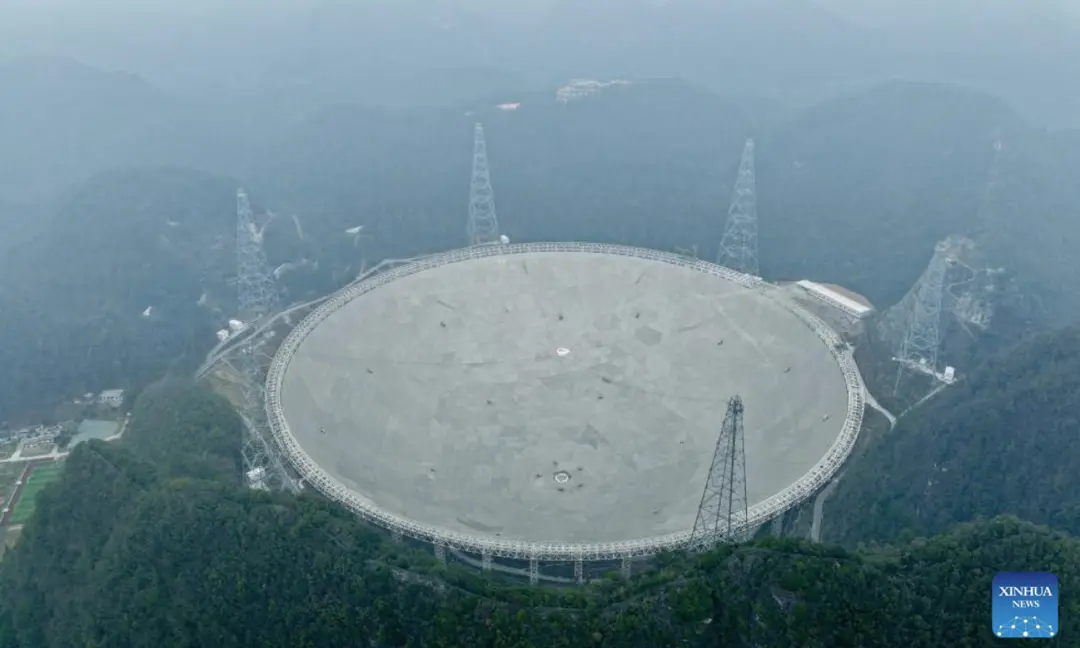
China's FAST telescope marks 10 years, to push Phase II work
China's Five-hundred-meter Aperture Spherical Radio Telescope (FAST), the world's largest single-dish radio telescope, marks the 10th anniversary of its inauguration on September 25. It was inaugurated on September 25, 2016 in Guizhou Province. FAST has discovered 1,284 pulsars, including more than 170 millisecond pulsars, Xinhua reported. The FAST team will advance the project's Phase II to strengthen China's position in radio astronomy, CCTV News said.
Source
Global Times (China) · read the original report ↗
Desk check · compared with the source
What the desk checked (5)
- FAST was inaugurated on September 25, 2016 in Guizhou Province and marks its 10th anniversary on September 25. — Dates appear in source and are internally consistent; attributed to Global Times/CCTV News reporting.
- FAST has discovered 1,284 pulsars, including more than 170 millisecond pulsars and over 160 pulsar binary systems. — Figures appear in source, attributed to Xinhua News Agency; not independently verifiable here.
- A domestically developed microwave ranging system entered trial use in April 2026 after seven years of research, costing nearly half as much per set. — Stated in source without named institutional source; cost and accuracy claims unattributed.
- An academic conference in Pingtang County drew more than 200 experts from over 40 universities and research institutions. — Attendance figure attributed to CCTV News; no independent confirmation in source.
- The FAST team will advance Phase II of the project. — Forward-looking statement attributed to CCTV News; no timeline or budget given.
Analysts’ view opinion
FAST's ten-year mark is less a story about one dish than about what a decade of operating a frontier instrument does to a country's engineering base. The headline number — 1,284 pulsars, including more than 170 millisecond pulsars — matters scientifically, but the quieter theme in the reporting is import substitution: domestically developed steel cables, receivers and a new microwave ranging system replacing laser total stations that reportedly failed in a third of observation windows because of Guizhou's rain and fog. That is the classic pattern of big-science facilities: the telescope produces papers, and the supply chain it forces into existence produces capability that outlives the papers.
- Single-dish sensitivity is FAST's structural advantage, and pulsar and fast-radio-burst searches are exactly the survey-style work where raw collecting area pays off fastest.
- The reported shift from imported to homegrown measurement, cabling and receiver technology is the more durable industrial story, since those components have uses well beyond astronomy.
- A locally built all-weather microwave ranging system at roughly half the cost per set, per the report, points to a familiar trajectory in which a bespoke scientific solution becomes a cheaper commodity instrument.
- The stated applications — cislunar target detection, pulsar-based timing standards, asteroid monitoring — show how radio astronomy infrastructure is increasingly dual-purpose for space situational awareness, a trend visible across major space powers.
- For international peers, FAST's discovery volume raises the competitive stakes but also the collaboration stakes, since pulsar timing and transient science depend on data shared across many facilities and time zones.
What to watch — Watch what Phase II actually specifies — whether it is added receivers and instrumentation on the existing dish, or an array of additional antennas, since that choice determines whether China is optimising sensitivity or moving toward the resolution advantages that array-based projects offer.
The story does not establish Phase II's scope, cost, timeline or funding, nor does it offer independent verification of the discovery counts and the new ranging system's performance, which are attributed to Chinese state media and a domestic anniversary conference.
Deep dive
Research brief · 8 facts · 5 dates · exam-readyThe brief
Context
China's Five-hundred-meter Aperture Spherical Radio Telescope (FAST), nicknamed the "Sky Eyes", is the world's largest single-dish radio telescope, built in a natural karst depression in Guizhou Province in southwest China. Inaugurated on September 25, 2016, it gave China the ability to "listen in" on radio waves from deep space to study the evolution of the universe, new stars and the possibility of extraterrestrial life. As the facility marks a decade since inauguration, its team says it will push ahead with a Phase II project to consolidate China's leading position in radio astronomy. The source is drawn from CCTV News and Xinhua reports carried by Global Times.
Key facts
- FAST was inaugurated on September 25, 2016 in Guizhou Province, southwest China, and is the world's largest single-dish radio telescope.
- To date FAST has discovered 1,284 pulsars, far more than all other radio telescopes worldwide combined over the same period.
- Its pulsar haul includes more than 170 millisecond pulsars and over 160 pulsar binary systems, among them the binary pulsar system with the shortest known orbital period.
- An academic conference marking the 10th anniversary is being held Tuesday to Thursday in Pingtang County, Guizhou, drawing over 200 experts from more than 40 universities and research institutions in China.
- A domestically developed microwave ranging system, the result of seven years of research, went into trial use in April 2026, replacing imported laser total stations.
- The imported laser total stations failed during one-third of observation periods because of Guizhou's frequent rain and fog.
- The homegrown microwave ranging system costs nearly half as much per set, works in all weather, and matches laser total stations in order-of-magnitude accuracy.
- FAST has contributed to cislunar space target detection, pulsar-based time standards and asteroid defence, supporting national space security needs.
Timeline
- September 25, 2016FAST inaugurated in Guizhou Province, marking the start of China's deep-space radio listening capability.
- January 16, 2026Aerial photo shows FAST undergoing maintenance in Guizhou.
- April 2026Domestically developed microwave ranging system enters trial use, replacing imported laser total stations.
- Tuesday to Thursday (week of the report)Anniversary academic conference held in Pingtang County, Guizhou, with over 200 experts from 40-plus institutions.
- September 25 (10th anniversary)FAST marks 10 years since inauguration; team to advance Phase II of the project.
Who has a stake
- FAST team / operators — Responsible for stable operation, indigenising components and delivering Phase II and further original scientific breakthroughs.
- Chinese government and national strategy — FAST supports space security and major strategic needs via cislunar target detection, pulsar time standards and asteroid defence.
- Chinese universities and research institutions — Over 40 institutions and 200-plus experts engaged in FAST-based research on pulsars, fast radio bursts and gravitational waves.
- Guizhou Province and Pingtang County — Host the facility and the anniversary conference; local weather conditions directly shape equipment design choices.
- Global radio astronomy community — FAST's discovery rate of rare celestial objects far outpaces international peers, shifting leadership in the field.
- Domestic technology suppliers — Indigenous steel cables, receivers and measurement systems replace imported key components.
Why it matters
FAST shows how a single large scientific facility can move a country from following the global research frontier to leading it, with 1,284 pulsar discoveries in a decade. Its record of replacing imported components with homegrown measurement systems, cables and receivers is a case study in technological self-reliance in big science. The spillovers into cislunar detection, pulsar-based timekeeping and asteroid defence also link pure astronomy directly to national space security.
UPSC angle
Prelims pointers
- FAST = Five-hundred-meter Aperture Spherical Radio Telescope, world's largest single-dish radio telescope, located in Guizhou Province, China.
- FAST was inaugurated on September 25, 2016; nicknamed China's 'Sky Eyes'.
- FAST has discovered 1,284 pulsars, including over 170 millisecond pulsars and over 160 pulsar binary systems.
- FAST research areas: pulsars, neutral hydrogen galaxies, fast radio bursts and gravitational waves.
- Indigenous microwave ranging system replacing imported laser total stations began trial use in April 2026 after seven years of research.
- 10th anniversary academic conference held in Pingtang County, Guizhou, with 200+ experts from 40+ institutions.
Mains framing
The FAST decade illustrates how sustained investment in a single mega-science facility can reorder global scientific hierarchies: since its inauguration in September 2016, the telescope has found 1,284 pulsars, more than all other radio telescopes worldwide combined over the same period, alongside results in neutral hydrogen galaxies, fast radio bursts and gravitational waves. Equally significant is the technological trajectory: key components were initially imported, but a decade of operation produced indigenous steel cables, high-performance receivers and a microwave ranging system that entered trial use in April 2026 after seven years of research, costing nearly half as much per set and functioning in all weather, unlike laser total stations that failed in a third of observation windows due to Guizhou's rain and fog. This demonstrates that operating conditions themselves can drive indigenisation, and that dual-use spillovers, cislunar target detection, pulsar-based time standards and asteroid defence, tie basic research to strategic capability. The declared way forward is Phase II of the project, aimed at consolidating leadership in radio astronomy; for other countries, the lesson is that such leadership depends on long-horizon funding, a domestic instrumentation ecosystem and a broad research community, here over 200 experts from more than 40 institutions.
Key terms
- FAST
- Five-hundred-meter Aperture Spherical Radio Telescope in Guizhou, China, the world's largest single-dish radio telescope, inaugurated in 2016.
- Pulsar
- A rapidly rotating dense stellar remnant emitting regular radio pulses; FAST has discovered 1,284 of them.
- Millisecond pulsar
- A pulsar spinning extremely fast, with pulse periods of milliseconds; FAST has found more than 170.
- Fast radio burst (FRB)
- Brief, intense bursts of radio emission from deep space, one of FAST's main research areas.
- Laser total station
- Imported precision surveying instrument once used as FAST's primary measurement equipment; failed in a third of observations due to rain and fog.
- Cislunar space
- The region of space between Earth and the Moon; FAST has aided target detection there for space security purposes.
Practice questions
- Large scientific facilities can transform a nation's research standing. Discuss with reference to China's FAST telescope and its decade of pulsar discoveries.
- How does indigenisation of scientific instrumentation strengthen research capability? Illustrate using FAST's replacement of imported laser total stations with a domestic microwave ranging system.
- Examine the dual-use character of radio astronomy infrastructure, using FAST's applications in cislunar space detection, pulsar-based time standards and asteroid defence.
Grounded only in the source report — figures and dates are the source's, not inferred.