
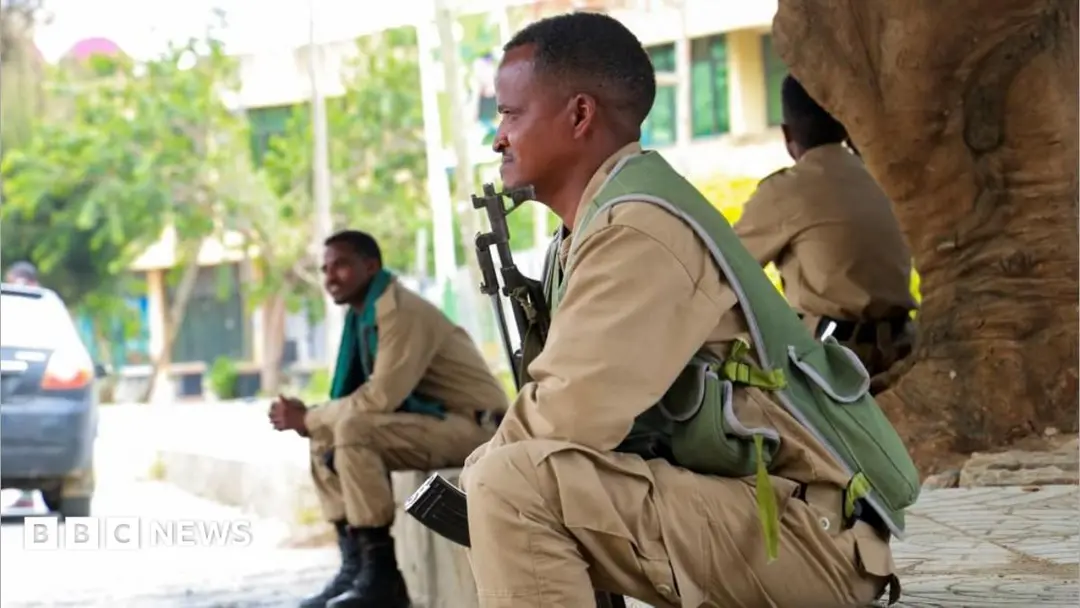
Ethiopian army says it repelled Tigrayan forces' attacks in north
Ethiopia's army said it had repelled attacks by Tigrayan forces and their allies in parts of the country's north, in its first statement since fighting began on Wednesday. It said hostilities started in Amhara region near the Tigray border and that troops inflicted heavy casualties and seized weapons. The TPLF has not commented and the BBC could not verify the claims. The TPLF seized three airports from federal police on Wednesday. An AU mediator estimated 600,000 died in the 2020-2022 war.
Source
BBC — World · read the original report ↗
Desk check · some claims need care
What the desk checked (5)
- Ethiopia's army repelled attacks by Tigrayan forces and allies in northern Ethiopia, inflicting heavy casualties and seizing weapons. — Attributed to an army statement; source says BBC could not independently verify and TPLF has not commented.
- The TPLF seized control of three airports from federal police on Wednesday. — Reported in source; supported by Mekelle residents' accounts of the airport takeover.
- Tigrayan forces launched heavy artillery attacks near the town of Yallo in Afar. — Attributed to a humanitarian source in Afar speaking to AFP; described as unconfirmed.
- TPLF vice-president Amanuel Assefa said 'We are in the situation of full-blown war now'. — Quote attributed to AFP news agency in the source.
- About 600,000 people died in the 2020-2022 war, per the AU mediator's estimate. — Figure appears in source, attributed to the African Union's mediator as an estimate.
Analysts’ view opinion
These developments suggest the 2022 African Union-brokered peace deal is now at risk of collapsing in practice, not just on paper. The seizure of three airports, the TPLF's announced alliance with six other armed groups, and the army's claim to have repelled attacks together point to something broader than a localised skirmish. With no way to independently verify either side's claims, an information vacuum is forming — and that alone makes de-escalation diplomacy harder.
- Taking airports from federal police is not merely symbolic: it carries strategic weight over supply lines and military airlift.
- The TPLF's stated alliance with six armed groups, plus reports of fighting spreading into Amhara and Afar, suggests the confrontation may not stay confined to one region.
- The AU mediator's estimate of some 600,000 deaths in the 2020-22 war is a reminder of the humanitarian scale a renewed conflict could reach.
- Because independent reporting from Tigray is not possible and the TPLF has not responded, competing narratives will dominate — raising the risk of miscalculation.
- A Mekelle resident's account of cash shortages and withheld budgets signals civilian resilience was already eroding before the shooting started.
What to watch — Watch how quickly the African Union and regional powers move toward mediation, whether fighting spreads further into Afar and Amhara, and whether communications are cut.
The BBC has not independently verified the army's claims about casualties and captured weapons, and the story does not establish that full-scale war is inevitable or who initiated the fighting.
Deep dive
Research brief · 8 facts · 6 dates · exam-readyThe brief
Context
Ethiopia's federal army says it has beaten back attacks by Tigrayan forces and their allies in the north, its first statement since fighting erupted on Wednesday. The escalation follows months of mutual accusations that the African Union-brokered peace deal, which ended the 2020-2022 Tigray war, is being violated. The Tigray People's Liberation Front (TPLF), which dominates the region, seized three airports from federal police and has announced an alliance with six other armed groups to oust Prime Minister Abiy Ahmed's government. The BBC cannot report from Tigray and could not verify the army's claims.
Key facts
- Ethiopia's army said hostilities began in an area of Amhara region close to the Tigray border, and that its soldiers inflicted heavy casualties and seized weapons.
- The statement was the army's first since fighting broke out on Wednesday; the TPLF has not commented and the BBC could not independently verify the claims.
- On Wednesday the TPLF seized control of three airports from federal police, including the airport in Tigray's main city Mekelle.
- Ethiopian Airlines has cancelled all flights to Tigray following the seizure of the airports.
- The AU's mediator estimated some 600,000 people died in the 2020-2022 war, one of the most deadly conflicts this century, which drove the region to the precipice of famine.
- On Sunday, the TPLF announced an alliance with six other armed groups to oust the government.
- A humanitarian source in Afar told AFP on Thursday that Tigrayan forces launched heavy artillery attacks while trying to take the town of Yallo, near the Tigray border.
- TPLF vice-president Amanuel Assefa is quoted by AFP as saying: "We are in the situation of full-blown war now."
Timeline
- 2020 to 2022Ethiopia's federal government and Tigray authorities fight a devastating war; AU mediator estimates some 600,000 deaths.
- End of the war (2022)An African Union-brokered peace deal ends the fighting; in recent months both sides accuse each other of violating it.
- Recent days before the fightingReports of drone strikes in Tigray; sharp escalation of tensions between the federal government and Tigrayan leaders.
- SundayTPLF announces an alliance with six other armed groups to oust the government.
- WednesdayFighting breaks out; TPLF seizes three airports from federal police, including Mekelle's, early in the day.
- ThursdayArmy issues first statement saying it repelled attacks; humanitarian source reports artillery attacks near Yallo in Afar; Mekelle resident describes calm but cash crisis.
Who has a stake
- Ethiopian federal army / Prime Minister Abiy Ahmed's government — Says it repelled attacks and inflicted heavy casualties; faces the risk of a renewed civil war on multiple fronts.
- Tigray People's Liberation Front (TPLF) — Dominates Tigray, seized three airports, allied with six armed groups to oust the government; its vice-president speaks of "full-blown war".
- Residents of Tigray, especially Mekelle — Face economic distress, cash shortages, curfew-like conditions and risk if communications are cut off.
- Amhara and Afar regions — Unconfirmed reports of TPLF attacks; Yallo town in Afar reportedly hit by heavy artillery.
- African Union — Brokered the 2022 peace deal now accused of being violated by both sides; its mediator estimated 600,000 deaths.
- Ethiopian Airlines — Cancelled all flights to Tigray after the airport seizures.
- Media and the public — BBC is unable to report from Tigray and surrounding areas, leaving claims unverified.
Why it matters
A return to war between Ethiopia's federal government and the TPLF would revive a conflict that the AU's own mediator estimated killed some 600,000 people and pushed Tigray to the edge of famine. The spread of fighting into Amhara and Afar, a TPLF alliance with six armed groups, and an information blackout raise the risk of a wider, poorly documented regional crisis. For Tigray's civilians, the immediate danger is economic collapse — cash shortages and possible communication cut-offs — layered on top of the threat of combat.
UPSC angle
Prelims pointers
- TPLF — Tigray People's Liberation Front, the party dominating Ethiopia's Tigray region.
- The 2020-2022 Tigray war ended with an African Union-brokered peace deal; both sides now accuse each other of violating it.
- AU mediator's estimate: about 600,000 deaths in the 2020-2022 conflict.
- Abiy Ahmed is Ethiopia's Prime Minister; Mekelle is Tigray's main city.
- Amhara and Afar are regions neighbouring Tigray where attacks were reported.
- Ethiopian Airlines cancelled all flights to Tigray after the TPLF seized three airports.
Mains framing
Ethiopia's renewed north-eastern fighting illustrates how fragile negotiated settlements can be when political grievances, resource control and local security forces remain unresolved. The 2022 African Union-brokered deal halted a war that the AU's mediator estimated killed some 600,000 people and brought Tigray to the brink of famine, but both sides have since accused each other of violations; the TPLF's alliance on Sunday with six other armed groups to oust the government and its seizure of three airports from federal police mark a shift from political dispute to armed confrontation, now reportedly spilling into Amhara and Afar. Compounding the military escalation is a civilian crisis described by a Mekelle resident: months of denied budgets for civil servants, banks running out of cash, reliance on mobile banking and the danger of communications blackouts. An information vacuum — the BBC cannot report from Tigray and cannot verify army claims — hampers accountability. A way forward, on the evidence in the source, rests on restoring the credibility of the AU-brokered agreement, verified reporting of hostilities, and addressing the financial and administrative grievances that keep civilians in distress.
Key terms
- TPLF
- Tigray People's Liberation Front, the political force dominating Tigray region, now in armed confrontation with the federal government.
- African Union-brokered peace deal
- The 2022 agreement that ended the 2020-2022 Tigray war; both sides now accuse each other of breaching it.
- Mekelle
- Tigray's main city, where local forces took over the airport from national police early on Wednesday.
- Amhara and Afar
- Ethiopian regions neighbouring Tigray where TPLF attacks were reported, including artillery fire near Yallo town in Afar.
- Abiy Ahmed
- Ethiopia's Prime Minister, whose government the TPLF and six allied armed groups say they want to oust.
Practice questions
- Examine why negotiated peace settlements in Africa's internal conflicts often collapse, with reference to the African Union-brokered Ethiopia-Tigray agreement of 2022.
- Discuss how restrictions on independent journalism in conflict zones affect humanitarian response and international accountability.
- How do economic instruments such as budget allocations and access to cash and banking shape civilian outcomes in intra-state conflicts? Illustrate with the situation in Tigray.
Grounded only in the source report — figures and dates are the source's, not inferred.