
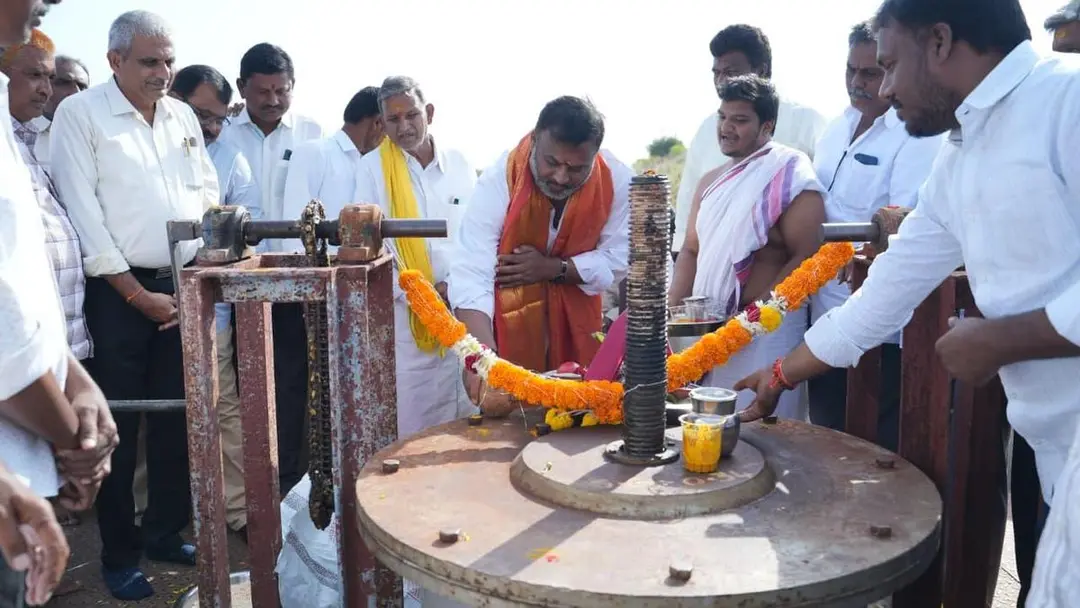
Water released into Veligallu right canal; Minister urges dryland crops
Transport Minister Mandipalli Ramprasad Reddy on Sunday released water into the right canal of the Veligallu project at Galiveedu mandal in Annamayya district. He said 120 cusecs were being released initially and the discharge would be regulated at 80 cusecs after a fortnight, with 0.5 TMC earmarked until the end of October. Tanks will be filled only to 30 per cent as per the Collector's directions. Citing possible drought due to El Niño, he urged farmers to prefer dryland crops.
Source
Annamayya — agriculture · read the original report ↗
Desk check · compared with the source
What the desk checked (5)
- Transport Minister Mandipalli Ramprasad Reddy released water into the right canal of the Veligallu project at Galiveedu mandal, Annamayya district, on September 6, 2026. — Attributed to the source report and accompanying photo caption; date appears consistently in the text.
- 120 cusecs are being released initially, to be regulated at 80 cusecs after a fortnight. — Figures stated by the Minister to the media; no independent documentation cited.
- About 0.5 TMC has been earmarked for use until the end of October, with a plan to replenish a similar quantity via Handri-Neeva. — Attributed to the Minister; the replenishment plan is described as under preparation, not finalised.
- Tank filling will be limited to 30 per cent in line with the Collector's directions. — Attributed to the Minister citing the Collector; the directive itself is not quoted in the source.
- Drought is possible due to El Niño conditions. — Stated by the Minister as a reason for caution; no meteorological agency is cited in the source.
Analysts’ view opinion
This is water rationing dressed as a water release. By capping tank filling at 30%, tapering flows from 120 to 80 cusecs and earmarking only 0.5 TMC to end-October, the administration is effectively reallocating a scarce input away from irrigated agriculture towards drinking water, livestock and groundwater recharge — the lowest-risk economic use of each litre. The cost lands on farmers in the Veligallu command, who are being asked to switch to lower-value dryland crops; the benefit is spread across the wider district in the form of avoided drinking-water distress later in the year.
- Advising dryland crops over water-intensive ones lowers per-acre revenue potential for command-area farmers, but also cuts their downside risk of a total crop failure mid-season.
- Rationing now protects a public good — drinking water and livestock supply through to the next monsoon — which has a far higher economic cost of failure than a weaker cropping season.
- The mention of crop insurance compensation for water-scarcity losses signals part of the burden could shift to the public purse and insurers, though the story says this is only under consideration.
- The plan to replenish a similar volume via Handri-Neeva is the key variable: if the transfer materialises, the effective loss of irrigated output shrinks; if not, the 0.5 TMC cap binds harder.
- Early, explicit signalling before sowing has economic value in itself, since farmers who reallocate seed and input spending upfront avoid sunk costs on crops that cannot be carried to harvest.
What to watch — Watch whether the Handri-Neeva replenishment actually arrives and whether the crop insurance assurance is formalised, as both determine how much of the adjustment cost farmers ultimately absorb.
The story does not establish how large the affected command area is, how many farmers or acres are involved, what the likely income loss would be, or any confirmed insurance terms or timelines.
Deep dive
Research brief · 8 facts · 4 dates · exam-readyThe brief
Context
The Veligallu project in Annamayya district of Andhra Pradesh's Rayalaseema region is a source of irrigation and drinking water for the drought-prone Galiveedu belt. On September 6, 2026, Transport Minister Mandipalli Ramprasad Reddy released water into the project's right canal, but with strict limits, saying the government was prioritising drinking water, livestock needs and groundwater recharge amid concerns over water availability. He warned farmers against water-intensive crops, citing possible drought due to El Niño conditions.
Key facts
- Water released into the right canal of the Veligallu project at Galiveedu mandal, Annamayya district, on Sunday, September 6, 2026.
- Initial release is 120 cusecs; the discharge will be regulated down to 80 cusecs after a fortnight.
- About 0.5 TMC of water has been earmarked for use until the end of October.
- The administration is working on a plan to replenish a similar quantity of water through the Handri-Neeva project.
- Filling of tanks will be limited to 30 per cent, in line with the District Collector's directions, with no release beyond essential requirements.
- The Minister asked farmers not to depend on Veligallu water for water-intensive crops and to give priority only to dryland crops, citing possible drought from El Niño.
- The government is 'seriously considering' facilitating crop insurance compensation where crops suffer losses due to water scarcity.
- Senior officials of Handri-Neeva Sujala Sravanthi, the irrigation department and the Veligallu project were present at the release.
Timeline
- September 6, 2026 (Sunday)Transport Minister Mandipalli Ramprasad Reddy releases water into the Veligallu right canal at Galiveedu mandal; 120 cusecs released initially.
- About a fortnight after September 6, 2026Discharge to be regulated down to 80 cusecs.
- Until end of October 2026Around 0.5 TMC of water earmarked for use during this period.
- Till the onset of the monsoon next yearFarmers asked to conserve water to avoid drinking water shortages.
Who has a stake
- Farmers in the Veligallu right canal command area — Told not to plan water-intensive crops on project water; asked to shift to dryland crops, with possible crop insurance cover for water-scarcity losses.
- Andhra Pradesh government / Transport Minister Mandipalli Ramprasad Reddy — Managing a limited release while prioritising drinking water, livestock needs and groundwater recharge.
- District Collector and district officials, Annamayya — Directed tank filling to be capped at 30 per cent and no release beyond essential requirements.
- Irrigation department and Veligallu project officials — Asked to ensure efficient distribution through canals and tanks and to monitor water flow.
- Handri-Neeva Sujala Sravanthi project authorities — Expected to help replenish a quantity of water similar to the 0.5 TMC drawn from Veligallu.
- Drinking water and livestock users in the region — Named as the first priority for the available water till the next monsoon.
Why it matters
The release shows how a drought-prone Rayalaseema district is rationing scarce storage — capping tank filling at 30 per cent and tapering canal discharge — to protect drinking water and livestock needs ahead of an anticipated El Niño-linked dry spell. For farmers, it signals an administratively guided shift from water-intensive to dryland cropping, with crop insurance floated as a cushion. It is a concrete example of demand-side water management and crop-choice advisories replacing assured canal supply.
UPSC angle
Prelims pointers
- Veligallu project is located in Annamayya district, Andhra Pradesh; water released into its right canal at Galiveedu mandal on September 6, 2026.
- Release: 120 cusecs initially, to be regulated to 80 cusecs after a fortnight; 0.5 TMC earmarked till end of October.
- Tank filling capped at 30 per cent as per the District Collector's directions.
- Handri-Neeva Sujala Sravanthi project cited as the source to replenish a similar quantity of water.
- El Niño conditions cited as the reason for expecting drought and advising dryland crops.
- Stated priorities for water use: drinking water, livestock needs and groundwater recharge.
Mains framing
The Veligallu release illustrates the core dilemma of irrigation governance in semi-arid Rayalaseema: limited storage must simultaneously serve drinking water, livestock, groundwater recharge and crop irrigation in a year when El Niño conditions raise the risk of drought. The state's response here is largely regulatory and advisory — a tapering discharge from 120 to 80 cusecs, a hard cap of 0.5 TMC till end-October, tank filling restricted to 30 per cent on the Collector's orders, a plan to replenish an equivalent quantity via Handri-Neeva, and an explicit call on farmers to abandon water-intensive crops for dryland crops. The implications are twofold: rationing protects essential needs till the next monsoon, but it transfers risk to farmers who must change cropping plans at short notice, which is why the Minister flagged crop insurance compensation for water-scarcity losses. A credible way forward, on the source's own terms, rests on efficient canal and tank distribution with active monitoring by irrigation officials, timely and clearly communicated crop advisories, inter-basin replenishment through Handri-Neeva, and making the insurance assurance operational rather than aspirational.
Key terms
- Veligallu project
- Irrigation project in Annamayya district, Andhra Pradesh; water was released into its right canal at Galiveedu mandal.
- Cusec
- Unit of water flow (cubic feet per second) used here for canal discharge — 120 cusecs initially, later 80 cusecs.
- TMC
- Thousand million cubic feet, a measure of stored water volume; 0.5 TMC was earmarked till end-October.
- Handri-Neeva Sujala Sravanthi
- Andhra Pradesh irrigation project proposed to replenish a quantity of water similar to that drawn from Veligallu.
- El Niño
- Climate pattern cited by the Minister as a reason to expect drought conditions and prefer dryland crops.
- Dryland crops
- Crops grown with low water requirement, recommended instead of water-intensive crops dependent on project water.
Practice questions
- Discuss how climate signals such as El Niño should shape reservoir operation and crop advisories in semi-arid regions, using the Veligallu release as an illustration.
- Rationing water for drinking, livestock and recharge over irrigation raises equity questions for farmers. Examine, with reference to the Veligallu case, how crop insurance can cushion such administrative decisions.
- Evaluate the role of district administration and irrigation officials in demand-side water management, citing measures such as capping tank filling at 30 per cent and tapering canal discharge.
Grounded only in the source report — figures and dates are the source's, not inferred.