
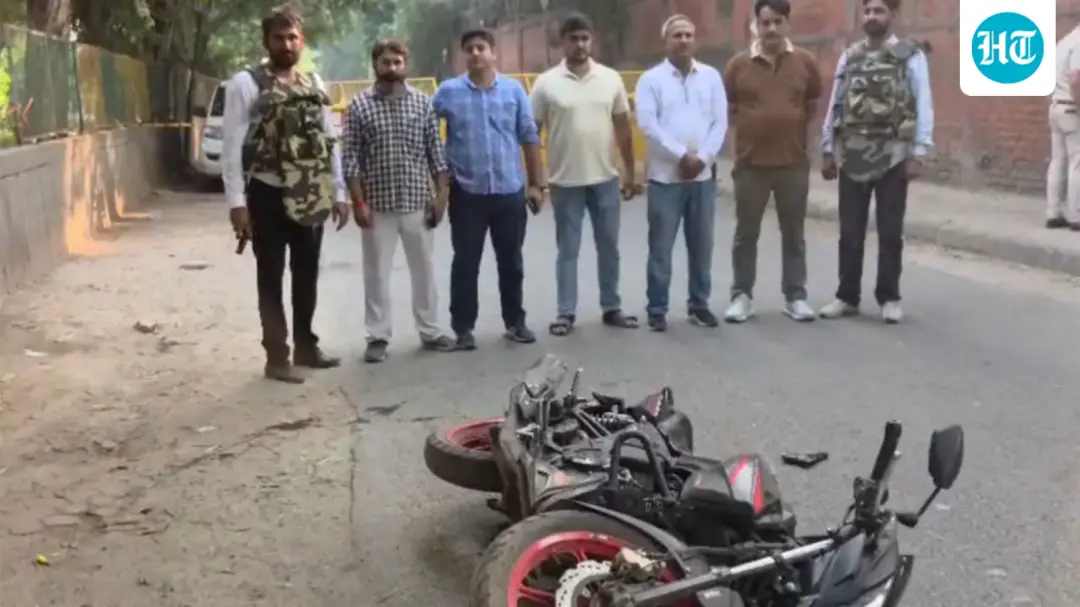
Congress questions Delhi CM over Kalkaji gangrape case
Congress leader Pawan Khera on Tuesday criticised Delhi Chief Minister Rekha Gupta over the alleged gang rape of a 17-year-old girl in a park near Kalkaji Temple, asking on X what the point of a woman Chief Minister was if women lacked safety. He called it the third rape of a minor in the capital in September. Police said all three accused, posing as police personnel, were arrested, including Hemant and Mukesh; one was held after an exchange of fire. A case was registered under the POCSO Act.
Source
Hindustan Times — India · read the original report ↗
Desk check · some claims need care
What the desk checked (5)
- A 17-year-old girl was allegedly gang-raped in a park near Kalkaji Temple on Monday evening by three men posing as police personnel. — Attributed to Delhi Police in the source; described throughout as alleged.
- All three accused have been arrested; two identified as Hemant and Mukesh, the third apprehended after a brief exchange of fire. — Attributed to police officials in the source; figure and names appear in source.
- A case was registered under the POCSO Act and other sections of law. — Attributed to police; specific sections not detailed in source.
- Congress leader Pawan Khera said this was the third rape of a minor in the national capital in September. — Direct quote from Khera's post on X; the count is not independently corroborated in the source.
- A PCR call was received around 8:45 pm after which a police team reached the spot. — Attributed to police; time appears in source.
Analysts’ view opinion
Politically this is being framed as a failure of governance, but legally it is now a POCSO case — meaning the victim's age (17) triggers a special court, statutory timelines and strict protections for her identity. The allegation that the accused posed as police officers and used threats with weapons could, if established, open the door to additional charges beyond the sexual offence. Police saying all three are in custody is a stage in the investigation, not a finding of guilt; that remains for the court.
- Registration under the POCSO Act routes the case to a designated special court and imposes a legal bar on disclosing the survivor's identity.
- Early steps such as the medical examination and collection of CCTV footage will be central to the evidentiary strength of any eventual trial.
- If the allegations of impersonating police officers and threatening with weapons hold up, they could support additional charges under other provisions of law.
- The apprehension of one accused after an exchange of fire ordinarily attracts a separate procedural review; the story provides no detail on that process.
- Arrest is not conviction — the presumption of innocence applies, and bail, chargesheet and trial stages all lie ahead.
What to watch — Watch whether the chargesheet is filed within the statutory period, how the POCSO special court proceeds, and how it treats any bail applications.
Nothing here establishes guilt in court, and the story does not specify the exact sections invoked, the accused's background, or the circumstances of the firing.
Deep dive
Research brief · 8 facts · 5 dates · exam-readyThe brief
Context
A 17-year-old girl was allegedly gang-raped in a park near the Kalkaji Temple in southeast Delhi on a Monday evening by three men who posed as police personnel after she had offered prayers at the temple. Delhi Police registered a case under the Protection of Children from Sexual Offences (POCSO) Act and arrested all three accused, one of them after a brief exchange of fire. The case triggered a political attack, with Congress leader Pawan Khera questioning Delhi Chief Minister Rekha Gupta, Delhi's fourth woman CM, on women's safety in the national capital.
Key facts
- The victim is a 17-year-old girl; the alleged gang rape occurred in a public park near Kalkaji Temple, southeast Delhi, after she offered prayers at the temple.
- Three men allegedly approached the minor and her friend posing as police personnel, threatened them, and took the minor to a secluded area in the park.
- A PCR call was received at around 8:45 pm on Monday, after which a police team reached the spot.
- A case was registered under relevant provisions of the POCSO Act and other sections of law.
- One accused was apprehended after a brief exchange of fire; two absconding accused, identified as Hemant and Mukesh, were arrested on Tuesday.
- All three accused named in the case have now been apprehended, police said.
- Congress leader Pawan Khera said on X it was the 'third rape of a minor in the National Capital in September'.
- The incident occurred near Kalkaji Temple and Aastha Kunj Park, an area with significant public movement.
Timeline
- Monday eveningMinor allegedly approached by three men posing as police personnel near Kalkaji Temple and sexually assaulted in a park.
- Monday, around 8:45 pmPCR call received; police team reaches the spot, minor taken for medical examination, investigation initiated.
- After the incidentPolice examine CCTV footage from the park and surrounding areas; one accused apprehended after a brief exchange of fire.
- TuesdayTwo absconding accused, Hemant and Mukesh, arrested, completing the arrest of all three accused.
- TuesdayCongress leader Pawan Khera criticises CM Rekha Gupta in a post on X over women's safety in Delhi.
Who has a stake
- The 17-year-old survivor and her friend — Safety, dignity, medical care and justice under POCSO; were threatened by men impersonating police.
- Delhi Police — Investigation credibility — PCR response, CCTV analysis, arrest of all three accused including one after an exchange of fire.
- Delhi Chief Minister Rekha Gupta — Political accountability for law and order and women's safety in the capital; described as Delhi's fourth woman CM.
- Congress leader Pawan Khera — Leading the opposition's attack, alleging repeated crimes against minors in September.
- Accused Hemant, Mukesh and a third man — Face prosecution under POCSO Act and other legal provisions; allegedly impersonated police personnel.
- Visitors to Kalkaji Temple and Aastha Kunj Park — Public safety in a high-footfall religious and recreational area.
Why it matters
The case highlights how impersonation of police personnel can be used to intimidate and isolate victims in crowded public spaces, raising questions about policing and surveillance around high-footfall temple and park areas. It has also become a political flashpoint over whether having a woman Chief Minister translates into safety for women and girls in Delhi.
UPSC angle
Prelims pointers
- POCSO Act = Protection of Children from Sexual Offences Act; invoked in cases of sexual offences against those under 18.
- Victim in the Kalkaji case is a 17-year-old, hence a minor under POCSO.
- Rekha Gupta is described in the source as Delhi's fourth woman Chief Minister.
- PCR call received at around 8:45 pm triggered the police response in the Kalkaji case.
- Incident site: park near Kalkaji Temple and Aastha Kunj Park, southeast Delhi.
- All three accused arrested; one apprehended after a brief exchange of fire.
Mains framing
The Kalkaji case illustrates three intersecting failures in urban safety: the vulnerability of minors in public spaces adjoining religious and recreational sites, the misuse of police identity by criminals to coerce victims, and the reliance on reactive rather than preventive policing. The sequence in the source — a PCR call at 8:45 pm, medical examination, CCTV scrutiny, an exchange of fire and arrest of all three accused — shows investigative responsiveness, but arrests after the fact do not address deterrence in a high-footfall area described as witnessing significant public movement. The invocation of the POCSO Act signals the special statutory protection children enjoy, including child-sensitive procedures, yet enforcement depends on ground-level presence, lighting, surveillance and rapid verification of anyone claiming to be a police officer. Politically, the opposition's framing — that Delhi has seen a third rape of a minor in September under its fourth woman Chief Minister — turns a crime into a test of governance and accountability. The way forward, on the evidence in the source, lies in visible patrolling and CCTV coverage in temple-park precincts, public awareness on verifying police identity, and time-bound POCSO trials so that swift arrests translate into swift convictions.
Key terms
- POCSO Act
- Protection of Children from Sexual Offences Act, the special law under which the Kalkaji case was registered as the victim is 17.
- PCR call
- Police Control Room emergency call; one received around 8:45 pm brought a police team to the spot.
- Absconding accused
- Accused who evade arrest; two such men, Hemant and Mukesh, were later arrested.
- Exchange of fire
- Gunfire between police and a suspect; one accused was apprehended after a brief exchange of fire.
- Aastha Kunj Park
- Park near Kalkaji Temple in southeast Delhi, in whose vicinity the alleged assault took place.
Practice questions
- Impersonation of police personnel as a tactic in crimes against women and children: what preventive and verification mechanisms can cities adopt? Discuss with reference to the Kalkaji case.
- Examine the adequacy of the POCSO Act framework in ensuring child-sensitive investigation and speedy justice in cases of sexual assault on minors.
- 'Law and order in the national capital is as much a political question as a policing one.' Critically analyse in the light of recent crimes against minors in Delhi.
Grounded only in the source report — figures and dates are the source's, not inferred.