
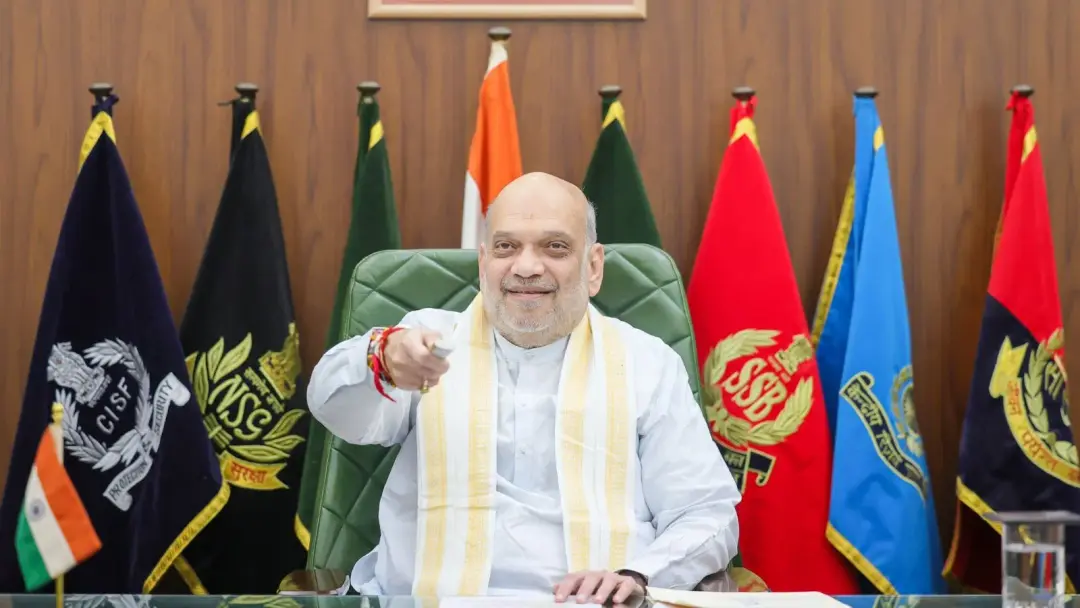
Shah sets December 31, 2029 deadline for drug-free India
Union Home Minister Amit Shah on Tuesday set a deadline of December 31, 2029, to uproot the drug trade from India, calling it the government's most difficult battle. Addressing the 3rd National Conference of Anti-Narcotics Task Force heads in Delhi, he said a drug-free country was the only option to build a Viksit Bharat by 2047. The two-day NCB conference drew ANTF heads from 36 states and Union Territories. Vision Document 2026-2029, framed after consulting over 35 departments, lists more than 100 targets; 46,780 of one lakh Nashamukt Mitras are registered.
Source
Indian Express — India · read the original report ↗
Desk check · compared with the source
What the desk checked (5)
- Amit Shah set a deadline of December 31, 2029 to uproot the drug trade in India. — Attributed to Amit Shah at the 3rd National ANTF Heads Conference; date appears in source.
- The two-day NCB-organised conference is attended by ANTF heads from 36 states and Union Territories. — Figure appears in source as reported detail; no separate attribution given.
- Vision Document 2026-2029 was prepared after consultations with more than 35 departments and has over 100 targets under five pillars. — Attributed to Shah in his address; figures appear in source.
- 46,780 Nashamukt Mitras have been registered against a target of one lakh. — Attributed to Shah; figure appears in source and is internally consistent.
- The Centre succeeded against terrorism in Kashmir, Northeast insurgency and Naxalism with state cooperation. — Statement of opinion attributed to Shah; not independently verifiable here.
Analysts’ view opinion
The December 31, 2029 deadline is as much a political calendar as an administrative one, landing in the period after the next general election cycle. By explicitly linking the anti-drugs push to claimed successes against terrorism in Kashmir, Northeast insurgency and Naxalism, Shah is reinforcing the BJP's preferred image as the party that takes on intractable problems. Tying it to Viksit Bharat 2047 converts enforcement into a youth-focused nation-building narrative — but since policing is a state subject, delivery depends on centre-state cooperation, which is also the plan's political soft spot.
- Convening ANTF heads from 36 states and UTs lets the Centre entrench itself as the coordinating authority in a domain constitutionally shared with states.
- The framing of 'meeting to mission, case to conviction' demands measurable outcomes, which raises accountability pressure on officials and eventually on the government itself.
- Drugs are a rare low-polarisation issue, so opposition-run states will find it hard to object publicly — though friction over central agencies and implementation is plausible.
- With 46,780 of a targeted one lakh Nashamukt Mitras registered, the outreach machinery is still short of the halfway mark, signalling how much scaling remains.
- The focus on entry points and inter-state corridors could see specific states labelled as sources or transit zones, opening the door to fresh blame politics.
What to watch — Watch whether progress on the Vision Document's 100-plus targets is reviewed publicly, and whether opposition-ruled states embrace the mission or read it as central agency overreach.
The story establishes a stated deadline and roadmap only — it does not establish funding, legal changes, formal state buy-in, or independent measures of results achieved so far.
Deep dive
Research brief · 8 facts · 5 dates · exam-readyThe brief
Context
Union Home Minister Amit Shah, addressing the 3rd National Conference of Anti-Narcotics Task Force (ANTF) heads in Delhi, set December 31, 2029 as the deadline to uproot the drug trade from India, describing the fight against narcotics as the government's most difficult battle. The two-day conference was organised by the Narcotics Control Bureau (NCB) and attended by ANTF heads from 36 states and Union Territories, government department representatives and other stakeholders. At the event Shah showcased a Vision Document 2026-2029, prepared after consultations with more than 35 departments, which lists more than 100 targets across enforcement, precursor and synthetic drug control, demand reduction and capacity building. He linked the anti-drug drive to the goal of a Viksit Bharat by 2047, arguing that India's youth cannot be allowed to be weakened by addiction.
Key facts
- Shah set December 31, 2029 as the deadline to uproot the drug trade from India.
- The 3rd National Conference of ANTF heads, held in Delhi, was a two-day event organised by the Narcotics Control Bureau (NCB).
- ANTF heads from 36 states and Union Territories attended, along with government department representatives and other stakeholders.
- Vision Document 2026-2029 was prepared after consultations with more than 35 departments and contains clear targets and timelines.
- More than 100 targets have been categorised under the roadmap's pillars: enforcement, intelligence and operations, precursor and synthetic drug control, demand and harm reduction, and capacity building and coordination.
- Of the target of one lakh Nashamukt Mitras, 46,780 have already been registered by various ministries and are operational.
- Shah said cartels should be attacked at three levels: entry points, inter-state distribution systems and local sales networks within districts.
- Districts are to be categorised into clusters as points of manufacture or entry, transportation corridors, or areas of consumption.
Timeline
- Past five yearsGovernment took a series of steps under PM Narendra Modi's leadership towards the goal of a drug-free India, per Shah.
- Tuesday (day of the story)Shah addresses the 3rd National Conference of ANTF heads in Delhi and sets the 2029 deadline; Vision Document 2026-2029 highlighted.
- 2026-2029Period covered by the Vision Document, with over 100 targets to be reviewed periodically.
- December 31, 2029Deadline set for uprooting the drug trade from India.
- 2047Target year for Viksit Bharat, to which the anti-drug campaign is linked.
Who has a stake
- Ministry of Home Affairs — Owns the anti-narcotics mission but, as Shah said, cannot achieve the objectives alone.
- Narcotics Control Bureau (NCB) — Organiser of the ANTF conference and central agency driving the Vision Document targets.
- State and UT Anti-Narcotics Task Forces (36 states and UTs) — Expected to move from seizures to dismantling networks and to form out-of-the-box officer teams.
- State governments — Their cooperation is central; Shah cited state cooperation in tackling terrorism, insurgency and Naxalism.
- Youth and future generations — Shah said the youth cannot be allowed to be weakened by addiction if Viksit Bharat 2047 is to be achieved.
- Nashamukt Mitras (volunteers) — 46,780 of a targeted one lakh registered; they form the community arm of demand reduction.
- Drug cartels and dealers — Targeted through financial investigations, digital trails and action against their funds.
Why it matters
The announcement converts a broad anti-drug slogan into a dated, target-bound mission with a written roadmap, shifting the yardstick of success from seizures and reporting to dismantled networks and convictions. It also frames narcotics as a development question, tying the health of India's youth to the Viksit Bharat 2047 goal. Since enforcement against drugs is largely executed by states, the deadline puts the onus on 36 state and UT task forces and on coordination across more than 35 departments.
UPSC angle
Prelims pointers
- Amit Shah set December 31, 2029 as the deadline for a drug-free India, at the 3rd National Conference of ANTF heads in Delhi.
- The ANTF conference was organised by the Narcotics Control Bureau (NCB) and attended by ANTF heads of 36 states and UTs.
- Vision Document 2026-2029: framed after consulting 35-plus departments; over 100 targets under enforcement, precursor/synthetic drug control, demand and harm reduction, capacity building.
- Nashamukt Mitra target is one lakh; 46,780 already registered and operational.
- Emerging challenges flagged: synthetic drugs, precursor chemical diversion, dark net, crypto and dead-drop delivery systems.
- Shah's formula: meeting to mission, reporting to result, seizure to dismantling of networks, case to conviction.
Mains framing
India's anti-narcotics effort has historically been measured by seizures, but the Home Minister's December 31, 2029 deadline and the Vision Document 2026-2029 attempt to reorient it towards outcomes — dismantling networks, tracing financial and digital trails, attacking dealers' funds, and converting cases into convictions. The stated causes of the challenge are structural: synthetic drugs, diversion of precursor chemicals, new communication technologies, the dark net, crypto, dead-drop delivery systems and international cartels, all of which outpace conventional policing. The implications are twofold: a public-health and demographic concern, since Shah linked youth addiction to the feasibility of Viksit Bharat by 2047, and a federal-coordination concern, since the Ministry of Home Affairs and NCB, by Shah's own admission, cannot deliver alone and depend on 36 state and UT task forces and over 35 departments. The way forward as articulated in the source lies in a three-tier attack on cartels at entry points, inter-state distribution and district-level sales networks; clustering districts by manufacture/entry, transit corridor and consumption profiles; building officer teams capable of out-of-the-box responses; periodic review of the roadmap; and scaling community participation from 46,780 to one lakh Nashamukt Mitras so that supply suppression is matched by demand and harm reduction.
Key terms
- Anti-Narcotics Task Force (ANTF)
- State/UT-level specialised force against drugs; heads of 36 states and UTs attended the 3rd National Conference in Delhi.
- Narcotics Control Bureau (NCB)
- Central agency that organised the two-day national conference of ANTF heads.
- Vision Document 2026-2029
- Anti-drug roadmap framed after consulting 35-plus departments, with over 100 targets and timelines; called 'like the Gita' for the campaign by Shah.
- Nashamukt Mitra
- Registered anti-drug volunteers; 46,780 registered by ministries against a target of one lakh.
- Precursor chemicals
- Chemicals diverted to manufacture synthetic drugs; their control is one pillar of the roadmap.
- Dead-drop delivery
- Method of drug delivery without direct contact between supplier and buyer, flagged by Shah as an emerging challenge.
Practice questions
- Critically examine the shift from a 'seizure-centric' to a 'network-dismantling' approach in India's anti-narcotics strategy, with reference to the Vision Document 2026-2029.
- Emerging technologies such as the dark net, crypto and dead-drop delivery have changed the nature of the drug trade. Discuss the institutional capacity India needs to respond.
- "Drug control is as much a federal coordination challenge as a policing one." Discuss in the light of the December 31, 2029 drug-free India deadline.
Grounded only in the source report — figures and dates are the source's, not inferred.