
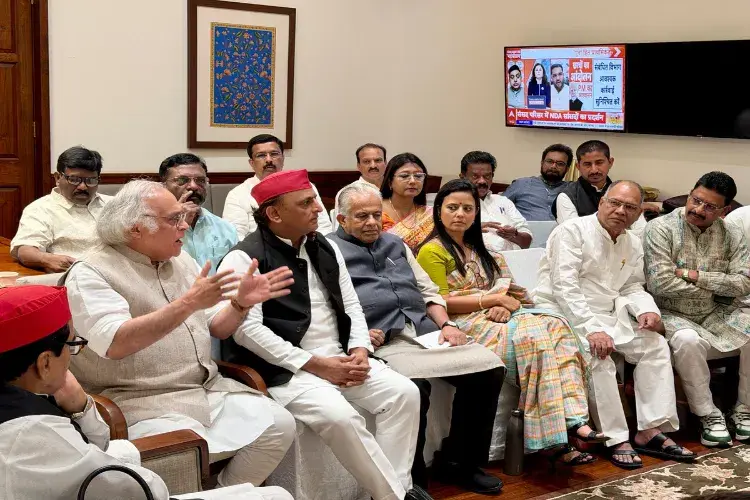
INDIA bloc plans October 2-8 protests, seeks CEC's resignation
The INDIA bloc has demanded the immediate resignation of Chief Election Commissioner Gyanesh Kumar. After a meeting at the Constitution Club in New Delhi, Congress president Mallikarjun Kharge announced nationwide protests from October 2 to 8, including a march to the Election Commission on October 6 and a meeting with President Droupadi Murmu the following week. Citing concerns over EVMs and the Special Intensive Revision of voter rolls, the bloc sought restoration of earlier rolls and ballot paper voting. The BJP called the stance frustration over electoral defeat.
Source
Politics · read the original report ↗
Desk check · some claims need care
What the desk checked (5)
- INDIA bloc demands immediate resignation of Chief Election Commissioner Gyanesh Kumar — Attributed in source to a bloc meeting at the Constitution Club, New Delhi; no document cited.
- Protests planned nationwide from October 2 to 8, with a march to the Election Commission on October 6 — Attributed to Congress president Mallikarjun Kharge; dates appear in source.
- Opposition leaders will meet President Droupadi Murmu the following week — Attributed to Kharge; exact date not specified in source.
- Elections were rigged and electoral integrity is at risk — Allegation attributed to Congress general secretary KC Venugopal; no evidence presented in source.
- Five states are preparing for elections in 2027 — Stated in source without attribution or naming of the states.
Analysts’ view opinion
By making the CEC's resignation the single focal demand, the INDIA bloc is trying to bundle its scattered grievances into one shared agenda — the political gain lies in converting a conversation about electoral defeats into one about "saving democracy". The October 2-8 nationwide protests, the march to the Election Commission and the planned meeting with the President give the bloc a joint street-level programme outside Parliament. The BJP's counter-strategy is equally clear: brand it as post-defeat frustration and pivot the debate from electoral process to the opposition's own internal contradictions.
- Focusing on one institutional figure — the CEC — is the easiest way to manufacture consensus among parties with divergent regional interests.
- The demands for ballot paper voting and restoration of older electoral rolls are unlikely to be met in practice; their value is largely symbolic and mobilisational.
- The BJP's rebuttal is straightforward — pointing to Congress wins in several states raises the awkward question of why EVMs are acceptable in victory but not in defeat.
- Parties that fight each other at state level marching together nationally remains the bloc's structural weakness, and the Bihar BJP chief's remarks are aimed precisely at those cracks.
- With five states heading to polls in 2027, this agitation may serve long-term narrative-building for the opposition even if it yields no immediate concession.
What to watch — Watch how far parties outside the bloc actually turn up on the ground, and the size of the October 6 march — that will decide whether this becomes a movement or a one-week news cycle.
The rigging allegations here are opposition assertions only; the story establishes neither proof of any claim nor any response from the CEC or the Election Commission.
Deep dive
Research brief · 8 facts · 5 dates · exam-readyThe brief
Context
The INDIA bloc, the opposition alliance led by the Congress, has demanded the immediate resignation of Chief Election Commissioner Gyanesh Kumar, alleging that the integrity of the electoral process is compromised. The demand followed a meeting of opposition leaders at the Constitution Club in New Delhi, where concerns were raised over electronic voting machines (EVMs) and the Special Intensive Revision (SIR) of voter rolls. Congress president Mallikarjun Kharge announced nationwide protests from October 2 to 8, a march to the Election Commission on October 6 and a meeting with President Droupadi Murmu the following week. The BJP has dismissed the campaign as frustration over electoral defeat.
Key facts
- The INDIA bloc has demanded the immediate resignation of Chief Election Commissioner Gyanesh Kumar.
- The decision followed a meeting of opposition leaders at the Constitution Club in New Delhi.
- Congress president Mallikarjun Kharge announced nationwide protests from October 2 to October 8.
- Opposition members plan to march to the Election Commission on October 6 and meet President Droupadi Murmu the following week.
- The bloc's joint statement demands reinstatement of previous electoral rolls and a return to ballot paper voting.
- Congress general secretary KC Venugopal claimed the integrity of the electoral process is at risk.
- Union Agriculture Minister Shivraj Singh Chouhan said the opposition's claims of manipulated elections reflect reaction to losses, noting Congress had won elections in several states.
- The protests come as five states prepare for elections in 2027, per the source.
Timeline
- Before the announcement (date not stated in the source)INDIA bloc leaders meet at the Constitution Club, New Delhi, and resolve to seek CEC Gyanesh Kumar's resignation.
- October 2 to October 8Nationwide protests announced by Mallikarjun Kharge across the country.
- October 6Opposition march to the Election Commission.
- Week after October 8 (exact date not stated in the source)Opposition leaders to meet President Droupadi Murmu on institutional integrity.
- 2027Five states are due to go to elections, per the source.
Who has a stake
- Chief Election Commissioner Gyanesh Kumar — Faces the opposition's demand for immediate resignation over alleged lapses in electoral management.
- Election Commission of India — Its credibility, EVM use and Special Intensive Revision of rolls are the focus of the protest march on October 6.
- INDIA bloc / Congress (Kharge, KC Venugopal) — Seeks to consolidate voter trust and press demands for old electoral rolls and ballot paper voting.
- BJP (Shivraj Singh Chouhan, Sanjay Sarogi) — Rebutting allegations as post-defeat frustration and pointing to divisions within the opposition.
- President Droupadi Murmu — To be approached by the opposition with its concerns over institutional integrity.
- Mamata Banerjee, former West Bengal Chief Minister — Pledges to continue protests until the CEC resigns and seeks support from students and journalists.
- Voters and parties outside the INDIA bloc — Affected by roll revision and voting method; some non-alliance parties have backed the movement against the CEC.
Why it matters
A coordinated opposition campaign against the head of the Election Commission raises the stakes on the credibility of India's electoral machinery, from EVMs to the revision of voter rolls. With five states heading to polls in 2027, contested trust in the referee of elections can shape both campaign narratives and public confidence in results. The clash also tests whether the INDIA bloc can hold together, a question the BJP has publicly raised.
UPSC angle
Prelims pointers
- Gyanesh Kumar is the Chief Election Commissioner whose resignation the INDIA bloc has demanded.
- INDIA bloc protests announced for October 2-8; march to the Election Commission on October 6.
- Special Intensive Revision (SIR) refers to the revision of voter rolls at the centre of the dispute.
- The opposition meeting was held at the Constitution Club, New Delhi; Mallikarjun Kharge made the announcement.
- Demands include restoring earlier electoral rolls and reverting to ballot paper voting.
- Five states are slated to hold elections in 2027, per the source.
Mains framing
The INDIA bloc's demand for the Chief Election Commissioner's resignation converts a technical dispute over electoral administration into a question of institutional trust. The stated triggers are two: doubts over electronic voting machines and the Special Intensive Revision of voter rolls, which the opposition wants reversed in favour of earlier rolls and ballot paper voting; the demands are being pressed through street protests from October 2 to 8, a march to the Election Commission on October 6 and a planned representation to the President. The BJP's counter, voiced by Shivraj Singh Chouhan, is that the allegations are post-defeat rationalisation, since the Congress itself has won elections in several states, while Bihar BJP president Sanjay Sarogi points to widening opposition divisions. The implications cut both ways: unsubstantiated attacks can erode faith in a constitutional body that depends on perceived neutrality, while unaddressed grievances about roll revision and machine-based voting can leave losers permanently disputing outcomes. A grounded way forward lies in transparent, documented handling of roll revision objections and an institutional mechanism for hearing party complaints, so that contests over process are settled in the Commission's procedures and courts rather than only on the street, especially before the five state elections due in 2027.
Key terms
- INDIA bloc
- The opposition alliance, including the Congress, that jointly demanded the CEC's resignation and called the October 2-8 protests.
- Chief Election Commissioner (CEC)
- Head of the Election Commission of India; currently Gyanesh Kumar, whose resignation the opposition seeks.
- Special Intensive Revision (SIR)
- The revision exercise of voter rolls that the opposition objects to, demanding restoration of previous rolls.
- EVM (Electronic Voting Machine)
- Machine used for voting; the opposition wants a return to ballot paper voting citing EVM-related concerns.
- Constitution Club, New Delhi
- Venue of the opposition meeting where the resignation demand and protest plan were finalised.
Practice questions
- Critically examine how contestation over electoral rolls and voting technology affects public trust in the Election Commission of India.
- The opposition's protest calendar culminates in a representation to the President. Discuss the constitutional avenues available to political parties that dispute the conduct of the Election Commission.
- Do coordinated street protests strengthen or weaken the case for electoral reform? Argue with reference to the INDIA bloc's October 2-8 campaign.
Grounded only in the source report — figures and dates are the source's, not inferred.