
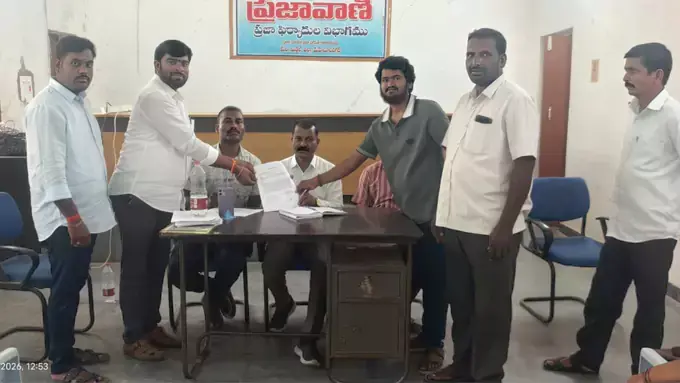
BJYM demands Indiramma houses for all eligible families
State BJYM leader Tirupathi demanded that Indiramma houses be allotted to all eligible poor families in rural areas. Along with mandal leaders, he submitted a petition to officials at the Prajavani grievance programme in Midjil on Monday. He alleged that families left homeless after rains damaged their houses were promised pucca houses but have not received them, and that ineligible persons were being allotted houses for political gain. He sought a comprehensive inquiry and transparent beneficiary selection through gram sabhas.
Source
Mahbubnagar — స్థానికం · read the original report ↗
Desk check · some claims need care
What the desk checked (5)
- State BJYM leader Tirupathi demanded Indiramma houses for all eligible poor rural families — Attributed in source to the named leader; petition submitted at Prajavani on Monday.
- Officials promised pucca houses to families rendered homeless when rains collapsed their homes but have not delivered — Allegation attributed to the leader; no official response or figures given in source.
- Ineligible persons are being allotted houses for political gain while eligible hut-dwellers are ignored — Unverified allegation attributed to the leader; no documentary evidence cited.
- Congress leaders are using central funds meant for the poor for personal gain — Political allegation with no supporting data or response from those named in the source.
- Demand for a comprehensive inquiry and transparent beneficiary selection through gram sabhas — Stated demand, attributed; no official action reported in source.
Analysts’ view opinion
This reads like a routine mandal-level petition, but its political grammar is clear: the BJP's youth wing is turning beneficiary selection under the Indiramma housing scheme into a "transparency" issue, and through it questioning the Congress government's flagship welfare delivery. Grievances over village-level beneficiary lists are an almost inevitable by-product of large welfare schemes, and opposition parties routinely convert them into a direct, door-to-door line of attack. The sharpest manoeuvre here is the framing that central funds are being used for local political gain — an attempt to shift credit upward to the Centre and blame downward to the state.
- Using the official Prajavani grievance platform is a low-cost, high-visibility tactic that converts a government redressal forum into an opposition stage.
- By foregrounding families who lost homes in the rains and those still in thatched huts, the demand targets an emotionally and electorally potent constituency.
- Alleging that ineligible people got houses attacks implementation credibility without opposing the scheme itself — a deliberately safe line of criticism.
- The demand for selection through gram sabhas is politically hard to refuse, which puts officials and the ruling party on the defensive.
- Youth wing leaders fronting the effort suggests an organisational aim too: activating local cadre ahead of grassroots-level political contests.
What to watch — Watch whether officials announce any review of the selection lists, and whether Congress leaders push back publicly against the allegations.
The story does not establish that ineligible beneficiaries were in fact selected or that funds were misused — these are one opposition leader's allegations, with no government response or official data included.
Deep dive
Research brief · 8 facts · 3 dates · exam-readyThe brief
Context
Indiramma Illu is the Telangana government's rural housing scheme under which pucca houses are sanctioned to poor beneficiaries. In Midjil mandal of the erstwhile Mahbubnagar region, the state Bharatiya Janata Yuva Morcha (BJYM) leader Tirupathi, along with BJP and Yuva Morcha mandal leaders, used the weekly Prajavani grievance redressal platform to submit a petition demanding houses for all eligible poor families. The petition alleges that families rendered homeless when rains collapsed their houses are still waiting, while ineligible persons are being allotted houses for political advantage.
Key facts
- State BJYM leader Tirupathi demanded on Monday that Indiramma houses be given to all eligible poor families in rural areas.
- The petition was submitted to officials at the Prajavani grievance programme in Midjil, along with mandal leaders.
- He said officials had promised pucca houses to families left homeless after their houses collapsed in rains, but the houses have not been given till date.
- He alleged that poor people living in thatched huts across the mandal were being set aside and houses distributed to ineligible persons for political gain.
- He charged that Congress leaders were using funds sent by the Union government for the poor for their own selfish ends.
- He demanded that higher officials immediately hold a comprehensive inquiry into the selection of houses.
- He demanded transparent selection of beneficiaries through gram sabhas.
- BJP mandal leaders Balaraju Goud and Yuva Morcha leaders Aravind Goud, Naveen and Sai took part in the programme.
Timeline
- Earlier (date not stated in the source)Houses of some families in Midjil mandal collapsed in rains; officials promised them pucca houses, which were not delivered.
- MondayBJYM leader Tirupathi and mandal leaders submitted a petition at the Prajavani programme in Midjil demanding houses for all eligible families.
- Published 28 September 2026The report on the demand appeared in the Mahbubnagar edition.
Who has a stake
- Eligible poor families in Midjil mandal — Await allotment of Indiramma pucca houses; some are homeless after rain damage and living in thatched huts.
- State BJYM leader Tirupathi and BJP/Yuva Morcha mandal leaders — Petitioners demanding inquiry into beneficiary selection and transparent allotment.
- Revenue and local officials at Prajavani — Received the petition; accused of not honouring the promise of pucca houses and of faulty selection.
- Congress leaders (as alleged) — Accused of using central funds meant for the poor for selfish and political ends.
- Gram sabhas — Sought as the transparent forum for selecting housing beneficiaries.
Why it matters
Rural housing schemes are among the most politically contested welfare deliveries, and allegations of ineligible beneficiaries strike at the credibility of the selection process. The demand for gram sabha-based selection and a higher-level inquiry raises the larger question of transparency and grievance redressal in welfare targeting. For the homeless families cited, the gap between an official promise and actual allotment is an immediate livelihood and safety issue.
UPSC angle
Prelims pointers
- Indiramma Illu: Telangana government housing scheme under which pucca houses are allotted to poor beneficiaries.
- Prajavani: government grievance redressal programme where citizens submit petitions to officials.
- BJYM (Bharatiya Janata Yuva Morcha) is the youth wing of the BJP.
- Midjil is a mandal in the Mahbubnagar region of Telangana.
- Gram sabha is the demanded forum for transparent selection of housing beneficiaries.
- Report date: 28 September 2026; petition submitted on a Monday.
Mains framing
The Midjil petition illustrates a recurring problem in welfare delivery: a scheme with finite house sanctions, a large pool of claimants, and a selection process whose criteria and records are not visible to those excluded. The BJYM's specific charges are that rain-affected homeless families promised pucca houses were not given them, that poor households in thatched huts were bypassed, and that allotments were made to ineligible persons for political advantage, with central funds for the poor allegedly diverted by ruling-party leaders; the source records these as allegations, not findings. The remedies sought are procedural rather than financial: a comprehensive inquiry by higher officials into the selection list and beneficiary identification through gram sabhas. That points to the wider way forward of publishing eligibility criteria and waiting lists, verifying claims of rain damage on record, using the gram sabha's social audit function to validate names, and treating grievance platforms like Prajavani as a traceable, time-bound channel rather than a one-off petition counter. Beyond this mandal, the episode is a reminder that in welfare targeting perceived fairness is as important as coverage.
Key terms
- Indiramma Illu
- Telangana housing scheme under which pucca houses are sanctioned to eligible poor families.
- Prajavani
- Weekly grievance redressal programme where citizens hand petitions directly to government officials.
- BJYM
- Bharatiya Janata Yuva Morcha, the youth wing of the Bharatiya Janata Party.
- Gram sabha
- Assembly of all village voters; sought here as the transparent forum for selecting housing beneficiaries.
- Pucca house
- A permanent house with durable walls and roof, as against a thatched hut or temporary shelter.
- Mandal
- Administrative sub-district unit in Telangana; Midjil is the mandal in question.
Practice questions
- Examine how gram sabhas can strengthen transparency in the selection of beneficiaries for rural housing schemes. Illustrate with the demands raised in the Midjil case.
- Allegations of ineligible beneficiaries undermine public trust in welfare schemes. Discuss the institutional safeguards available to prevent such exclusion errors.
- Discuss the role of grievance redressal platforms such as Prajavani in citizen-government interaction, and suggest measures to make their outcomes accountable.
Grounded only in the source report — figures and dates are the source's, not inferred.