
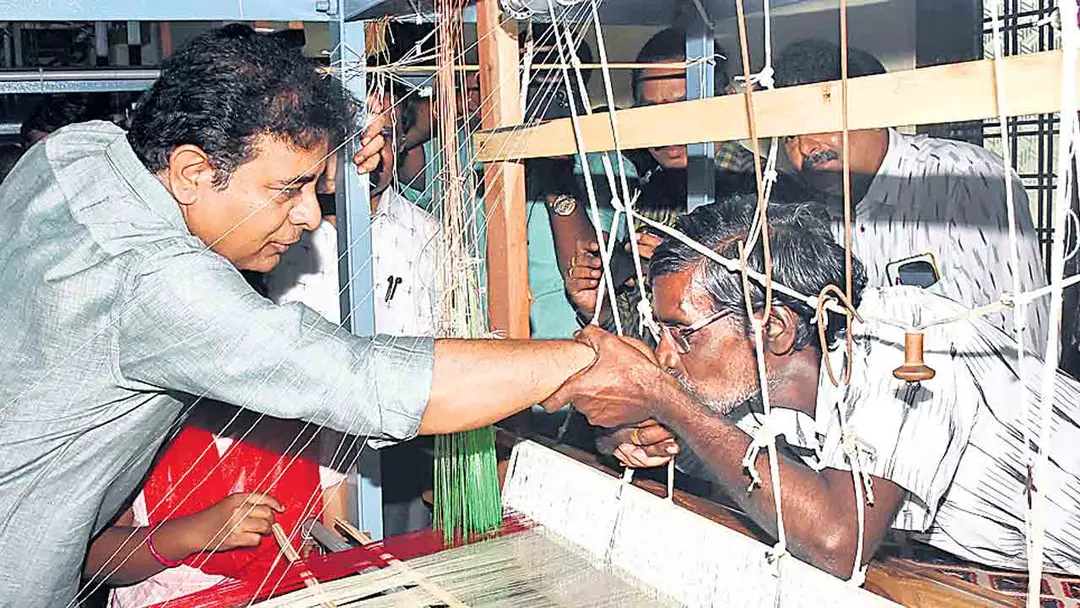
KTR asks CM when Rs 60 crore weaver dues will be paid
BRS working president and Sircilla MLA KTR wrote an open letter on Saturday to Chief Minister Revanth Reddy ahead of his Sircilla visit. He said Rs 60 crore of Rs 300 crore in dues to weavers remains unpaid and that the 10 percent yarn subsidy has been stopped. He alleged work for weavers fell below six months after the Bathukamma sarees scheme was halted in 2024. He demanded revival of the Rs 5 lakh Nethanna Bima, opening of the weaving park, a yarn depot in Sircilla and a white paper.
Source
Sircilla — స్థానికం · read the original report ↗
Desk check · some claims need care
What the desk checked (5)
- Rs 60 crore of Rs 300 crore in dues to Sircilla weavers remains unpaid. — Attributed to KTR; figures appear in source, no official confirmation included.
- The Congress government stopped the Bathukamma sarees scheme in 2024 and later relaunched it under another name limited to women's groups. — Attributed to KTR; no government response or documentary source in the text.
- The 10% yarn subsidy and the Rs 5 lakh Nethanna Bima scheme have been halted without premium payment. — Claim made by KTR; unverified in source, no insurer or department confirmation.
- BRS built a weaving park on 88 acres for Rs 387.61 crore with 50 sheds and supplied 4,416 powerlooms to 1,104 workers. — Detailed figures stated by KTR about his own party's tenure; internally consistent but unaudited in source.
- KTR wrote the open letter on Saturday ahead of CM Revanth Reddy's visit to Sircilla. — Stated in source datelined Hyderabad, September 27; sourced to Namaste Telangana.
Analysts’ view opinion
Releasing a list of demands as an open letter just before the Chief Minister lands is a classic bit of political timing by KTR — he sets the agenda before the government's own event can. Because Sircilla is his own constituency, foregrounding weavers' dues, yarn subsidy and the weavers' insurance scheme is also an attempt to reassert his personal bond with local voters. By repeatedly demanding "announce clear dates", he has engineered a position where he gains politically whether the government responds or ignores him.
- Writing ahead of the CM's visit lets KTR capture the news agenda of the trip rather than merely react to it.
- The long recital of BRS-era spending and projects is designed to keep ownership of the 'development record' even after losing office.
- Widening the letter beyond weavers to farmers, students and BC groups such as Mudiraj turns a constituency grievance into broader social-coalition politics.
- If dues are released he can claim credit for the pressure; if not, the neglect charge hardens — a two-way-win framing.
- The Congress side is largely absent here beyond a reference to the government saying old dues were cleared, so this remains a one-sided political argument for now.
What to watch — Watch whether the Chief Minister uses the Sircilla visit to put firm timelines on the pending dues, yarn subsidy and weaving park, or chooses to bypass the criticism altogether.
Every figure and allegation here — the Rs 60 crore in dues, the stalled schemes — comes from KTR; the story carries no official government rebuttal or independent verification.
Deep dive
Research brief · 8 facts · 4 dates · exam-readyThe brief
Context
Sircilla (Rajanna Sircilla district, Telangana) is a powerloom textile town whose weavers depended heavily on government fabric orders, notably the BRS-era Bathukamma sarees scheme. Ahead of Chief Minister A. Revanth Reddy's visit to Sircilla, BRS working president and local MLA K.T. Rama Rao (KTR) wrote an open letter on Saturday listing pending dues and stalled schemes for weavers, farmers, students and other groups. The letter contrasts BRS-period spending and schemes in the constituency with what KTR alleges is Congress government neglect, and demands a white paper and firm dates for implementation.
Key facts
- KTR says of Rs 300 crore in weaver dues, Rs 60 crore remains unpaid, and the 10 percent yarn subsidy has been stopped by the Revanth Reddy government.
- He alleges the Congress government halted the Bathukamma sarees scheme in 2024; after weaver protests it was restarted under another name but limited only to women's self-help groups.
- Work available to weavers, earlier year-round, has fallen to less than six months, per KTR.
- He says fabric production needs yarn worth Rs 300 crore but only Rs 50 crore was allocated, and the yarn depot was set up in Vemulawada instead of Sircilla.
- The Rs 5 lakh Nethanna Bima (weavers' insurance), modelled on Rythu Bima, was stopped without premium payment, KTR alleges.
- Weaving park: 88 acres, Rs 387.61 crore, 50 sheds, and 4,416 modern powerlooms given to 1,104 workers (four each) in phase one; sheds now allegedly used as paddy and electrical goods godowns.
- Apparel park at Peddur: 60 acres, Rs 174 crore, employment for 2,500 women via Gokuldas, Texport; scope for 8,000 more jobs claimed.
- BRS-era claims: Rs 3,313 crore worth of PP and TESO orders for 100 crore metres of cloth; Sircilla textile turnover up from Rs 250 crore to nearly Rs 1,000 crore a year; weaver wages Rs 15,000-20,000 a month.
Timeline
- 2014 to December 2023KTR says only 1,272 acres of land were distributed in Rajanna Sircilla district, of which 204 acres in Sircilla constituency.
- 2014 to 2023About Rs 1,564 crore of development works taken up in Sircilla town under BRS, per KTR.
- 2024Congress government halted the Bathukamma sarees scheme, leaving weavers without work, KTR alleges; scheme later revived under another name for women's groups only.
- Saturday (September 27, dateline Hyderabad)KTR writes an open letter to CM Revanth Reddy ahead of the CM's Sircilla visit, demanding dates and a white paper.
Who has a stake
- Sircilla powerloom weavers (nethannas) — Rs 60 crore pending dues, 10 percent yarn subsidy, Rs 5 lakh Nethanna Bima, weaving park sheds and year-round work.
- CM A. Revanth Reddy / Congress government — Asked to answer publicly during the Sircilla visit on dues, subsidies, funds and manifesto promises.
- KTR, BRS working president and Sircilla MLA — Defending his constituency record and pressing the government through an open letter.
- Farmers of Sircilla constituency — Rythu Bandhu dues and the promised Rs 15,000 per acre, Rs 2 lakh loan waiver, Rythu Bima revival, farm mechanisation funds.
- Students and youth — Rs 400 crore JNTU engineering college funds, fee reimbursement dues, Mana Ooru-Mana Badi pending bills, new industries for jobs.
- BC communities (Padmashali, Gouds, Mudiraj, Yadavs) — Corporation chairmanship for a Sircilla Padmashali, Padmashali welfare building funds, Mudiraj shift from BC-D to BC-A.
Why it matters
Sircilla's powerloom economy runs largely on government fabric orders, so the halting of schemes like Bathukamma sarees and the yarn subsidy directly determines how many months a year weavers earn. The dispute also illustrates how welfare continuity across a change of government becomes the central axis of state politics, with demands for a white paper and firm implementation dates.
UPSC angle
Prelims pointers
- Bathukamma sarees scheme: BRS-era Telangana scheme supplying sarees, giving Sircilla powerloom weavers continuous work; halted in 2024 per KTR.
- Nethanna Bima: Rs 5 lakh insurance for weavers, modelled on Rythu Bima.
- Sircilla weaving park: 88 acres, Rs 387.61 crore, 4,416 powerlooms for 1,104 workers in phase one.
- Kaleshwaram Package 9: Mid Manair to Upper Manair link works worth Rs 1,604 crore; Malapeta reservoir of 3 TMC completed at Rs 533 crore.
- Mission Kakatiya: Rs 80 crore for tank development and tank bunds in the constituency, per KTR.
- Rythu Bima in Sircilla constituency: Rs 5 lakh each to 806 farm families, totalling Rs 40.30 crore under BRS.
Mains framing
The Sircilla row shows how a single-industry town's welfare architecture can be destabilised by discontinuity in state procurement and subsidy policy. KTR's letter alleges a chain of causes: withdrawal of the Bathukamma sarees scheme in 2024, diversion of government cloth orders such as school uniforms, KCR kits and festival gift packs to a large industry, stoppage of the 10 percent yarn subsidy, inadequate yarn allocation (Rs 50 crore against a stated Rs 300 crore requirement), a yarn depot located at Vemulawada rather than Sircilla, and non-payment of Rs 60 crore of Rs 300 crore in dues. The implications are shrinking work from year-round to under six months, idle assets like the Rs 387.61 crore weaving park whose sheds are allegedly used as godowns, and the risk of return to distress migration and suicides that KTR says had declined. The demanded way forward in the letter is procedural and time-bound: clear dates for clearing dues and releasing the yarn subsidy, revival of Nethanna Bima with premium payment, a yarn depot in Sircilla, allotment of weaving park sheds to workers, restoration of the separate powerloom and handloom development corporations, completion of sanctioned industries and education projects, and a government white paper on Sircilla's development, alongside disclosure of survey-level details of the 8,000 and 2,400 acres cited in the land recovery claim.
Key terms
- Bathukamma sarees scheme
- Telangana scheme of distributing sarees produced by Sircilla powerlooms, giving weavers steady government orders.
- Yarn subsidy (10 percent)
- State subsidy on yarn cost for weavers; KTR says the Revanth Reddy government has stopped releasing it.
- Nethanna Bima
- Rs 5 lakh life insurance cover for weavers introduced by BRS on the lines of Rythu Bima.
- Weaving park
- 88-acre, Rs 387.61 crore Sircilla project with 50 sheds and 4,416 modern powerlooms meant to turn weavers into owners.
- TESO / PP orders
- Government cloth procurement routes through which BRS says it gave orders worth Rs 3,313 crore for 100 crore metres of fabric.
- SESS (Sircilla cooperative power distribution society)
- Local cooperative electricity distribution body whose cancellation KTR calls rule-violating and wants explained.
Practice questions
- Government procurement has been the backbone of Sircilla's powerloom economy. Examine how discontinuity in such procurement-linked welfare schemes affects artisan livelihoods, using the weaver dues dispute in Telangana.
- Discuss the utility of a government white paper and time-bound implementation dates as instruments of legislative accountability, with reference to demands made by an opposition MLA in Telangana.
- Evaluate the design of insurance schemes for unorganised workers such as Nethanna Bima and Rythu Bima, and the consequences of lapses in premium payment by state governments.
Grounded only in the source report — figures and dates are the source's, not inferred.