
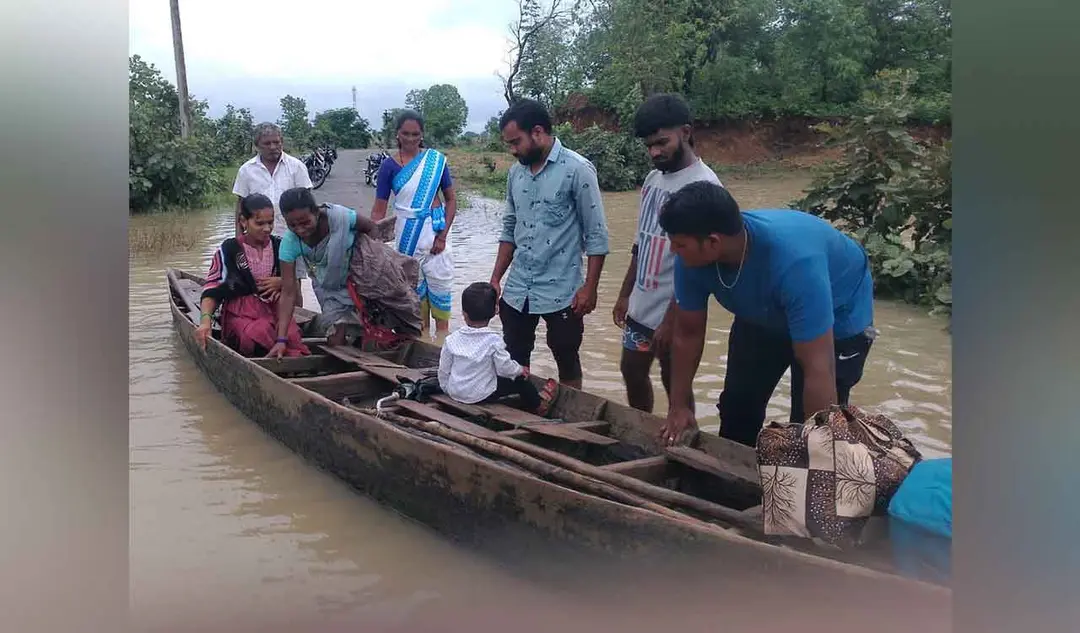
128 pregnant women in 151 cut-off Telangana villages face monsoon risk
Health officials in Kumram Bheem Asifabad district have identified 151 villages likely to be cut off by overflowing streams during the monsoon, home to 128 pregnant women due to deliver between June and August. In Gundi village of Asifabad mandal, four women due in August would have to travel 25 km to the district headquarters hospital if the stream floods; a temporary bridge was recently washed away. Medical and Health Department data show nearly 100 pregnant women died during childbirth in the erstwhile Adilabad district between 2018 and 2024. Officials said committees are monitoring the women and relocation to safer places is planned if required.
Source
Adilabad — health · read the original report ↗
Desk check · compared with the source
What the desk checked (5)
- 128 pregnant women in 151 remote villages of Kumram Bheem Asifabad may be cut off during the monsoon. — Figures attributed to health officials who identified the villages; consistent within the source.
- Gundi village in Asifabad mandal has four pregnant women due in August and a washed-away temporary bridge, leaving a 25 km trip to the district headquarters hospital. — Specific detail appears in source without named official attribution.
- Nearly 100 pregnant women died during childbirth in the erstwhile Adilabad district between 2018 and 2024. — Attributed to Medical and Health Department data in the source.
- Farzana Begum (28) of Yelkapalli and Bodduna Saritha (32) of Sulugupalli died while being taken to hospital. — Named past cases cited in source; Saritha's death dated 2018, Begum's given only as 'a few years ago'.
- Committees are monitoring the women and relocation to safer places is planned if needed. — Attributed to Health and Medical Department officials.
Analysts’ view opinion
This is less a health-service story than an infrastructure-policy one. Identifying 151 cut-off villages and the 128 women due to deliver between June and August is sound pre-emptive administration, but the remedy on offer is the same temporary relocation model repeated every monsoon. When the department's own data attributes nearly 100 maternal deaths in the erstwhile Adilabad district between 2018 and 2024 largely to missing roads and bridges, the gap is not in diagnosis but in the capital-works response.
- The temporary bridge at Gundi being washed away illustrates the cost-and-failure cycle of relying on stopgap structures instead of permanent ones.
- A 25 km journey to the district headquarters hospital once a stream floods runs directly against the 'golden hour' logic central to maternal care.
- Relocating pregnant women to safer places echoes older birth-waiting-home style approaches — it can save lives, but places the burden of displacement on the women themselves.
- Constituting committees and stocking medicines are process-level steps; the story does not spell out the implementation hurdles of transport, lodging, family consent or lost wages.
- The health department can only do so much alone — without convergence with roads, panchayat raj and tribal welfare agencies, this problem returns annually.
What to watch — Watch whether officials publish how many of the 128 women were actually relocated and delivered in institutions this season, and whether the washed-away bridge is replaced with a funded permanent structure.
The story documents the risk and past deaths but does not establish how many relocations will occur this year, what budget or committee structure backs the plan, or any timeline for bridge construction.
Deep dive
Research brief · 8 facts · 5 dates · exam-readyThe brief
Context
Kumram Bheem Asifabad, a tribal district in Telangana carved out of the erstwhile Adilabad district, has hundreds of interior hamlets that get cut off every monsoon when streams and rivulets overflow and roads and temporary bridges give way. Health officials there have mapped 151 such villages ahead of the 2025 monsoon and found 128 pregnant women in them whose deliveries fall between June and August. With primary health centres and the district headquarters hospital often unreachable, transportation delays have historically turned into maternal deaths. The district administration says monitoring committees have been formed and women may be shifted to safer locations before they go into labour.
Key facts
- Health officials identified 151 villages in Kumram Bheem Asifabad district likely to be cut off by overflowing streams and rivulets during the monsoon.
- These 151 villages are home to 128 pregnant women expected to deliver between June and August.
- Gundi village in Asifabad mandal has four pregnant women with expected delivery dates in August.
- If the Gundi stream floods, these women would have to travel 25 km to reach the district headquarters hospital.
- A temporary bridge across the stream near Gundi was recently washed away, worsening villagers' access problems.
- Between 2018 and 2024, nearly 100 pregnant women died during childbirth in the erstwhile Adilabad district, as per Medical and Health Department data.
- Most of these deaths were attributed to poor road connectivity and absence of bridges across rivulets, preventing timely hospital access.
- Bodduna Saritha (32), a full-term pregnant woman from Sulugupalli village, died in 2018 while being rushed to a hospital in Mancherial.
Timeline
- 2018Bodduna Saritha (32) of Sulugupalli village dies while being rushed to a hospital in Mancherial.
- 2018 to 2024Nearly 100 pregnant women die during childbirth in the erstwhile Adilabad district, mostly due to poor road connectivity.
- A few years ago (year not stated in the source)Farzana Begum (28), a daily-wage labourer from Yelkapalli village in Bejjur mandal, dies en route to hospital.
- 2024Pregnant women shifted to a safer place in Bejjur mandal (file photograph reference).
- 12 June 2025Report published: officials list 151 cut-off villages with 128 pregnant women due between June and August; committees monitoring them.
Who has a stake
- 128 pregnant women in the 151 identified villages — Risk of being cut off from primary health centres or sub-centres during delivery, with possible loss of life during transportation.
- Health and Medical Department, Kumram Bheem Asifabad — Responsible for identifying and monitoring the women, stocking medicines at health centres and relocating women if required.
- Recently constituted monitoring committees — Tasked with tracking the health condition of each identified pregnant woman through the monsoon.
- Residents of Gundi village, Asifabad mandal — Lost their temporary bridge; face a 25 km journey to the district headquarters hospital if the stream floods.
- Kotnaka Vijay, tribal rights activist — Argues safe delivery depends on timely arrival at a primary health centre and flags repeated maternal deaths during transportation.
- Families such as those of Farzana Begum and Bodduna Saritha — Represent past maternal deaths en route to hospitals, illustrating the human cost of missing bridges and roads.
Why it matters
Maternal deaths here are not caused by a shortage of doctors alone but by the last-mile failure of roads and bridges, which turns a routine delivery into a life-threatening journey of 25 km. The district's own record of nearly 100 childbirth deaths in seven years shows how seasonal geography can undo institutional delivery targets in tribal areas. The pre-monsoon mapping of 151 villages and 128 women suggests anticipatory administration is possible, but it also exposes how much of maternal safety still depends on relocating women away from their homes.
UPSC angle
Prelims pointers
- Kumram Bheem Asifabad is a district of Telangana carved out of the erstwhile Adilabad district.
- 151 villages in the district were identified as likely to be cut off by overflowing streams in the 2025 monsoon; they had 128 pregnant women due June-August.
- Nearly 100 maternal deaths during childbirth were recorded in erstwhile Adilabad district between 2018 and 2024 (Medical and Health Department data).
- Gundi village (Asifabad mandal): four expected August deliveries; 25 km to the district headquarters hospital if the stream floods.
- Primary health centres and sub-centres are the first points of maternal care named in the report.
- Bejjur mandal has previously seen pregnant women shifted to safer places during the monsoon (2024).
Mains framing
The Kumram Bheem Asifabad case illustrates that maternal mortality in tribal and forested districts is primarily a problem of access rather than of medical capacity: 151 villages get hydrologically isolated each monsoon, and the 128 women due to deliver between June and August may be unable to reach even a sub-centre, with the fallback being a 25 km trip to the district headquarters hospital. The nearly 100 childbirth deaths recorded in the erstwhile Adilabad district between 2018 and 2024, most attributed by the Medical and Health Department to poor road connectivity and missing bridges across rivulets, show the pattern is structural and repetitive, and individual cases such as Farzana Begum of Yelkapalli and Bodduna Saritha of Sulugupalli show that deaths occur in transit rather than in hospital. The administration's response, as stated in the source, is anticipatory: pre-identification of at-risk women, monitoring by newly constituted committees, assured availability of medicines at nearby health centres, and relocation to safer locations where necessary. The unresolved gap is infrastructure durability, as the washed-away temporary bridge at Gundi demonstrates, and the way forward implied by the reporting is to combine pre-monsoon relocation and birth-waiting arrangements with permanent all-weather crossings, so that safe delivery does not depend on a woman leaving her village in advance.
Key terms
- Primary health centre (PHC)
- The first institutional point of care for deliveries in rural areas; unreachable PHCs are the core risk flagged in the report.
- Sub-centre
- The smallest peripheral health facility below a PHC, also named as a care point for these pregnant women.
- District headquarters hospital
- The higher referral hospital in Asifabad, 25 km away for Gundi village if the local stream floods.
- Erstwhile Adilabad district
- The undivided district from which Kumram Bheem Asifabad was carved; its 2018-2024 data records nearly 100 childbirth deaths.
- Monitoring committees
- Recently constituted bodies in the district tracking the health status of identified pregnant women during the monsoon.
- Mandal
- An administrative sub-district unit in Telangana; Asifabad and Bejjur mandals feature in the report.
Practice questions
- Maternal mortality in India's tribal districts is often a problem of transport rather than treatment. Examine with reference to monsoon isolation of villages in Kumram Bheem Asifabad.
- Discuss how anticipatory administrative measures, such as pre-monsoon identification and relocation of pregnant women, can supplement institutional delivery programmes in geographically difficult areas.
- 'All-weather connectivity is a health intervention.' Critically evaluate this statement using the evidence of nearly 100 childbirth deaths recorded in the erstwhile Adilabad district between 2018 and 2024.
Grounded only in the source report — figures and dates are the source's, not inferred.