
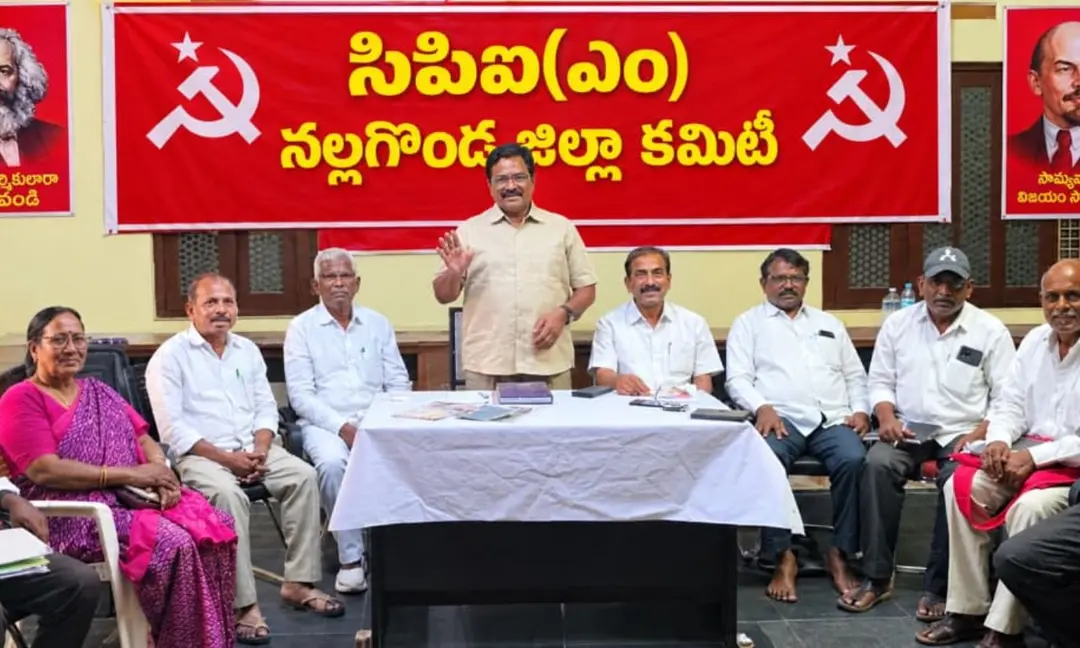
CPM leader demands removal of CEC Gyanesh Kumar
CPM state secretariat member and former MLA Julakanti Rangareddy demanded the immediate removal of Chief Election Commissioner Gyanesh Kumar, alleging he is acting unconstitutionally through unilateral decisions in the Election Commission. He spoke at the party's district secretariat meeting held on Saturday at Doddi Komuraiah Bhavan in Nalgonda, chaired by state committee member Nari Ailaiah. He alleged Kumar ignored the views of the two Election Commissioners, became an agent of one party and deleted 13 crore votes nationwide under 'SIR'. He sought an independent inquiry.
Source
Nalgonda — నాయకులు · read the original report ↗
Desk check · some claims need care
What the desk checked (4)
- CPM state secretariat member and former MLA Julakanti Rangareddy demanded the removal of CEC Gyanesh Kumar. — Directly attributed to the named leader in the source.
- CEC Gyanesh Kumar took unilateral decisions without considering the views of the two Election Commissioners and acted as an agent of one party. — Allegation attributed to Rangareddy; no supporting evidence or ECI response in source.
- 13 crore votes were deleted nationwide under 'SIR'. — Figure appears in source only as the speaker's claim; no official source cited.
- The district secretariat meeting was held on Saturday at Doddi Komuraiah Bhavan, Nalgonda, chaired by CPM state committee member Nari Ailaiah. — Routine event detail stated in source; source is dated 26 September 2026.
Analysts’ view opinion
Though this demand was voiced at a district-level party meeting, its political target is national — the CPM is aligning itself with a broader opposition narrative questioning the Election Commission's credibility. By pushing criticism of the 'SIR' exercise and roll revision down to the local cadre level, the party appears to be building a pre-emptive 'the playing field is not level' argument ahead of elections. For the Left, this is also a way to reassert its historical positioning on constitutional and institutional questions, gaining ideological salience beyond its limited electoral weight.
- Removing a CEC is constitutionally difficult, so the demand functions more as political messaging than as a realistic path to an outcome.
- The electoral roll revision issue offers a potential common platform for opposition parties, and the CPM is positioning itself visibly at the front of that line.
- The choice of a district secretariat meeting as the venue suggests cadre mobilisation and preparation for ground-level agitation.
- The charge of acting as 'an agent of one party' is a serious one, and the ruling side can be expected to counter it as blaming institutions in anticipation of defeat.
- The claim that two commissioners' views were ignored pushes forward a debate on collective decision-making inside the Commission — a question likely to persist in courts and Parliament.
What to watch — Watch whether this demand is escalated to the CPM's state and national leadership and into joint opposition action, or remains a district-level statement.
These are allegations by one party leader; the story does not establish the Election Commission's or the CEC's response, nor any independent verification of the deletion and unilateralism claims.
Deep dive
Research brief · 8 facts · 3 dates · exam-readyThe brief
Context
The CPM (Communist Party of India-Marxist) has escalated its attack on the Election Commission of India's leadership, targeting Chief Election Commissioner Gyanesh Kumar. At a district secretariat meeting of the party in Nalgonda, Telangana, a senior state leader alleged that the CEC is taking unilateral decisions in the three-member Commission, bypassing the two Election Commissioners, and acting as an agent of one political party. The specific grievance cited is the deletion of votes nationwide under an exercise referred to as 'SIR'. The party has demanded his removal from office and an independent inquiry into his conduct.
Key facts
- CPM state secretariat member and former MLA Julakanti Rangareddy demanded immediate action against and removal of CEC Gyanesh Kumar from office.
- He alleged the CEC is acting unconstitutionally by taking unilateral decisions in the Central Election Commission.
- He alleged Gyanesh Kumar takes decisions without considering the opinions of the two Election Commissioners and has become an agent of one party.
- He alleged 13 crore votes were deleted across the country in the name of 'SIR'.
- He said ignoring the serious objections raised over the vote deletions is itself a violation of the Constitution.
- He demanded an independent inquiry into the CEC's conduct and style of functioning.
- The CPM district secretariat meeting was held on Saturday at Doddi Komuraiah Bhavan in Nalgonda.
- The meeting was chaired by CPM state committee member Nari Ailaiah, with Rangareddy as chief guest.
Timeline
- Saturday (as reported)CPM district secretariat meeting held at Doddi Komuraiah Bhavan, Nalgonda, chaired by Nari Ailaiah.
- At the same meetingJulakanti Rangareddy, as chief guest, demands removal of CEC Gyanesh Kumar and an independent inquiry into his functioning.
- 26 September 2026Report of the meeting and the demand published.
Who has a stake
- Chief Election Commissioner Gyanesh Kumar — Faces allegations of unilateral, unconstitutional decision-making and a demand for his removal and an independent inquiry.
- The two Election Commissioners — Alleged to have been sidelined, their opinions not considered in Commission decisions.
- Election Commission of India — Its institutional credibility and the collegiality of its three-member structure are in question.
- CPM (Telangana unit) — Pressing the demand politically; leaders Julakanti Rangareddy and Nari Ailaiah led the Nalgonda meeting.
- Voters whose names were allegedly deleted — Reportedly 13 crore votes deleted nationwide under 'SIR', affecting the right to vote.
Why it matters
The Election Commission's authority rests on being seen as neutral and collegial; an allegation that the CEC overrides the two Election Commissioners strikes at that perception. Claims of large-scale deletion of voters under a roll-revision exercise link institutional process directly to the integrity of the franchise. Demands for removal and an independent probe raise questions about accountability mechanisms for constitutional functionaries.
UPSC angle
Prelims pointers
- Gyanesh Kumar is the Chief Election Commissioner named in the story; the Commission also has two Election Commissioners.
- CPM leader making the demand: Julakanti Rangareddy, state secretariat member and former MLA.
- Meeting venue: Doddi Komuraiah Bhavan, Nalgonda (Telangana); chaired by state committee member Nari Ailaiah.
- Alleged figure: 13 crore votes deleted nationwide under 'SIR' (as claimed by the CPM leader).
- Demand made: immediate removal of the CEC plus an independent inquiry into his conduct.
Mains framing
The controversy raised by the CPM in Nalgonda frames a recurring question in Indian democracy: how far can the credibility of the Election Commission survive allegations of one-man decision-making within a multi-member body? The charge, as stated in the source, is threefold — that the CEC bypassed the two Election Commissioners, acted as an agent of one political party, and disregarded serious objections to the deletion of 13 crore votes nationwide under 'SIR', which the leader terms a constitutional violation. Whether or not these claims are established, they illustrate how electoral-roll revision exercises, which are technically administrative, become politically explosive when opposition parties perceive selective exclusion of voters. The implications extend to voter confidence, the legitimacy of results, and the perceived independence of a constitutional authority. The way forward suggested within the source itself is an independent inquiry into the CEC's functioning; more broadly, transparent disclosure of deletion data, collegial decision-making within the Commission, and accessible grievance redressal for deleted voters would help restore trust. No further policy claims can be drawn from the source.
Key terms
- Chief Election Commissioner (CEC)
- Head of the Election Commission; here Gyanesh Kumar, accused of unilateral decisions alongside two Election Commissioners.
- Election Commissioners
- The two other members of the Commission whose opinions the CEC allegedly did not consider.
- 'SIR'
- The electoral-roll exercise under whose name 13 crore votes were allegedly deleted nationwide; full form not stated in the source.
- CPM
- Communist Party of India (Marxist); its Telangana leaders raised the demand at the Nalgonda district secretariat meeting.
- District secretariat meeting
- A party organisational meeting of district-level office bearers, here chaired by state committee member Nari Ailaiah.
Practice questions
- Allegations of unilateral decision-making by the Chief Election Commissioner strike at the multi-member character of the Election Commission. Discuss with reference to the demands raised in this case.
- Large-scale deletion of names during electoral roll revision has become a flashpoint in Indian politics. Examine the implications for voter confidence and electoral legitimacy.
- What mechanisms exist to ensure accountability of constitutional functionaries, and how should demands for an 'independent inquiry' into them be evaluated?
Grounded only in the source report — figures and dates are the source's, not inferred.