
Telangana rainfall deficit at 31%, ministers urge crop shift
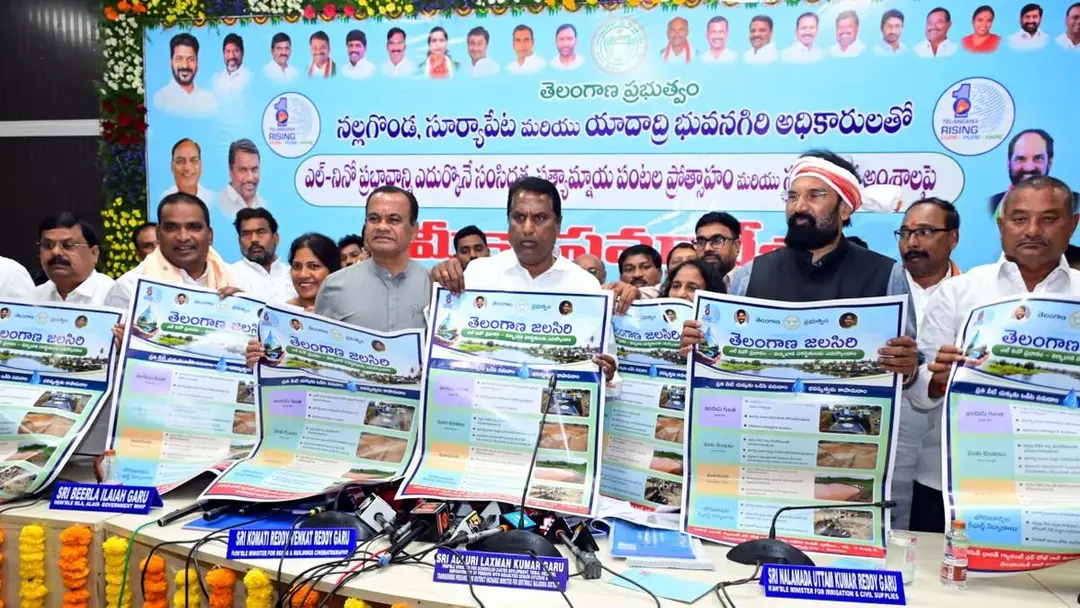
Telangana has recorded a 31% cumulative rainfall deficit since June 1, with 27 of its 33 districts classified as deficient as of Monday, July 20. Ministers held district-level reviews on El Nino preparedness. In Nalgonda, Minister Komatireddy Venkat Reddy ordered awareness campaigns on less water-intensive crops. In Mahabubnagar, Health Minister Damodar Raja Narasimha called the next 10 days crucial. On July 18, the government formed an expert committee led by Planning Board vice-chairman G. Chinna Reddy.
Source
Nalgonda — agriculture · read the original report ↗
Desk check · compared with the source
What the desk checked (5)
- Telangana recorded a 31% cumulative rainfall deficit since June 1, with 27 of 33 districts deficient as of July 20. — Figures appear in the source, dated as of Monday, July 20; no issuing agency named.
- The State government decided on July 18 to constitute a high-level expert committee led by Planning Board vice-chairman G. Chinna Reddy. — Stated in source with date and named chair; attributed to the State government.
- Minister Komatireddy Venkat Reddy directed officials to run awareness campaigns on less water-intensive crops at the Nalgonda review. — Directly attributed to the named minister in the source.
- Health Minister Damodar Raja Narasimha described the next 10 days as crucial and sought a mission-mode response in Mahabubnagar. — Attributed to the named minister; internally consistent.
- Chinna Reddy proposed mandal-level special officers and promotion of short-duration, low-investment crops. — Attributed to the named official; no independent confirmation possible.
Analysts’ view opinion
A 31% cumulative rainfall deficit with 27 of 33 districts classed as deficient is not just an agricultural headline — it is an early warning for the state's rural economy. Pushing farmers towards less water-intensive and short-duration crops is the economically sensible direction, but the cost of switching — fresh seed, re-sowing, uncertain market prices — lands first on the farmer. The directive to ready an action plan on seeds, fertiliser and subsidies reads as an attempt to share that burden, though the story does not put a figure on it.
- If sown area shrinks in largely rain-fed belts, rural incomes and farm labour workdays are at risk, which typically feeds through to local consumption demand.
- Shifting from water-heavy crops towards pulses, oilseeds, vegetables and horticulture saves water, but these crops carry sharper price volatility and thinner support-price cover.
- A farmer who switches late pays twice for seed and land preparation, so the timeliness of seed supply and subsidy delivery largely decides who absorbs the cost.
- A prolonged deficit shifts pressure to groundwater, raising indirect public costs through borewell pumping and higher power demand.
- Including drinking water, fodder and emergency preparedness in the Nizamabad review signals that officials see the fiscal exposure extending beyond farm output alone.
What to watch — Watch the rainfall over the next ten days, the size of any allocation for alternative-crop seed and subsidy, and how quickly the expert committee's recommendations turn into on-ground delivery.
The story establishes no estimate of crop loss, acreage decline, price impact or the value of any relief package — these are preparatory measures, not confirmed damage.
Deep dive
Research brief · 8 facts · 4 dates · exam-readyThe brief
Context
Telangana is facing a monsoon shortfall, with a 31% cumulative rainfall deficit since June 1 and 27 of its 33 districts classified as deficient as of July 20. The shortfall is linked to an anticipated El Nino impact, which typically weakens monsoon rainfall over India and hurts kharif sowing. On July 18 the State government set up a high-level multidisciplinary expert committee under Planning Board vice-chairman G. Chinna Reddy to assess the likely impact and frame mitigation strategies for agriculture and allied sectors. District-level review meetings on July 20 saw Ministers push farmers towards less water-intensive and short-duration crops and order contingency measures.
Key facts
- Telangana recorded a 31% cumulative rainfall deficit since June 1, as of Monday, July 20.
- 27 of Telangana's 33 districts were classified as rainfall deficient as of July 20.
- On July 18, the State government constituted a high-level multidisciplinary expert committee led by Planning Board vice-chairman G. Chinna Reddy to assess El Nino impact.
- Roads and Buildings Minister Komatireddy Venkat Reddy, at the Nalgonda District Collectorate review, ordered extensive awareness campaigns on crops requiring less water.
- Health Minister Damodar Raja Narasimha, chairing the Mahabubnagar review, described the next 10 days as crucial and called for a mission-mode response.
- Chinna Reddy urged promotion of short-duration, low-investment crops such as vegetables, pulses, oilseeds and horticultural crops in unsown areas.
- Chinna Reddy proposed appointing special officers at the mandal level, on the lines of district special officers, to monitor contingency plan implementation.
- In Nizamabad, a meeting chaired by Government Adviser P. Sudarshan Reddy reviewed rainfall deficiency impact on agriculture, drinking water, fodder, irrigation and emergency preparedness.
Timeline
- June 1Start of the period over which Telangana's 31% cumulative rainfall deficit is measured.
- July 18State government constitutes a high-level multidisciplinary expert committee led by G. Chinna Reddy on El Nino impact.
- Monday, July 20District-level review meetings held in Nalgonda, Mahabubnagar and Nizamabad; 27 of 33 districts deficient, deficit at 31%.
- Next 10 days from July 20Period described by Health Minister Damodar Raja Narasimha as crucial for the response.
Who has a stake
- Farmers in Telangana — Face sowing losses from rainfall deficit; urged to shift to less water-intensive, short-duration crops and to depend on seed, fertiliser and subsidy support.
- Telangana Agriculture Department — Directed to assess deficit conditions in advance, run awareness campaigns and prepare an immediate action plan on seeds, fertilisers, subsidies and alternative crops.
- Expert committee under G. Chinna Reddy (Planning Board vice-chairman) — Tasked with assessing likely El Nino impact and formulating strategies to minimise effects on agriculture and allied sectors.
- Ministers Komatireddy Venkat Reddy, N. Uttam Kumar Reddy, Adluri Laxman, Damodar Raja Narasimha — Leading district-level reviews and coordination of preventive and contingency measures.
- Agricultural scientists — Asked to tailor advisories to soil conditions, rainfall patterns and groundwater availability so every farmer gets crop-specific guidance.
- District administrations of Nalgonda, Mahabubnagar, Nizamabad — Must implement contingency plans covering crops, drinking water, fodder supply, irrigation management and emergency preparedness.
Why it matters
A 31% rainfall shortfall across 27 of 33 districts at the peak of the kharif sowing window threatens crop area, farm incomes, drinking water and fodder supply in a State heavily dependent on paddy and groundwater irrigation. The official response — crop diversification advisories, seed and fertiliser action plans and mandal-level monitoring — is a test of how quickly contingency planning can reach individual farmers. How Telangana manages this deficit will shape its resilience to El Nino-linked monsoon failures.
UPSC angle
Prelims pointers
- Telangana's cumulative rainfall deficit since June 1 stood at 31% as of July 20; 27 of 33 districts deficient.
- Expert committee on El Nino impact formed July 18, headed by Planning Board vice-chairman G. Chinna Reddy.
- Alternative crops suggested for unsown areas: vegetables, pulses, oilseeds and horticultural crops (short-duration, low-investment).
- Nalgonda review chaired by Roads and Buildings Minister Komatireddy Venkat Reddy; Irrigation Minister N. Uttam Kumar Reddy also attended.
- Mahabubnagar review chaired by Health Minister Damodar Raja Narasimha; Nizamabad review chaired by Government Adviser P. Sudarshan Reddy.
- Proposal: mandal-level special officers, on the lines of district special officers, to monitor contingency plans.
Mains framing
Telangana's 31% cumulative rainfall deficit since June 1, with 27 of 33 districts deficient, illustrates how an anticipated El Nino year translates rapidly into an agrarian stress event: delayed or failed sowing, uncertain irrigation, and knock-on pressure on drinking water and fodder, as flagged at the Nizamabad review. The State's response has been institutional and advisory — a high-level multidisciplinary expert committee under Planning Board vice-chairman G. Chinna Reddy formed on July 18, district-level reviews directing the Agriculture Department to draw up immediate action plans on seed availability, fertiliser supply and subsidies, and campaigns promoting less water-intensive, short-duration and low-investment crops such as pulses, oilseeds, vegetables and horticulture in unsown areas. The critical gap is last-mile delivery: hence the proposals for village-level meetings offering scientific guidance on crop selection, seed availability, irrigation and market prospects, scientist-tailored advisories based on soil, rainfall and groundwater conditions, toll-free helplines, and mandal-level special officers to monitor implementation. The way forward lies in converting these directives into timebound, locally calibrated contingency plans within the narrow sowing window that Minister Damodar Raja Narasimha called the crucial next 10 days, while ensuring inter-departmental coordination on water conservation and diversification incentives.
Key terms
- Cumulative rainfall deficit
- The shortfall in total rainfall received over a period against the normal for that period; here 31% since June 1 in Telangana.
- El Nino
- The climate phenomenon whose anticipated impact on monsoon and agriculture prompted Telangana's contingency planning and expert committee.
- Crop diversification
- Shifting from water-intensive crops to less water-demanding, short-duration or low-investment crops such as pulses, oilseeds, vegetables and horticulture.
- Multidisciplinary expert committee
- Panel formed by Telangana on July 18 under Planning Board vice-chairman G. Chinna Reddy to assess El Nino impact and frame mitigation strategies.
- Contingency plan
- Pre-planned departmental measures for deficit rainfall covering seeds, fertilisers, subsidies, alternative crops, drinking water, fodder and irrigation management.
- Mandal-level special officers
- Proposed officials below district level to intensify farmer awareness and monitor implementation of contingency measures.
Practice questions
- Examine how deficit monsoon years expose the vulnerability of water-intensive cropping patterns, using Telangana's 2026 rainfall deficit response as a case study.
- Discuss the institutional mechanisms — expert committees, district reviews, mandal-level officers and helplines — through which a State can deliver drought contingency advisories to individual farmers. How effective are they?
- "Crop diversification is the most durable insurance against monsoon variability." Critically evaluate in the context of pulses, oilseeds and horticulture being promoted in unsown areas.
Grounded only in the source report — figures and dates are the source's, not inferred.