
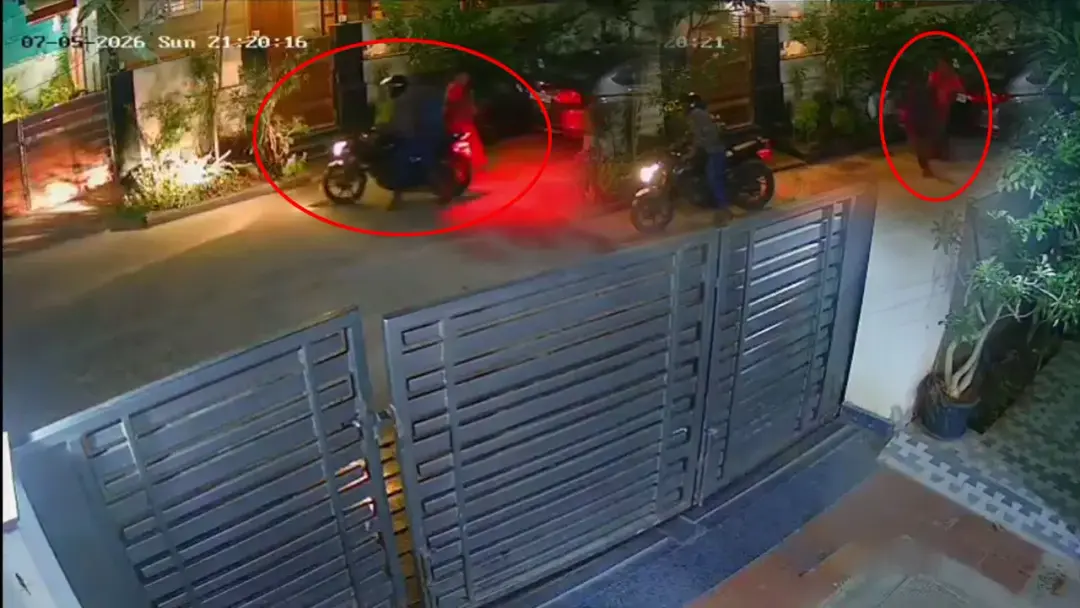
Gold chain snatched from woman in Tirupati, police probe on
A woman walking on a road in Tirupati had her gold chain snatched by unidentified men, according to a report. The accused, riding a motorcycle, followed her from behind and pulled the chain when the street was empty before speeding away. The victim lodged a complaint with police. Officers inspected the spot and are examining CCTV footage from the area, deploying special teams to trace the suspects using the bike number and their descriptions. The report said lone women are being targeted increasingly.
Source
Tirupati — crime & civic · read the original report ↗
Desk check · some claims need care
What the desk checked (5)
- Chain snatchers are increasingly targeting lone women in Tirupati — General trend claim in the source with no police data or official attribution given
- Two men on a motorcycle followed a woman and snatched her gold chain before fleeing — Described as a recent incident in the source; no date, locality or victim identity provided
- The victim filed a complaint with police — Stated in the source without attribution to a named officer or police station
- Police are examining CCTV footage and special teams have been deployed — Attributed generally to police in the source; no named official quoted
- Video of the incident is available — Source is a video page; the footage itself is the outlet's evidence and cannot be independently verified here
Analysts’ view opinion
This is not simple theft in law: snatching a chain from a woman's neck involves force, which under Indian criminal law pushes the offence into the graver category of robbery, carrying correspondingly stiffer punishment. The strength of any eventual prosecution now rests largely on technical evidence — CCTV footage, the motorcycle number and the complainant's identification. How methodically police handle this early stage will largely determine whether that evidence holds up in court.
- The element of force used to pull an ornament off the neck, and the fear caused to the victim, are precisely what distinguish this from ordinary theft and raise its gravity.
- CCTV footage is electronic evidence, so the manner of its seizure, the chain of custody and proper certification will decide how much weight a court gives it.
- A motorcycle number alone proves nothing — the registered owner and the actual rider may differ, so independent corroboration is essential.
- If identification procedures such as a test identification parade are not conducted in the prescribed manner, defence challenges to the identification of the accused become likely.
- Once arrests happen, constitutional safeguards for the accused — legal representation and production before a magistrate within the prescribed time — apply fully, while the complainant has a parallel interest in being kept informed of progress.
What to watch — Watch which sections the FIR is registered under, whether arrests follow, and whether any recovered gold can actually be identified as the victim's — those three points will shape the case.
The story does not establish the sections invoked, any arrests, the identity of the accused or the value of the stolen ornament, and the claim that attacks on lone women are rising is the report's own observation rather than verified official data.
Deep dive
Research brief · 8 facts · 4 dates · exam-readyThe brief
Context
Tirupati, the temple city in Andhra Pradesh that draws large numbers of pilgrims daily, has seen repeated chain-snatching incidents, according to the source report. In the latest case, a woman walking alone on a road had the gold chain pulled from her neck by unidentified men on a motorcycle who had followed her from behind and fled before she could raise an alarm. The victim lodged a complaint and police have begun an investigation using CCTV footage and special teams. The report says lone women — those walking to temples in the morning or to markets in the evening — are the main targets, raising questions about safety and law and order in the city.
Key facts
- The report was published on July 06, 2026 at 12:58 PM and updated at 1:02 PM the same day (byline: Phani CH).
- A woman walking on a road in Tirupati had her gold chain snatched from her neck within seconds by unidentified men.
- The accused came on a motorcycle and followed the woman from behind without arousing suspicion, striking when the street was empty.
- The snatchers pulled the chain forcefully and sped away on the bike before the shocked woman could scream for help.
- The victim immediately approached the police and lodged a complaint.
- Police reached the spot, collected details and are examining CCTV camera footage from the surrounding areas.
- Special teams have been deployed to trace the accused based on the bike number and the physical descriptions of the snatchers.
- The report says lone women — going to temples in the morning or to markets in the evening for essentials — are the chief targets of such thieves in Tirupati.
Timeline
- Recently (date not stated in the source)Men on a motorcycle followed a woman walking alone in Tirupati and snatched her gold chain before fleeing.
- Immediately after the incidentThe victim approached police and filed a complaint.
- After receiving informationPolice visited the scene, began the probe, started examining CCTV footage and formed special teams.
- July 06, 2026, 12:58 PM (updated 1:02 PM)The report on the incident was published.
Who has a stake
- The victim (unnamed woman) — Lost her gold chain, suffered shock; depends on the police probe for recovery of the ornament and justice.
- Tirupati police — Must trace the accused using CCTV footage, bike number and descriptions; their credibility on law and order is at stake.
- Lone women residents and pilgrims — Identified in the report as the main targets of chain snatchers while walking to temples or markets.
- Local residents of Tirupati — Report says the incident has caused fear and anxiety; everyday street safety is in question.
- Unidentified accused (chain snatchers) — Being hunted by special teams; face criminal action if identified and arrested.
Why it matters
Chain snatching in a crowded pilgrimage city affects not just property but the confidence of women to move alone on public streets. The case shows how everyday urban policing now depends on CCTV surveillance, vehicle number traces and special teams, and how gaps in street-level patrolling can be exploited in seconds.
UPSC angle
Prelims pointers
- Tirupati is a major temple city in Andhra Pradesh, visited daily by large numbers of pilgrims and locals.
- Chain snatching is a street crime typically committed by two-wheeler-borne offenders who target pedestrians.
- Police investigation tools cited in the source: CCTV footage, motorcycle registration number, suspect descriptions, special teams.
- The source dates the report to July 06, 2026; the exact date of the incident is not stated in the source.
- Filing a complaint with police is the first step that sets an investigation in motion.
Mains framing
The Tirupati chain-snatching case illustrates a familiar pattern of urban street crime: mobile, two-wheeler-borne offenders who exploit low-footfall moments and target pedestrians, in this case lone women walking to temples in the morning or to markets in the evening. The causes visible from the source are opportunity-driven — empty streets, visible gold ornaments, quick escape by motorcycle — in a city whose constant pilgrim and local crowds make anonymity easy. The implications go beyond the loss of an ornament: the report notes fear among residents and questions over safety and law and order in a pilgrimage centre where mobility of women is routine and religiously significant. The police response, as stated, relies on post-event investigation — spot inspection, CCTV footage from surrounding areas, tracing the bike number and suspect descriptions through special teams. The way forward suggested by these facts lies in strengthening preventive policing rather than only reactive detection: denser CCTV coverage with usable footage, patrolling at peak temple and market hours on identified vulnerable stretches, quick response to complaints, and public awareness among women about moving alone with visible valuables. The case is a reminder that urban safety is measured less by conviction data than by whether a woman feels secure walking an empty street.
Key terms
- Chain snatching
- A street offence in which offenders, usually on a two-wheeler, forcibly pull gold chains from pedestrians' necks and flee.
- CCTV footage
- Closed-circuit television recordings from cameras in the area, used by police here to identify the accused and their vehicle.
- Special teams
- Dedicated police squads deployed to trace and arrest suspects in a specific case, here using the bike number and descriptions.
- Tirupati
- Temple city in Andhra Pradesh described in the source as crowded daily with devotees and locals.
- Complaint (police)
- The victim's formal report to police about the offence, which triggers investigation.
Practice questions
- Street crimes such as chain snatching are 'opportunity crimes'. Discuss how preventive policing and surveillance technology can reduce them, with reference to urban India.
- Examine how the safety of women in public spaces affects their mobility and participation in religious, economic and social life in Indian cities.
- CCTV surveillance has become central to crime detection in Indian cities. Critically evaluate its effectiveness and limitations as an investigative tool.
Grounded only in the source report — figures and dates are the source's, not inferred.