
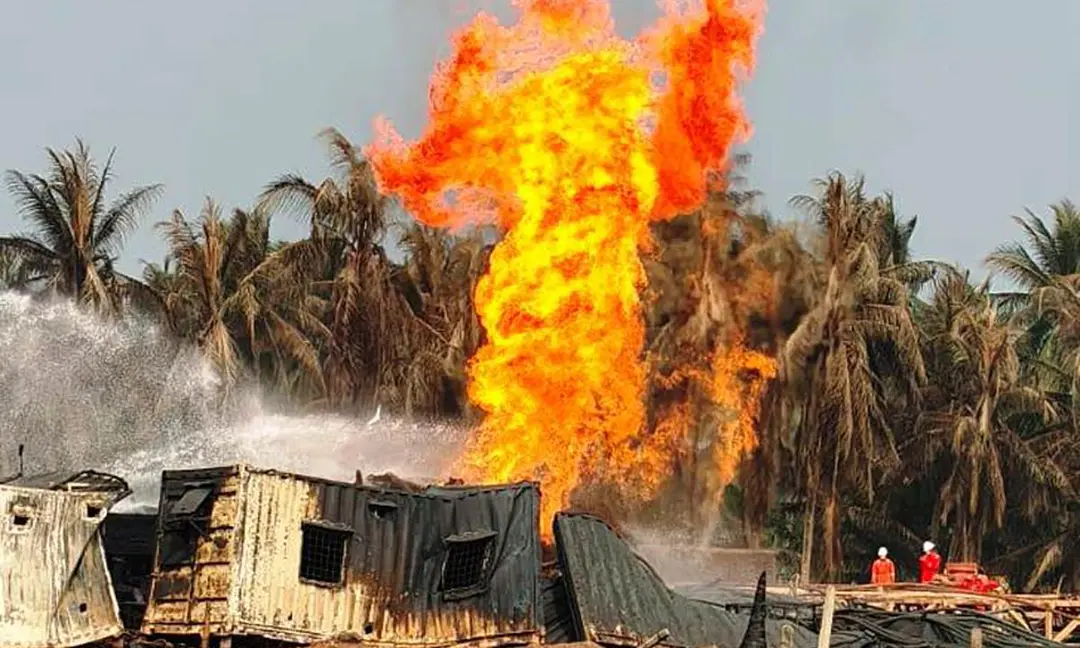
ONGC announces ₹10,000 ex-gratia per family after Irusumanda blowout
ONGC has announced ₹10,000 ex-gratia to each of 6,300 families in Irusumanda, Lakkavaram, Chintapalli and Gubbalapalem villages to compensate losses from the January 5 blowout at Irusumanda. Konaseema collector R. Mahesh Kumar said at Amalapuram on Saturday that ONGC will also set up a 100-bed multi-speciality hospital on 2.57 acres at Lakkavaram in Malikipuram mandal, serving 60 villages. The amount will be deposited directly into bank accounts.
Source
Konaseema — health · read the original report ↗
Desk check · compared with the source
What the desk checked (5)
- ONGC will set up a 100-bed multi-speciality hospital on 2.57 acres at Lakkavaram village, Malikipuram mandal, serving 60 villages. — Attributed to Konaseema district collector R. Mahesh Kumar at a press conference; acreage and bed count appear in source.
- ONGC announced ₹10,000 ex-gratia to each of 6,300 families in Irusumanda, Lakkavaram, Chintapalli and Gubbalapalem. — Attributed to the collector; village names and family count appear in source.
- A blowout occurred at Irusumanda village on January 5. — Date appears in source; no year specified.
- Razole MLA Deva Vara Prasad proposed the hospital and ₹5 lakh health insurance per family. — Attributed to the collector; insurance proposal not stated as accepted by ONGC.
- ONGC strictly follows all safety measures and will prevent recurrence. — Attributed statement by ONGC Rajamahendravaram asset manager Santanu Das; not independently verifiable.
Analysts’ view opinion
Technically this is a corporate compensation announcement, but politically it lands as a win credited to the local MLA. The collector's framing — that ONGC responded positively to the hospital proposal made by Razole MLA Deva Vara Prasad, while the ₹5 lakh health insurance demand remains unresolved — signals that the pressure is not over. Putting the collector, the MLA and the ONGC asset manager on one stage shifts the story from confrontation to settlement.
- ₹10,000 per family is a modest sum, but direct bank transfers to 6,300 families deliver visible, fast relief — politically the most useful form of compensation.
- The 100-bed multi-speciality hospital serving 60 villages converts an immediate grievance into a long-term development promise with wider constituency reach.
- The hospital got a positive response while the ₹5 lakh health insurance ask did not — that gap is exactly what rivals and village bodies can keep raising.
- The MLA publicly demanding advance notice to residents and stricter safety measures is the classic move of channelling local anger through an elected representative.
- Delivery of a central PSU's promises will effectively be judged through the district administration, so any slippage will be felt politically at the local level first.
What to watch — Watch whether a timeline and funding for the hospital are firmed up, and how ONGC responds to the ₹5 lakh insurance demand — that is the real political test of this announcement.
The story does not establish a timeline or cost for the hospital, the status of the insurance demand, the cause of or accountability for the blowout, or any opposition reaction.
Deep dive
Research brief · 8 facts · 3 dates · exam-readyThe brief
Context
A blowout — an uncontrolled release of oil or gas from a well — occurred at an ONGC well at Irusumanda village in Dr. B.R. Ambedkar Konaseema district of Andhra Pradesh on January 5. ONGC operates oil and gas wells across this Godavari delta region, and residents of nearby villages suffered losses from the incident. At a press conference in Amalapuram, the district collector announced ONGC's relief and health infrastructure response, following demands raised by the local MLA.
Key facts
- ONGC announced ₹10,000 ex-gratia to each of 6,300 families in four villages — Irusumanda, Lakkavaram, Chintapalli and Gubbalapalem — for losses from the blowout.
- The blowout occurred at Irusumanda village on January 5.
- ONGC will build a 100-bed multi-speciality hospital on 2.57 acres at Lakkavaram village, Malikipuram mandal, Dr. B.R. Ambedkar Konaseema district.
- The proposed hospital will serve 60 villages and be equipped to treat people affected by mishaps at ONGC oil and gas wells in the area.
- Razole MLA Deva Vara Prasad had proposed the hospital and ₹5 lakh health insurance for each family living near ONGC wells.
- The collector said ONGC responded positively on the hospital; on insurance, no decision is stated in the source.
- ONGC officials collected bank account details of the 6,300 affected families; ex-gratia will be deposited directly into accounts.
- Announcement made by Konaseema district collector R. Mahesh Kumar at Amalapuram on Saturday, with ONGC Rajamahendravaram asset manager Santanu Das and MLA Vara Prasad present.
Timeline
- January 5Blowout at ONGC well in Irusumanda village, Dr. B.R. Ambedkar Konaseema district.
- After the blowout (date not stated in the source)Razole MLA Deva Vara Prasad proposes an ONGC hospital in the area and ₹5 lakh health insurance per family near the wells.
- Saturday (date not stated in the source)Collector R. Mahesh Kumar announces at Amalapuram the 100-bed hospital and ₹10,000 ex-gratia to 6,300 families.
Who has a stake
- 6,300 families of Irusumanda, Lakkavaram, Chintapalli and Gubbalapalem — Receive ₹10,000 ex-gratia each for blowout losses; seek safety, advance information and health cover.
- ONGC (Rajamahendravaram asset, manager Santanu Das) — Liability for the blowout, cost of ex-gratia and hospital, and credibility of its safety claims and prevention measures.
- Dr. B.R. Ambedkar Konaseema district administration (Collector R. Mahesh Kumar) — Coordinating relief, verifying bank details and ensuring direct transfer of ex-gratia.
- Razole MLA Deva Vara Prasad — Pressing for the hospital, ₹5 lakh health insurance per family, advance intimation before well operations and stricter safety.
- Residents of 60 villages in the district — Access to the proposed 100-bed multi-speciality hospital equipped for oil and gas well mishaps.
Why it matters
Hydrocarbon extraction in the densely populated Godavari delta places villages close to live oil and gas wells, so a single blowout can disrupt thousands of households at once. The response — cash ex-gratia plus a dedicated hospital for 60 villages — shows how public-sector operators are being asked to internalise the health and safety costs of their operations. It also raises the unresolved questions of advance intimation to residents, insurance cover and accountability for prevention.
UPSC angle
Prelims pointers
- Blowout site: Irusumanda village, Dr. B.R. Ambedkar Konaseema district, Andhra Pradesh; date January 5.
- ONGC ex-gratia: ₹10,000 each to 6,300 families across four villages, paid by direct bank transfer.
- Proposed ONGC hospital: 100 beds on 2.57 acres at Lakkavaram, Malikipuram mandal; to serve 60 villages.
- MLA's demand: ₹5 lakh health insurance per family living near ONGC oil and gas wells.
- Officials named: Collector R. Mahesh Kumar; ONGC Rajamahendravaram asset manager Santanu Das; Razole MLA Deva Vara Prasad.
Mains framing
The Irusumanda blowout illustrates the tension between hydrocarbon production and habitation density in the Godavari delta, where ONGC's oil and gas wells lie adjacent to villages. The immediate cause of public grievance was uncontrolled escape of hydrocarbons on January 5 and resulting losses to households; the deeper issue is the absence of routine advance intimation to residents before extraction, reopening and perforation operations, a demand voiced by the Razole MLA. ONGC's response combines compensation (₹10,000 each to 6,300 families, transferred directly to bank accounts, limiting leakage) with infrastructure (a 100-bed multi-speciality hospital at Lakkavaram on 2.57 acres, serving 60 villages and equipped for well-related mishaps), while the asset manager asserted that safety norms are strictly followed and recurrence will be prevented. Implications include questions of adequacy and uniformity of ex-gratia relative to actual losses, the pending demand for ₹5 lakh health insurance per family, and whether a hospital substitutes for prevention. A credible way forward, on the source's own terms, would pair the hospital with pre-notification protocols, audited safety measures and clarity on insurance cover for households living near wells.
Key terms
- Blowout
- An uncontrolled release from an oil or gas well; the January 5 incident at Irusumanda that caused losses to nearby villagers.
- ONGC
- Oil and Natural Gas Corporation, the state-owned operator of the oil and gas wells in the Konaseema area.
- Ex-gratia
- A voluntary payment made without admission of legal liability; here ₹10,000 per affected family.
- Asset manager (ONGC Rajamahendravaram)
- ONGC official heading operations of the Rajamahendravaram asset; Santanu Das holds the post.
- Perforation
- A well operation stage mentioned by the MLA, during which residents should be informed in advance and safety measures ensured.
- Mandal
- Sub-district administrative unit in Andhra Pradesh; the hospital site Lakkavaram lies in Malikipuram mandal.
Practice questions
- Examine the safety and community-consent challenges of onshore oil and gas extraction in densely populated deltaic regions, using the Irusumanda blowout as an illustration.
- Is ex-gratia compensation an adequate substitute for preventive regulation in industrial accidents? Discuss with reference to ONGC's response in Konaseema district.
- Discuss the role of district administration and local elected representatives in mediating between public-sector enterprises and affected communities after an industrial mishap.
Grounded only in the source report — figures and dates are the source's, not inferred.