
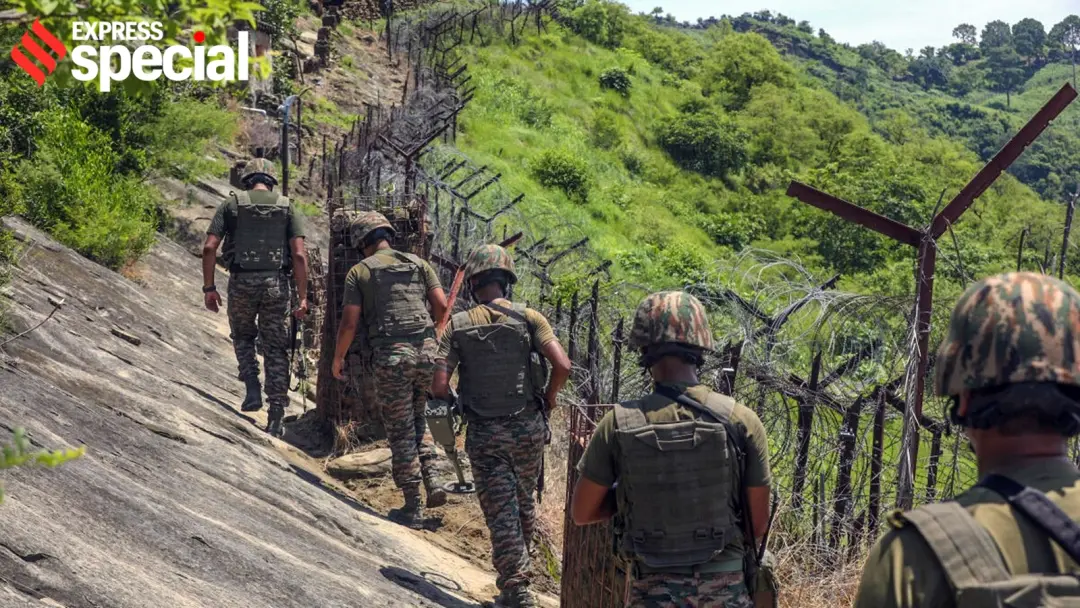
Ten years after surgical strikes, militant threat shifts to Jammu
On the night of September 28-29, 2016, the Indian Army carried out cross-border surgical strikes on seven terrorist launchpads across the Line of Control, killing an estimated 35-50 terrorists, in retaliation for the Uri attack that killed 19 soldiers. Government data showed 322 militant incidents in 2016, with 150 terrorists and 82 security personnel killed, against 12 incidents and 16 security personnel killed in 2025. ACLED says over 60% of violent militant activity in 2025 was in Jammu division, against 5% in 2018.
Source
Indian Express — India · read the original report ↗
Desk check · compared with the source
What the desk checked (5)
- On the night of September 28-29, 2016, Army Para (SF) teams struck seven terrorist launchpads across the LoC, killing an estimated 35-50 terrorists. — Figures appear in source; described as the Army's own account with an estimated range.
- The strikes followed the September 18 Uri attack in which 19 soldiers were killed. — Figure appears in source; no separate attribution given.
- Government data recorded 322 militant incidents in 2016 with 150 terrorists and 82 security personnel killed; 12 incidents in 2025 with 16 security personnel killed. — Attributed in source to government data.
- Over 60% of violent militant activity in J&K in 2025 was in Jammu division, against 5% in 2018. — Attributed to conflict-monitoring organisation ACLED.
- Improved surveillance has raised the risk of escalation, as seen during Operation Sindoor. — Attributed by name to retired Lt Gen D S Hooda, former Northern Army Commander.
Analysts’ view opinion
The tenth anniversary of the surgical strikes hands the central government a politically powerful storyline — a single arc from Uri through Balakot to Operation Sindoor, framed as an India that hits back. But the numbers in this story cut both ways: 322 incidents in 2016 against 12 in 2025 supports the claim of policy success, while violence in the Jammu division rising from 5% in 2018 to over 60% in 2025 makes it hard to argue the threat has been extinguished. The political argument is therefore shifting from whether militancy has been suppressed to where it has moved.
- Marking the decade as a national-security achievement naturally benefits the ruling side; the story notes the Prime Minister citing the surgical strikes and Operation Sindoor as examples of India's counter-terrorism policy.
- The fall from 322 incidents to 12 strengthens the government's case, but 16 security personnel killed in 2025 means talk of full normalcy has to be used carefully.
- The threat shifting from the Kashmir Valley to Jammu's forested and mountainous belt — which officials in the story link partly to post-Article 370 troop infusion and the 2020-21 India-China border crisis — creates a new pressure point in regional politics.
- Jammu's new security salience is likely to sharpen demands from local representatives and regional parties on protection, deployment and grievance redressal.
- Former Northern Army Commander Lt Gen D S Hooda's caution that escalation risk has grown is a reminder that each retaliatory option now carries a higher political price.
What to watch — Watch how government and opposition language evolves around the concentration of violence in the Jammu division, and how deployment and surveillance changes are debated politically.
The story documents shifts in the security picture only; it does not establish how parties will respond, what the electoral effect will be, or a single definitive cause for the geographic shift in the threat.
Deep dive
Research brief · 8 facts · 7 dates · exam-readyThe brief
Context
On the night of September 28-29, 2016, Indian Army Para (Special Forces) teams crossed the Line of Control and struck seven terrorist launchpads north and south of the Pir Panjal range, in retaliation for the September 18, 2016 attack on the Army Brigade Headquarters near Uri that killed 19 soldiers. It was the first time the Army publicly acknowledged carrying out "surgical strikes", though cross-border operations had happened earlier. A decade on, defence officials told The Indian Express that the Kashmir Valley is quieter but the militant threat has become more dispersed, harder to detect and concentrated in the forested, mountainous Jammu region. India's retaliatory template has also evolved — from ground raids in 2016 to the Balakot air strikes in 2019 and the integrated Operation Sindoor in May 2025.
Key facts
- Surgical strikes were carried out on the night of September 28-29, 2016, targeting seven terrorist launchpads across the LoC, killing an estimated 35-50 terrorists.
- The strikes retaliated for the September 18, 2016 attack on the Army Brigade Headquarters near Uri, in which 19 soldiers were killed.
- Para (Special Forces) teams operated under cover of artillery fire, carrying weapons, rocket launchers, flamethrowers and grenades, striking both north and south of the Pir Panjal range.
- Government data: 322 militant incidents in 2016, with 150 terrorists and 82 security personnel killed.
- In 2025 there were 12 terror-related incidents, with 16 security personnel killed.
- ACLED: over 60% of violent militant activity in J&K in 2025 occurred in the Jammu division, against 5% in 2018.
- ACLED attributes the shift partly to Jammu's forested, mountainous terrain and changes in troop deployment after the 2020-21 India-China border crisis.
- Officials cite the 2019 abrogation of Article 370, along with troop infusion into Kashmir, as a factor behind the changed militancy pattern.
Timeline
- September 18, 2016Terrorist attack on the Army Brigade Headquarters near Uri kills 19 soldiers.
- Night of September 28-29, 2016Army's first publicly acknowledged cross-border surgical strikes on seven launchpads across the LoC; 35-50 terrorists estimated killed.
- 2018Only 5% of violent militant activity in J&K was in the Jammu division, per ACLED.
- 2019Balakot air strikes; abrogation of Article 370 in J&K accompanied by infusion of troops into Kashmir.
- 2020-21India-China border crisis leads to changes in troop deployment.
- May 2025Operation Sindoor launched after the Pahalgam terror attack as an integrated operation.
- 202512 terror-related incidents recorded; 16 security personnel killed; over 60% of militant violence in Jammu division.
Who has a stake
- Indian Army, especially Para (Special Forces) and Rashtriya Rifles — Executes cross-border strikes and has historically carried much of the counter-insurgency burden in J&K.
- Northern Command / Lt Gen D S Hooda (retd) — Oversaw the 2016 strikes as Army Commander; warns that improved capability raises escalation risk.
- Residents of the Jammu division — Now the epicentre of militant activity, with over 60% of 2025 violent incidents in their region.
- Residents of the Kashmir Valley — Valley is considerably quieter than in 2016-18, but faces extensive patrolling and surveillance.
- Intelligence and security agencies — Must sustain human intelligence alongside UAVs and satellite imagery, and improve lateral and vertical information-sharing.
- ACLED — Independent conflict-monitoring body whose data frames the geographic shift in militancy.
Why it matters
The data show a dramatic fall in overall violence — from 322 incidents in 2016 to 12 in 2025 — but a relocation of the threat to Jammu's difficult terrain, where small groups can survive undetected for long periods. That demands a different counter-insurgency model: intelligence-specific operations with fewer troops, drones, counter-drone systems and satellite imagery rather than large cordon-and-search sweeps. It also raises a strategic question flagged by Lt Gen Hooda — stronger retaliatory capability has increased the risk of escalation, as seen during Operation Sindoor.
UPSC angle
Prelims pointers
- Uri attack: September 18, 2016; 19 soldiers killed at Army Brigade Headquarters near Uri.
- Surgical strikes: night of September 28-29, 2016; seven launchpads across the LoC; Para (Special Forces).
- Pir Panjal range: launchpads struck both north and south of it.
- ACLED — Armed Conflict Location & Event Data: independent non-profit conflict-monitoring and crisis-mapping organisation.
- Escalation ladder of Indian responses: 2016 surgical strikes (ground), 2019 Balakot air strikes, Operation Sindoor (May 2025, integrated).
- Rashtriya Rifles: Army force that has historically borne much of the J&K counter-insurgency burden.
Mains framing
The decade since the 2016 surgical strikes illustrates both the success and the adaptive limits of India's counter-terrorism approach in Jammu and Kashmir. Militant incidents fell from 322 in 2016 (150 terrorists and 82 security personnel killed) to 12 in 2025 (16 security personnel killed), but the geography of violence inverted: ACLED records over 60% of 2025 militant activity in the Jammu division against 5% in 2018. Officials attribute this to the abrogation of Article 370 in 2019 with accompanying troop infusion into Kashmir, a crackdown on local-militant contact through patrolling and surveillance, Jammu's forested and mountainous terrain, and deployment changes after the 2020-21 India-China border crisis. Militancy has moved from urban/semi-urban stone-pelting and local recruitment to small groups surviving undetected in forests and higher reaches. The operational response has shifted from large cordon-and-search contingents to intelligence-specific missions with fewer troops, UAVs, satellite imagery, enhanced inter-agency coordination, day-and-night area domination, and post-Pahalgam counter-drone capabilities and temporary operating bases. The way forward, as officials and Lt Gen D S Hooda (retd) caution, is to avoid jettisoning human intelligence despite technological gains, and to factor in the heightened escalation risk that accompanies stronger retaliatory capability, as seen during Operation Sindoor.
Key terms
- Surgical strike
- Targeted, limited cross-border military operation; in 2016 the Army publicly acknowledged such strikes for the first time.
- Line of Control (LoC)
- The de facto military line in Jammu and Kashmir that the Para (SF) teams crossed in September 2016.
- ACLED
- Armed Conflict Location & Event Data — independent non-profit that monitors conflict and maps crises, cited for J&K violence trends.
- Operation Sindoor
- Integrated Indian military operation of May 2025, launched after the Pahalgam terror attack.
- Rashtriya Rifles
- Army force that has historically shouldered a large share of counter-insurgency duties in Jammu and Kashmir.
- Cordon and search operation
- Older counter-insurgency method using large troop contingents to seal and search suspected areas, now largely replaced by intelligence-specific operations.
Practice questions
- Discuss how the pattern of militancy in Jammu and Kashmir has changed since 2016, and examine the factors behind the shift of violence to the Jammu division.
- India's retaliatory responses have evolved from the 2016 surgical strikes to the 2019 Balakot air strikes and Operation Sindoor in 2025. Critically assess the gains and the escalation risks of this evolution.
- Technology has transformed counter-insurgency in Jammu and Kashmir, but human intelligence remains indispensable. Comment with reference to recent operational experience.
Grounded only in the source report — figures and dates are the source's, not inferred.