
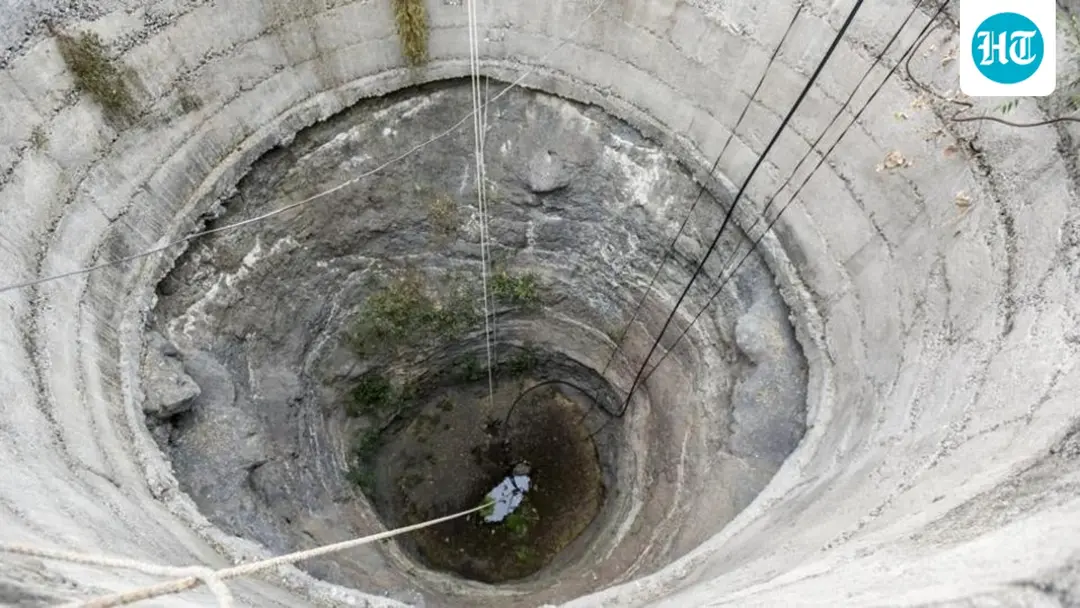
Woman held after toddlers thrown into well in Dakshina Kannada
Police said Noorunissa, 28, threw her three-and-a-half-year-old daughter Aliya and her husband's sister's three-year-old son Mohammed Rabih into a well near her house at Perne in Bantwal taluk, Dakshina Kannada, around 2pm on Saturday. The boy drowned; the girl was rescued and hospitalised in Mangaluru. SP Arun K said the act followed a phone quarrel with her husband Sinan, a mechanic. A case was registered under Sections 103 and 109 of the Bharatiya Nyaya Sanhita.
Source
Hindustan Times — India · read the original report ↗
Desk check · compared with the source
What the desk checked (5)
- A 28-year-old woman, Noorunissa, threw her daughter and her husband's sister's son into a well at Perne in Bantwal taluk on September 19 afternoon. — Attributed to police and a press release by Dakshina Kannada SP Arun K; figure and details appear in source.
- The boy, Mohammed Rabih, about three, drowned, while the girl, Aliya, about three-and-a-half, was rescued and taken to a Mangaluru hospital. — Attributed to police in the source; ages given as approximate.
- The incident was initially believed to be an accident but investigation revealed a crime. — Attributed to police; no further investigative detail given in source.
- The complaint was filed by father-in-law Aboobakkar M, and the FIR says she complained of frequent headaches after her second child's birth. — Sourced to the FIR as described in the article; not independently verifiable.
- A case was registered under Sections 103 (murder) and 109 (attempt to murder) of the Bharatiya Nyaya Sanhita. — Section numbers appear in source; attributed to police.
Analysts’ view opinion
Because the case is registered under the Bharatiya Nyaya Sanhita, it will move through the newer criminal framework — Section 103 (murder) attaching to the boy who died, and Section 109 (attempt to murder) to the girl who survived. Police say the incident was first treated as an accident and only later found to be a crime, which makes the evidentiary build-up — circumstantial evidence, the surviving child's account, phone records — central to the prosecution. The FIR's reference to frequent headaches after the second childbirth could, if pursued, open up mental-health assessment and arguments under the unsoundness-of-mind provisions. For now these are allegations only, and the presumption of innocence legally remains.
- Section 103 carries the gravest range of punishment, so this becomes a Sessions Court trial and bail is not a routine matter.
- The complainant is the accused's father-in-law and police cite a phone quarrel with the husband, so in a case resting largely on family witnesses the consistency of statements will be tested at trial.
- The surviving three-and-a-half-year-old could be a witness, but courts apply extra caution and competence checks before relying on testimony from a child that young.
- Since the FIR itself mentions post-childbirth health complaints, a psychiatric evaluation at the investigation stage is plausible and could become the focal point of any argument on mens rea.
- With child victims involved, custody and care of the surviving daughter and the three-month-old infant may come within the child welfare machinery's remit.
What to watch — Watch what circumstantial evidence the chargesheet rests on, whether a mental-health evaluation is ordered, and how the court treats any bail application.
The story establishes no medical finding on the accused's mental state, no version from her, and no detail on the rescued girl's condition — what exists so far is a police statement and FIR allegations, which still have to be proved in court.
Deep dive
Research brief · 8 facts · 4 dates · exam-readyThe brief
Context
In Dakshina Kannada district of Karnataka, a 28-year-old woman, Noorunissa, was arrested after two toddlers were thrown into a well near her house at Perne in Bantwal taluk, within the limits of Uppinangady police station. Police said the act followed a quarrel with her husband Sinan over a phone call; the three-year-old boy drowned while her three-and-a-half-year-old daughter was rescued. The incident was first believed to be an accident but investigation revealed a crime, and a case was registered under the Bharatiya Nyaya Sanhita, the penal code that replaced the IPC.
Key facts
- Noorunissa, 28, was arrested in Mangaluru after two toddlers were thrown into a well near her house at Perne, Bantwal taluk, Dakshina Kannada.
- The incident took place around 2pm on Saturday, September 19, according to the police press release.
- Her husband's sister's son, Mohammed Rabih, aged around three, drowned; her daughter Aliya, around three-and-a-half, was rescued and taken to a hospital in Mangaluru.
- Dakshina Kannada SP Arun K said the act followed a marital dispute between Noorunissa and her husband Sinan over a phone call.
- Sinan is a mechanic working in Mangaluru; the couple have been married for five years and have two children, including a three-month-old infant.
- Police initially believed the incident was an accident; subsequent investigation revealed the crime.
- The complaint was filed by Noorunissa's father-in-law, Aboobakkar M.
- The FIR states she had complained of frequent headaches after the birth of her second child and had been quarrelling with her husband over trivial matters.
Timeline
- Five years before the incidentNoorunissa and Sinan, residents of Perne, were married; they have two children.
- About three months before the incidentTheir second child, an infant, was born; the FIR says she complained of frequent headaches after this birth.
- September 19, around 2pm (Saturday)A phone quarrel with her husband was followed by the two toddlers being thrown into the well; the boy drowned, the girl was rescued and hospitalised in Mangaluru.
- SundayPolice announced the arrest of Noorunissa and said investigation had revealed the crime; case registered under BNS Sections 103 and 109.
Who has a stake
- Noorunissa, 28 (accused) — Arrested and booked under BNS Sections 103 and 109; faces trial for murder and attempt to murder.
- Aliya, her daughter (about 3.5 years) — Rescued from the well and hospitalised in Mangaluru; survivor and key victim in the case.
- Mohammed Rabih (about 3 years) — Nephew of the accused; drowned in the well.
- Sinan, husband, a mechanic in Mangaluru — Party to the phone quarrel cited as trigger; father of the deceased girl's sibling and of the surviving child.
- Aboobakkar M, father-in-law — Complainant whose statement forms the basis of the FIR.
- Dakshina Kannada police / Uppinangady police station, SP Arun K — Investigating agency; converted an assumed accident into a murder and attempt-to-murder case.
Why it matters
The case shows how a domestic quarrel can escalate into fatal violence against children, and how initial assumptions of accidental drowning can mask crime until investigation. It also flags the FIR's reference to persistent headaches and frequent quarrels after childbirth, pointing to the need for attention to post-childbirth health and family distress. Procedurally, it is an early example of homicide charges being framed under the Bharatiya Nyaya Sanhita rather than the IPC.
UPSC angle
Prelims pointers
- Bharatiya Nyaya Sanhita Section 103 deals with murder; Section 109 with attempt to murder.
- Incident location: Perne, Bantwal taluk, Dakshina Kannada district, Karnataka, under Uppinangady police station limits.
- Dakshina Kannada Superintendent of Police named in the case: Arun K.
- The complaint (FIR) was filed by the accused's father-in-law, Aboobakkar M.
- The surviving child was shifted to a hospital in Mangaluru.
- Police first treated the drowning as an accident; investigation established it as a crime.
Mains framing
The Bantwal case illustrates the intersection of intra-family conflict, child vulnerability and the quality of initial police assessment. The proximate trigger, as stated by police, was a marital dispute over a phone call; the FIR additionally records that the accused had complained of frequent headaches after the birth of her second child three months earlier and had been quarrelling over trivial matters, indicating unaddressed health and domestic stress within the household. Implications are threefold: children in the home are the most defenceless victims of adult conflict; an unattended open well near a house becomes a lethal hazard; and deaths initially classed as accidental risk under-detection unless investigated rigorously, as happened here before charges under BNS Sections 103 and 109 were framed. A way forward consistent with the source would emphasise careful investigation of all child drowning deaths rather than presumptive closure as accidents, family-level support and medical attention where post-childbirth distress is reported, and safety measures around domestic wells. Beyond this, the source does not state any policy response, and none should be assumed.
Key terms
- Bharatiya Nyaya Sanhita (BNS)
- India's penal code under which the case is registered; Section 103 covers murder and Section 109 attempt to murder.
- FIR
- First Information Report; here filed on the complaint of the accused's father-in-law, Aboobakkar M.
- Taluk
- A sub-district administrative unit; the incident occurred in Bantwal taluk of Dakshina Kannada.
- Superintendent of Police (SP)
- District police chief; Dakshina Kannada SP Arun K issued the press release on the case.
- Uppinangady police station
- The police station within whose limits Perne, the residence of the accused, falls.
Practice questions
- Discuss how presumptions of accidental death in cases involving children can affect criminal investigation, using the Dakshina Kannada well drowning case as an illustration.
- Sections 103 and 109 of the Bharatiya Nyaya Sanhita relate to which offences? Explain their application in the Bantwal case.
- Examine the role of family-level stress, including post-childbirth health complaints, in domestic violence against children, and suggest institutional safeguards.
Grounded only in the source report — figures and dates are the source's, not inferred.