
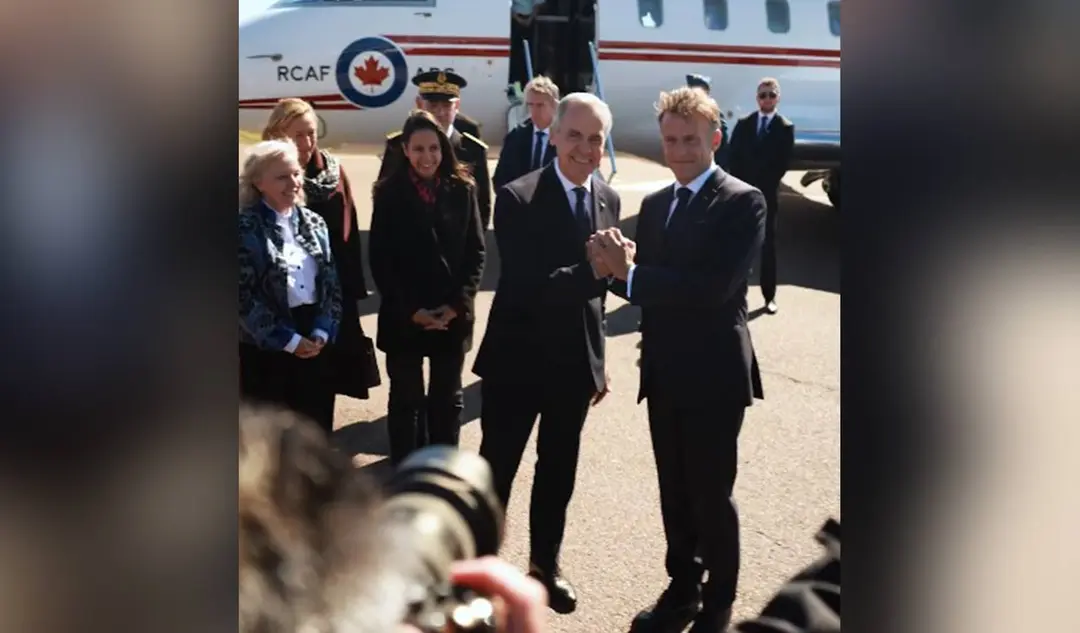
France backs closer Canada-EU ties, says Macron
French President Emmanuel Macron said France supports the agenda of rapprochement between Canada and the European Union, speaking at a joint press conference with Canadian Prime Minister Mark Carney in Saint-Pierre. He also backed Canada's potential status as an EU associate member and said cooperation would be strengthened in fisheries, security and energy. The leaders discussed Ukraine, the Middle East and the Arctic. Carney said Canada and Europe would build an "Alliance for the Future".
Source
Telangana Today · read the original report ↗
Desk check · compared with the source
What the desk checked (5)
- Macron said France supports the agenda of rapprochement between Canada and the EU and Canada's potential EU associate member status. — Attributed to Macron at a joint press conference in Saint-Pierre; reported by Xinhua as cited in source.
- Carney's visit is the first official visit by a Canadian prime minister to Saint-Pierre and Miquelon. — Attributed to Macron in the source; not independently verified here.
- European Commission President Ursula von der Leyen proposed on Wednesday that Canada could become the EU's first associate member, upgrading CETA to an 'Alliance for the Future'. — Attributed in source to her State of the Union address in Strasbourg.
- Trump said Canada becoming an EU associate member could be a 'hostile act' and threatened heavy tariffs on Europe. — Attributed to Trump in the source, dated Wednesday local time; no direct quote source given beyond the report.
- Saint-Pierre and Miquelon lies in the North Atlantic about 20 km from Newfoundland. — Geographic detail appears in the source text.
Analysts’ view opinion
On the surface this was a meeting about fisheries and energy; strategically, it is an attempt to redraw security alignments across the Atlantic. France's open backing for the idea of Canada as an EU "associate member", together with Carney's "Alliance for the Future" language, signals a relationship being stretched beyond trade into defence, the Arctic and energy security. With President Trump having called such a move a possible "hostile act" and threatened heavy tariffs on Europe, this rapprochement is already a transatlantic friction point.
- Holding the talks in Saint-Pierre, a French overseas territory in the North Atlantic close to Newfoundland, carries its own message that Europe is a geographic as well as political stakeholder in the region.
- The inclusion of the Arctic, defence and energy security in the agenda suggests the partnership is moving from a commercial framework into strategic territory.
- For Ottawa, the logic reads as hedging: widening options and reducing dependence on a single dominant partner.
- Trump's reaction indicates Washington may read this as a challenge to its sphere of influence rather than as allied burden-sharing, with tariff pressure the likely instrument.
- "Associate member" status has no established legal definition or precedent, and in a Union requiring broad consensus among 27 states, French support is an important first step rather than a settled outcome.
What to watch — Watch how other EU capitals — especially the larger economies — respond to the proposal, and whether the US tariff threat is actually acted upon.
The story does not establish what "associate member" would legally entail, what defence or security obligations it would carry, or any timeline — so far there is a proposal and political endorsement, nothing more.
Deep dive
Research brief · 8 facts · 4 dates · exam-readyThe brief
Context
French President Emmanuel Macron and Canadian Prime Minister Mark Carney held talks in Saint-Pierre, capital of the French overseas territory of Saint-Pierre and Miquelon in the North Atlantic, where Macron endorsed closer Canada-EU ties. The meeting followed European Commission President Ursula von der Leyen's proposal that Canada could become the EU's first "associate member", upgrading relations beyond the existing Comprehensive Economic and Trade Agreement (CETA). Macron said France "very much" supports this agenda of rapprochement, while Carney spoke of an "Alliance for the Future" between Canada and Europe. US President Donald Trump has warned that such a move could be a "hostile act" and threatened heavy tariffs on Europe.
Key facts
- Macron and Carney spoke at a joint press conference in Saint-Pierre on Sunday (local time); the story was published on 21 September 2026.
- It was the first official visit by a Canadian prime minister to Saint-Pierre and Miquelon, a French overseas territory.
- Macron said France "very much" supports the "agenda of rapprochement" between the EU and Canada and Canada's potential status as an EU associate member.
- France and Canada agreed to strengthen cooperation in fisheries, security and energy.
- Carney said Canada and Europe would build an "Alliance for the Future" to strengthen collective resilience.
- Ursula von der Leyen, in her annual State of the Union address to the European Parliament in Strasbourg on Wednesday, proposed opening the door for Canada to become the EU's first "associate member".
- The proposed Alliance for the Future would upgrade ties from CETA and cover manufacturing, technology, defence, the Arctic, energy, critical minerals and artificial intelligence.
- Trump said on Wednesday (local time) that Canada becoming an EU "associate member" could be a "hostile act" and threatened heavy tariffs on Europe.
Timeline
- Wednesday (before the Macron-Carney meeting)Von der Leyen, in her State of the Union address to the European Parliament in Strasbourg, proposes Canada as the EU's first "associate member" and an "Alliance for the Future" upgrading CETA.
- Wednesday (local time)US President Donald Trump calls Canada's possible EU "associate member" status a potential "hostile act" and threatens heavy tariffs on Europe.
- Sunday (local time)Macron and Carney hold a joint press conference in Saint-Pierre; Macron backs EU-Canada rapprochement; the two agree on fisheries, security and energy cooperation.
- 21 September 2026The report on the Macron-Carney talks is published.
Who has a stake
- France (President Emmanuel Macron) — Supports EU-Canada rapprochement and associate membership; seeks stronger bilateral cooperation in fisheries, security and energy.
- Canada (PM Mark Carney) — Seeks deeper European ties via an "Alliance for the Future" and collective resilience, while accelerating its potential as a clean and conventional energy superpower.
- European Commission (President Ursula von der Leyen) — Proposed the first-ever EU "associate member" status and an upgrade of CETA covering defence, technology, critical minerals and AI.
- United States (President Donald Trump) — Views Canada's possible EU associate membership as a potential "hostile act" and has threatened heavy tariffs on Europe.
- Saint-Pierre and Miquelon — French overseas territory 20 km from Newfoundland hosting the first official visit by a Canadian PM; directly affected by fisheries cooperation.
- European Parliament — Forum where the associate membership proposal was announced in the State of the Union address.
Why it matters
A Canadian "associate member" status would be a first for the EU, extending the bloc's partnership architecture beyond trade into defence, technology, critical minerals, the Arctic and AI. It signals a reordering of transatlantic relations, with Trump's tariff threat showing how such realignment can trigger friction with Washington. For India, it is a template for how middle powers are building alternative economic and security partnerships amid trade coercion.
UPSC angle
Prelims pointers
- Saint-Pierre and Miquelon: French overseas territory in the North Atlantic, about 20 km from Canada's Newfoundland; capital Saint-Pierre.
- CETA: Comprehensive Economic and Trade Agreement between the EU and Canada, proposed to be upgraded to an "Alliance for the Future".
- Ursula von der Leyen is President of the European Commission; she delivers the annual State of the Union address to the European Parliament in Strasbourg.
- Canada would be the EU's first-ever "associate member" under von der Leyen's proposal.
- Mark Carney is the Prime Minister of Canada; Emmanuel Macron is the President of France.
- Proposed EU-Canada cooperation areas: manufacturing, technology, defence, Arctic, energy, critical minerals and AI.
Mains framing
The proposed EU-Canada \"Alliance for the Future\", with Canada as the bloc's first \"associate member\", reflects the search by like-minded democracies for resilience amid tariff threats and conflict-driven energy insecurity. Drivers visible in the source include the war in Ukraine, questions over European and transatlantic security, Middle East instability, Arctic competition, and the impact of international conflicts on energy supply — issues Macron and Carney explicitly discussed. France's endorsement adds political weight, and the bilateral layer (fisheries, security, energy, and the first Canadian prime ministerial visit to Saint-Pierre and Miquelon) shows how geography and overseas territories anchor such partnerships. The implications are twofold: the EU's external relations framework moves beyond trade agreements like CETA into defence, critical minerals and AI, while Washington's characterisation of the move as a possible \"hostile act\", with threatened heavy tariffs, exposes the costs of hedging. The way forward, as suggested by the source, lies in institutionalising cooperation on energy security and collective resilience while managing the risk of transatlantic trade retaliation.
Key terms
- Rapprochement
- The establishment or renewal of closer, friendlier relations between states — here between the EU and Canada.
- EU associate member
- A proposed new status, offered first to Canada, giving deep partnership with the EU short of full membership.
- CETA
- Comprehensive Economic and Trade Agreement, the existing EU-Canada trade pact that the proposed alliance would upgrade.
- Alliance for the Future
- Proposed upgraded EU-Canada partnership covering manufacturing, technology, defence, the Arctic, energy, critical minerals and AI.
- State of the Union address
- Annual speech by the European Commission President to the European Parliament in Strasbourg setting out priorities.
- Saint-Pierre and Miquelon
- French overseas territory in the North Atlantic, about 20 km from Canada's Newfoundland, where the talks were held.
Practice questions
- Examine the significance of the European Union's proposal to grant Canada "associate member" status for the future of transatlantic relations.
- "Trade agreements are increasingly becoming security arrangements." Discuss with reference to the proposed EU-Canada Alliance for the Future covering defence, critical minerals and AI.
- How does the use of tariff threats as a diplomatic instrument affect the strategic autonomy of middle powers? Illustrate with recent developments.
Grounded only in the source report — figures and dates are the source's, not inferred.