
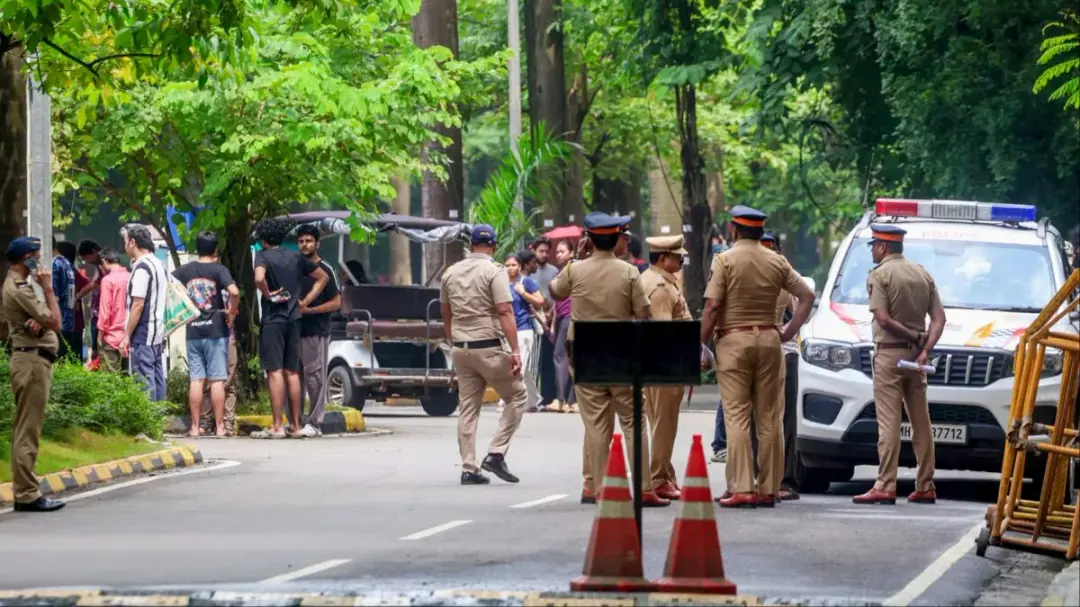
IIT Bombay director signs 18-point student charter after protests
IIT Bombay Director Professor Shireesh Kedare signed an 18-point student charter after a three-day sit-in over the death of a 22-year-old second-year student found dead in his hostel room on Friday, hours after allegedly being caught using a mobile phone and ChatGPT in a mid-semester exam. Demands include suspending Professor Suryanarayana Doolla, an independent probe and a public apology. PTI said Powai police registered a case on the parents' complaint and the Mumbai Crime Branch took over the probe.
Source
News18 — India · read the original report ↗
Desk check · some claims need care
What the desk checked (5)
- Director Shireesh Kedare signed an 18-point student charter after a three-day sit-in near the campus main gate. — Attributed in source to multiple media reports citing meeting details; not independently verified.
- Charter demands include suspension of Professor Suryanarayana Doolla, a public apology over a LinkedIn post, an independent probe, interim report by September 30 and final report by October 15. — Source credits the charter contents to India Today and Lokmat reporting.
- Powai police registered an FIR under Section 108 BNS and the SC/ST (Prevention of Atrocities) Act after the parents' complaint; Mumbai Crime Branch took over the probe. — Attributed to PTI in the source.
- The 22-year-old second-year student was found dead in his hostel room on Friday evening, hours after allegedly being caught using a mobile phone and ChatGPT in a mid-semester exam. — Attributed to PTI; institute says no disciplinary action was initiated.
- This was the third reported suicide at IIT Bombay in seven months. — Attributed to PTI; earlier cases cited as February and July without further detail.
Analysts’ view opinion
Signing an 18-point charter after a three-day sit-in is fast crisis management, but it is not yet policy design — the gap between agreement and implementation remains wide. The charter bundles two very different kinds of demands: immediate punitive action against an individual (suspension of Professor Doolla) and long-horizon institutional reform on mental health, counselling, disciplinary process and student representation. With PTI reporting this as the third such death in seven months, the real test is whether the charter becomes institutional policy or stays a document signed under pressure.
- Packing individual accountability and systemic reform into one document carries a known risk: once the punitive demands are met, pressure on the slower structural reforms tends to fade.
- The deadlines are unusually sharp for campus settlements in India — an open house before September 22, an interim report by September 30, a final report by October 15, and resignations of the Director and Deans if demands are unmet in a month, plus weekly written updates.
- The institute's own account is that no disciplinary action was initiated and that the instructor and Head of Department counselled the student, while the Faculty Forum says Doolla followed institutional protocol — which raises a natural-justice question about acting against a named individual before an inquiry concludes.
- With Powai police registering an FIR under Section 108 of the Bharatiya Nyaya Sanhita and the SC/ST (Prevention of Atrocities) Act, and the Mumbai Crime Branch now investigating, an institutional inquiry will run parallel to a criminal probe — and the boundaries between the two need to be kept clear.
- The demand for external members and members recommended by student representatives signals eroded trust in purely internal committees, a familiar pattern in past campus inquiries.
What to watch — Watch whether the September 22 open house and September 30 interim report actually materialise, and how the independent committee is composed — those three markers will reveal how seriously the charter is being implemented.
The story does not establish what caused the death or whether the harassment and caste-discrimination allegations are borne out — that is for the police probe and the proposed independent inquiry to determine — nor does it establish how the signed demands will actually be operationalised.
Deep dive
Research brief · 8 facts · 8 dates · exam-readyThe brief
Context
A 22-year-old second-year IIT Bombay student was found dead in his hostel room on a Friday evening, hours after he was allegedly caught using a mobile phone and ChatGPT during a mid-semester examination. Students held a three-day sit-in near the campus main gate demanding accountability, and on Sunday night Director Professor Shireesh Kedare signed an 18-point charter of their demands. Powai police registered an FIR on the parents' complaint alleging institutional harassment and caste-based discrimination, and the Mumbai Crime Branch has taken over the probe. The institute says the student uploaded the question paper to ChatGPT but that no disciplinary action had been initiated against him.
Key facts
- IIT Bombay Director Professor Shireesh Kedare signed an 18-point student charter late Sunday after a three-day sit-in near the campus main gate.
- The student, aged 22 and in his second year, was found dead in his hostel room on Friday evening, hours after the alleged exam incident.
- Powai police registered an FIR under Section 108 of the Bharatiya Nyaya Sanhita (abetment of suicide) and under the SC/ST (Prevention of Atrocities) Act on the parents' complaint.
- Professor Suryanarayana Doolla was named as an accused; the Mumbai Crime Branch took over the probe and was likely to summon him and others.
- Charter demands include immediate suspension of Professor Doolla and removal of any stakeholders found guilty after the investigation.
- Students sought an interim report by September 30 and a final report by October 15, and an open house with the Director, Dean SA, Dean AP and the department head before September 22.
- The charter says the Director, Dean AP and Dean SA should resign if specified demands are not implemented within one month, with weekly progress updates.
- PTI reported this was the third reported suicide at IIT Bombay in seven months, with two other student deaths in February and July.
Timeline
- FebruaryA student death by suicide reported at IIT Bombay (one of two earlier cases cited by PTI).
- JulySecond earlier student death by suicide reported at IIT Bombay.
- FridayThe 22-year-old second-year student was found dead in his hostel room, hours after allegedly being caught using a mobile phone and ChatGPT in a mid-semester exam.
- After the death (three days)Students held a sit-in protest near the campus main gate demanding accountability and transparency.
- Late SundayDirector Shireesh Kedare signed the 18-point charter after a prolonged meeting with protesting students.
- Before September 22 (sought)Open house with the Director, Dean SA, Dean AP and the student's department head.
- September 30 (sought)Interim report of the independent investigation committee.
- October 15 (sought)Final report of the independent investigation committee.
Who has a stake
- Deceased student's family — Complained to Powai police alleging institutional harassment and caste-based discrimination; seeking accountability and justice.
- IIT Bombay administration (Director Shireesh Kedare, Dean SA, Dean AP) — Signed the 18-point charter; faces demands to resign if specified demands are not implemented within a month.
- Professor Suryanarayana Doolla — Named as an accused in the FIR; students demand his immediate suspension; likely to be summoned by the Crime Branch.
- IIT Bombay Faculty Forum — Expressed solidarity with Doolla, saying he followed institutional protocol in reporting alleged academic malpractice, and objected to the 'tarnishing' of his reputation.
- Protesting students — Seek an independent probe, public apology over a LinkedIn post they called defamatory, mental-health reforms and greater student representation.
- Mumbai Crime Branch and Powai police — Investigating the alleged abetment of suicide and atrocities case, including possible summons to faculty.
- Families of four people who lost loved ones at IIT Bombay in recent months — Charter seeks fair and prompt financial assistance and continued institutional support for them.
Why it matters
The case links three pressures on India's elite technical institutes at once: student mental health, caste-discrimination allegations, and how campuses police the use of AI tools like ChatGPT in examinations. With the Crime Branch probing an abetment-of-suicide FIR under the SC/ST Act while faculty defend the invigilator for following protocol, the episode tests whether institutional disciplinary processes are seen as fair by both students and teachers. It is the third reported suicide on the campus in seven months, making the charter's time-bound accountability clauses a test case for reform.
UPSC angle
Prelims pointers
- Section 108 of the Bharatiya Nyaya Sanhita deals with abetment of suicide; the FIR also invoked the SC/ST (Prevention of Atrocities) Act.
- IIT Bombay's Director is Professor Shireesh Kedare; the campus is located at Powai, Mumbai.
- The 18-point charter seeks an interim report by September 30 and a final report by October 15.
- The independent probe panel sought includes professors, student representatives and external members, and is to examine emergency and hospital response.
- PTI: third reported suicide at IIT Bombay in seven months (others in February and July).
- IIT Bombay stated no disciplinary action had been initiated against the student over the alleged ChatGPT use.
Mains framing
The IIT Bombay episode shows how an exam-integrity incident involving generative AI escalated into a crisis of institutional trust. The proximate trigger was an allegation of unauthorised smartphone and ChatGPT use in a mid-semester exam; the deeper issues flagged by the family's complaint are institutional harassment and caste-based discrimination, now under investigation via an FIR under BNS Section 108 and the SC/ST (Prevention of Atrocities) Act, with the Mumbai Crime Branch in charge. The students' 18-point charter is instructive because it combines punitive demands (suspension of the invigilating professor, removal of those found guilty, resignations if deadlines slip) with systemic ones: an independent committee with external and student-nominated members, time-bound interim and final reports, an open house with the Director and Deans, stronger counselling and mental-health sensitisation, reform of disciplinary procedures, and an independent mechanism with mental-health professionals to study student distress and recommend preventive steps. Against this, the Faculty Forum's defence that Doolla merely followed protocol in reporting alleged malpractice raises the question of procedural protection for teachers. The way forward suggested by the charter itself is transparent, participatory inquiry with written weekly updates, clearly codified academic-misconduct norms adapted to AI tools, accessible and non-punitive mental-health support, and credible grievance redress for caste-discrimination complaints so that neither students nor faculty are judged by street pressure.
Key terms
- 18-point charter
- The list of demands submitted by protesting IIT Bombay students, signed by Director Shireesh Kedare, covering probes, accountability and welfare reforms.
- Section 108, Bharatiya Nyaya Sanhita
- Provision relating to abetment of suicide, under which the Powai police registered the FIR.
- SC/ST (Prevention of Atrocities) Act
- Law invoked in the FIR after the family alleged caste-based discrimination against the deceased student.
- Dean SA / Dean AP
- Institute officials for Student Affairs and Academic Programmes; students sought their participation in an open house and their resignation if demands lapse.
- IIT Bombay Faculty Forum
- Faculty body that expressed solidarity with Professor Doolla, saying he followed protocol in reporting alleged academic malpractice.
- Mumbai Crime Branch
- Specialised police unit that took over the investigation into the student's alleged suicide.
Practice questions
- Examine the institutional factors behind recurring student suicides in premier technical institutions in India, using the IIT Bombay case, and suggest reforms in mental-health support and grievance redress.
- How should higher-education institutions frame academic-integrity rules for generative AI tools such as ChatGPT while protecting due process for students and invigilating faculty?
- Discuss the significance of invoking the SC/ST (Prevention of Atrocities) Act alongside abetment-of-suicide provisions in campus death cases. What safeguards ensure a fair investigation for all parties?
Grounded only in the source report — figures and dates are the source's, not inferred.