
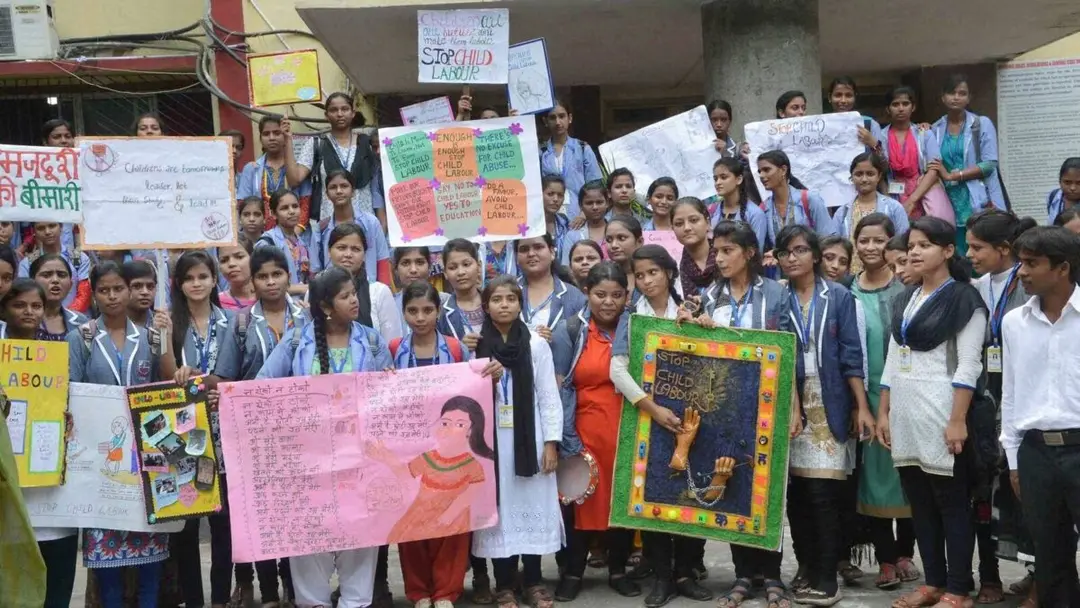
529 child labourers rescued in Bengaluru; rehabilitation now the challenge
Karnataka's crackdown on child labour, launched after Chief Minister DK Shivakumar's surprise visit to the APMC yard in Yeshwanthpur, has led to 529 children being rescued in Bengaluru and 105 cases against employers, with about 800 rescued statewide. Officials inspected 16,951 premises on September 13. Children were found in hotels, petrol pumps and warehouses. Police say no trafficking pattern was found, while experts stress rehabilitation and interstate coordination.
Source
News18 — India · read the original report ↗
Desk check · compared with the source
What the desk checked (5)
- 529 children rescued in Bengaluru and 105 cases registered against employers; around 800 rescued across Karnataka. — Figures appear in the source and are repeated consistently; attributed to the reported crackdown data.
- The crackdown followed CM DK Shivakumar's surprise visit to the APMC yard in Yeshwanthpur, where children were found working. — Stated as reported fact in the source; no direct quote from the CM given.
- On September 13, officials inspected 16,951 premises statewide and rescued over 800 children in two hours; Bengaluru accounted for 503. — Figures appear in the source; attributed to the statewide operation, no document cited.
- Police found no trafficking pattern; families were often working alongside children. — Attributed to Bengaluru Police Commissioner Seemant Kumar Singh; contrasted with former CWC Urban chairperson Meena Jain's call to examine the trafficking angle.
- Cases registered under the Child and Adolescent Labour (Prohibition and Regulation) Act, 1986, and the Juvenile Justice Act, 2015. — Legal provisions named in the source without direct official quote.
Analysts’ view opinion
The state machinery moved at speed only after Chief Minister DK Shivakumar's surprise visit to the Yeshwanthpur APMC yard — making this as much a political signal of hands-on leadership as an administrative drive. The headline numbers (16,951 premises inspected, over 800 children rescued in two hours) give the government immediate optics; but the political dividend will be decided in the rehabilitation phase, not the rescue phase. Labour Minister Santosh Lad framing this as "every citizen's responsibility" and the police adopting a "wait-and-watch" stance both raise the natural question of whether the momentum holds.
- That the crackdown began with the Chief Minister personally showing up at the APMC yard gives him direct ownership of the initiative and a visible leadership narrative.
- With 105 cases filed against employers, discontent among hotel, retail and fuel-station operators is a plausible pressure point for the government from local business constituencies.
- Because the rescued children come from Bihar, Rajasthan, UP, West Bengal, Assam, Jharkhand and Nepal, this stops being a purely Karnataka issue and becomes an interstate — and cross-border — coordination question.
- The Police Commissioner says no trafficking pattern was found while child rights experts want the trafficking angle examined; that divergence is likely to become the focal point of any accountability debate.
- The Labour Minister's insistence that his department cannot do this alone, plus his appeal for public participation, spreads responsibility across departments and citizens — which also cushions political blame if lapses recur.
What to watch — Watch whether, once the raids taper off, the government puts in place a concrete rehabilitation mechanism and interstate coordination framework for the 529 rescued children in Bengaluru — that will determine the political credibility of the drive.
The story does not establish any political reactions or opposition criticism, nor any budget, timeline or institutional plan for rehabilitation, and whether trafficking is involved remains unresolved.
Deep dive
Research brief · 8 facts · 4 dates · exam-readyThe brief
Context
Karnataka has launched a statewide crackdown on child labour after Chief Minister DK Shivakumar made a surprise visit to the APMC yard in Yeshwanthpur, Bengaluru, where children were found working. A coordinated police-Labour Department drive followed, inspecting nearly 17,000 premises and rescuing children from hotels, petrol pumps, grocery stores and logistics warehouses. While officials describe the drive as a success in numbers, child rights experts argue that rescue is only the first step, and that profiling, trauma care, rehabilitation and interstate coordination are the harder tasks. Police say the pattern points to family-driven "livelihood" labour rather than organised trafficking, a reading that experts contest.
Key facts
- 529 children have been rescued in Bengaluru and 105 cases registered against employers, according to figures cited in the report.
- Around 800 children have been rescued across Karnataka in the crackdown.
- On September 13, police and Labour Department officials inspected 16,951 premises across Karnataka and rescued over 800 children in two hours.
- Bengaluru accounted for 503 of the September 13 rescues, the highest in the state; the city's overall total reached 529.
- Bengaluru police teams inspected 5,897 premises across 188 police station limits in the city.
- Cases were registered under the Child and Adolescent Labour (Prohibition and Regulation) Act, 1986, and the Juvenile Justice Act, 2015.
- The rescued children came from Karnataka, Bihar, Rajasthan, Uttar Pradesh, West Bengal, Assam, Jharkhand and Nepal.
- The initial APMC yard drive rescued around 19 children, after which police shortlisted about 67 labour-intensive locations for checks.
Timeline
- Recent (date not stated in the source)CM DK Shivakumar makes a surprise visit to the APMC yard in Yeshwanthpur; children found working there.
- After the APMC visitPolice rescue around 19 children at APMC and shortlist about 67 labour-intensive locations across Bengaluru for checks.
- September 13Statewide operation: 16,951 premises inspected; over 800 children rescued in two hours; Bengaluru accounts for 503.
- As reportedBengaluru total rises to 529 rescues with 105 cases against employers; focus shifts to rehabilitation.
Who has a stake
- Rescued children (529 in Bengaluru, ~800 statewide) — Risk of returning to the same workplaces; need profiling, shelter, emotional first aid and rehabilitation.
- Karnataka Labour Department (Minister Santosh Lad) — Conducts raids, registers cases, maps locations and shuts establishments; says it cannot tackle the issue alone.
- Bengaluru City Police (Commissioner Seemant Kumar Singh) — Executed inspections across 188 station limits; says no trafficking pattern found, calls it a livelihood issue.
- Child Welfare Committees (CWC) and former CWC members like Meena Jain — Handle post-rescue procedures; Jain seeks a special panel of former CWC members to report on rehabilitation.
- Employers in hotels, petrol pumps, grocery stores and logistics units — Face 105 cases in Bengaluru and closure of establishments after action.
- Source states (Bihar, Rajasthan, UP, West Bengal, Assam, Jharkhand) and Nepal — Need interstate/cross-border coordination for repatriation and rehabilitation of children and families.
Why it matters
The scale of the drive — 16,951 premises inspected in a single day and over 800 children rescued — shows how visible and widespread child labour remains in India's tech capital and its supply chains. But without profiling, trauma care and interstate coordination, rescued children can slide straight back into the same establishments, turning enforcement into a cycle of raids. The dispute over whether this is trafficking or family-driven livelihood labour determines which laws, agencies and remedies apply.
UPSC angle
Prelims pointers
- Child and Adolescent Labour (Prohibition and Regulation) Act, 1986 and Juvenile Justice Act, 2015 were invoked in the Bengaluru cases.
- September 13 statewide drive: 16,951 premises inspected in Karnataka; over 800 children rescued in two hours.
- Bengaluru: 529 children rescued, 105 cases against employers, 5,897 premises checked across 188 police station limits.
- Police classified cases in two categories — children below 14 and those aged 14 to 18.
- Rescued children hailed from Karnataka, Bihar, Rajasthan, UP, West Bengal, Assam, Jharkhand and Nepal.
- Child Welfare Committee (CWC) is the statutory body under the Juvenile Justice Act handling children in need of care and protection.
Mains framing
Karnataka's post-APMC crackdown illustrates both the reach and the limits of enforcement-led responses to child labour. The drive's numbers — 16,951 premises inspected, over 800 children rescued statewide, 529 in Bengaluru with 105 employer cases — reveal that child labour is concentrated in labour-intensive, low-visibility segments such as hotels, petrol pumps, grocery stores and logistics warehouses, and that it is sustained by migration from Bihar, Rajasthan, UP, West Bengal, Assam, Jharkhand and Nepal. The causal accounts differ: the Bengaluru police commissioner frames it as a livelihood strategy in which whole families, including children under 14, work together and older children's ages are misrepresented as above 18, while a former CWC Urban chairperson insists the trafficking angle be examined since parents may be enticed with money or promises of a better life. The implication is that rescue without rehabilitation risks recycling children back into the same workplaces. A grounded way forward, as articulated in the story, includes profiling every rescued child, immediate interstate coordination between Labour Departments and Juvenile Justice authorities, emotional first aid and shelter beyond routine CWC procedures, a dedicated review panel reporting on rehabilitation, convergence between Labour, Revenue and Police Departments, and a public awareness campaign encouraging citizens to report child employment rather than ignore it.
Key terms
- APMC yard, Yeshwanthpur
- Agricultural produce market complex in Bengaluru where the CM's surprise visit found children working, triggering the crackdown.
- Child and Adolescent Labour (Prohibition and Regulation) Act, 1986
- Central law under which cases were registered against employers of children and adolescents in Bengaluru.
- Juvenile Justice Act, 2015
- Law governing children in need of care and protection; its authorities handle rescued children alongside the Labour Department.
- Child Welfare Committee (CWC)
- Statutory body under the JJ Act that processes rescued children; experts say its routine procedures alone are inadequate here.
- Interstate coordination
- Network sought between Labour Departments and JJ authorities across states and Nepal, since rescued children come from many regions.
Practice questions
- Rescue is only the beginning of the response to child labour. Examine this statement in the light of Karnataka's recent crackdown, and suggest measures for effective rehabilitation of rescued children.
- Distinguish between trafficking-driven child labour and family-driven 'livelihood' child labour. How should legal and administrative responses differ in each case?
- Discuss the role of interstate coordination and public participation in enforcing the Child and Adolescent Labour (Prohibition and Regulation) Act, 1986 in destination cities with high migrant inflows.
Grounded only in the source report — figures and dates are the source's, not inferred.