
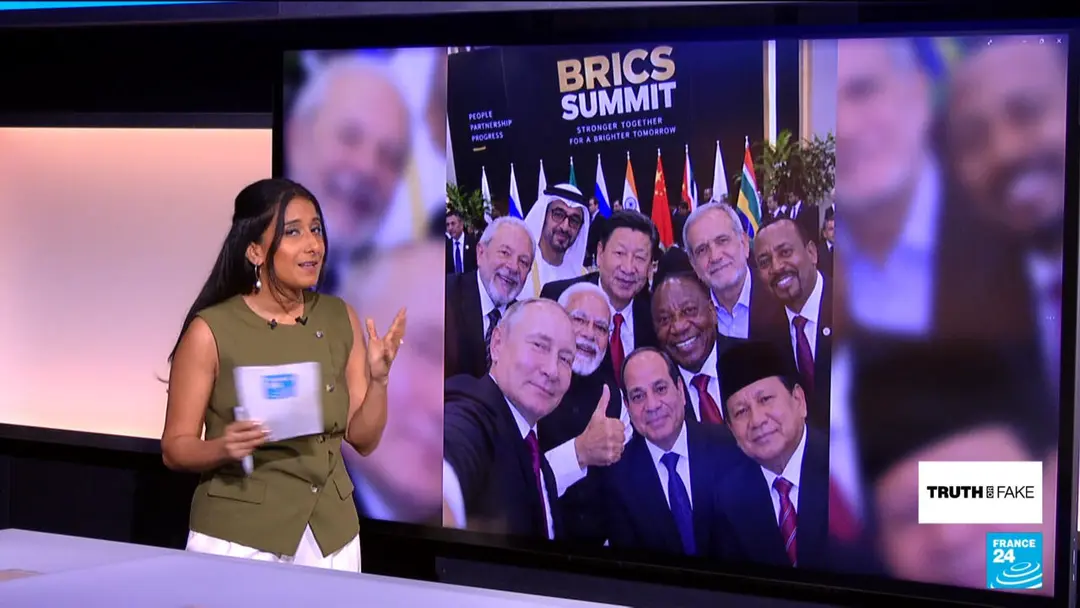
Viral BRICS summit selfie of Putin, Modi, Xi is AI-generated
A selfie shared widely online purporting to show Vladimir Putin, Xi Jinping, Narendra Modi and other leaders together at the BRICS 2026 summit in New Delhi is AI-generated, a France 24 fact-check found. A SynthID watermark indicates it was made with OpenAI tools. Brazil's Lula and Turkey's Erdogan did not attend; a second image also included Ebrahim Raisi, who died in a helicopter crash in May 2024. Russia's embassy in South Africa and Iranian embassy accounts shared the images. BJP spokesperson Shazia Ilmi deleted her post, calling it a "mistake".
Source
France 24 · read the original report ↗
Desk check · compared with the source
What the desk checked (5)
- A viral selfie showing Putin, Xi, Modi and other leaders at the BRICS summit in New Delhi is AI-generated. — Attributed to France 24 fact-check; source cites an invisible SynthID watermark indicating creation with OpenAI tools.
- Brazil's President Lula did not attend the summit; Brazil was represented by Foreign Minister Mauro Vieira. — Stated in source as verification evidence; no external document cited.
- Abu Dhabi was represented by Crown Prince Sheikh Khaled bin Mohamed bin Zayed Al Nahyan, not Sheikh Mohamed bin Zayed. — Appears in source text as a detection clue; no separate attribution given.
- A second AI image includes former Iranian president Ebrahim Raisi, who died in a helicopter crash in May 2024. — Date and manner of death appear in source; consistent with the debunking argument.
- BJP spokesperson Shazia Ilmi shared the second image, later deleted it and called it a 'mistake'. — Quoted word attributed to Ilmi in source; the deletion is reported, not independently shown.
Analysts’ view opinion
This is more than a photo blunder — it shows how cheaply the strategic message of "BRICS unity" can now be manufactured. The fact that Russia's embassy in South Africa and official Iranian embassy accounts amplified an AI image with a line like "BRICS is a superpower" points to a preference for a flattering narrative over verification. And the presence of Raisi, who died in 2024, alongside Turkey's Erdogan — Turkey being neither a BRICS member nor partner — shows how careless the amplification was.
- When official embassy accounts push a fabricated image, it stops being an ordinary viral post and becomes a question of diplomatic credibility.
- With the bloc seeking a larger role in global affairs, a visual of leaders standing shoulder to shoulder carries real political value — which is precisely why it travelled so fast.
- The story notes Lula and Erdogan were absent, with Brazil represented by its foreign minister and Abu Dhabi by its crown prince — those levels of representation are the real diplomatic signal.
- Detection via the invisible SynthID watermark underlines how much verification of AI-driven influence content now depends on technical provenance markers.
- BJP spokesperson Shazia Ilmi's use of the image in a domestic political jab, later deleted as a "mistake", shows how foreign-policy imagery gets pulled into internal political contests.
What to watch — Watch whether the embassy accounts delete or explain the posts, and whether this triggers any push for verification standards on official diplomatic channels.
The story does not establish who created the images, with what intent, or whether the accounts that shared them knew they were fake.
Deep dive
Research brief · 8 facts · 4 dates · exam-readyThe brief
Context
A selfie circulating online appeared to show Vladimir Putin photographing himself with Xi Jinping, Narendra Modi and other leaders at the BRICS 2026 summit in New Delhi, feeding a narrative of BRICS unity. A France 24 fact-check by Vedika Bahl found the image to be AI-generated, carrying an invisible SynthID watermark indicating it was made using OpenAI tools. A second, similar AI selfie also spread, this one including Turkey's Erdogan and former Iranian President Ebrahim Raisi, who died in a helicopter crash in May 2024. Both images were amplified by official embassy accounts and Indian political figures.
Key facts
- A viral selfie purporting to show Putin, Xi, Modi and other leaders at the BRICS 2026 summit in New Delhi is AI-generated, per a France 24 fact-check by Vedika Bahl.
- The image carries an invisible digital watermark known as SynthID, which indicates it was created using OpenAI tools.
- Russia's embassy in South Africa shared the image with the message "BRICS is a superpower"; the post received millions of views.
- Official Iranian embassy accounts in India and Armenia also shared the image.
- Brazilian President Lula did not attend the summit; Brazil was represented by Foreign Minister Mauro Vieira, who was pictured with Modi at the event.
- The selfie shows Abu Dhabi's President Sheikh Mohamed bin Zayed, but Abu Dhabi was represented by Crown Prince Sheikh Khaled bin Mohamed bin Zayed Al Nahyan.
- A second AI selfie included Turkish President Erdogan, though Turkey is not a BRICS member or partner country, and former Iranian President Ebrahim Raisi, who died in a helicopter crash in May 2024.
- BJP spokesperson Shazia Ilmi posted the second image with the caption "this pic says all", tagging opposition politicians including Rahul Gandhi, then deleted it and called it a "mistake".
Timeline
- May 2024Former Iranian President Ebrahim Raisi dies in a helicopter crash.
- BRICS 2026 summitLeaders of major emerging economies gather in New Delhi; Brazil sends Foreign Minister Mauro Vieira and Abu Dhabi sends Crown Prince Sheikh Khaled bin Mohamed bin Zayed Al Nahyan.
- During/after the summitTwo AI-generated 'selfies' of BRICS leaders go viral, shared by Russia's embassy in South Africa and Iranian embassy accounts in India and Armenia.
- SubsequentlyBJP spokesperson Shazia Ilmi deletes her post carrying the second AI image, calling it a "mistake".
Who has a stake
- BRICS bloc — Its push for a greater role in global affairs is being bolstered online by fabricated imagery of leaders' unity.
- Russia's embassy in South Africa — An official state account amplified an AI-generated image with the caption "BRICS is a superpower", drawing millions of views.
- Iranian embassies in India and Armenia — Official diplomatic accounts shared a fabricated image, including one version featuring a deceased Iranian president.
- Shazia Ilmi, BJP spokesperson — Posted the fake image tagging opposition leaders, then deleted it and admitted a "mistake".
- Fact-checkers such as France 24's Vedika Bahl — Tasked with detecting synthetic images using watermarks like SynthID and internal inconsistencies.
- Leaders depicted falsely (Lula, Erdogan, Sheikh Mohamed bin Zayed, Raisi) — Shown at an event they did not attend, or in Raisi's case after his death, distorting the diplomatic record.
Why it matters
When official embassy accounts and ruling-party spokespersons circulate AI-generated images of a summit, synthetic media stops being a fringe problem and becomes part of state and political messaging. Detection tools such as SynthID watermarks and basic verification of who actually attended an event are now essential civic skills, not just journalistic ones.
UPSC angle
Prelims pointers
- SynthID: an invisible digital watermark that in this case indicated the image was created using OpenAI tools.
- BRICS 2026 summit was held in New Delhi; Turkey is not a BRICS member or partner country.
- Brazil was represented at the summit by Foreign Minister Mauro Vieira, not President Lula.
- Abu Dhabi was represented by Crown Prince Sheikh Khaled bin Mohamed bin Zayed Al Nahyan.
- Iran's current president named in the fake image is Masoud Pezeshkian; former president Ebrahim Raisi died in a helicopter crash in May 2024.
- The fact-check was carried out by France 24's Vedika Bahl.
Mains framing
The viral BRICS 'selfies' illustrate how generative AI is reshaping diplomatic communication and political messaging. The causes are structural: cheap, realistic image generation, the reputational incentive for a bloc seeking a larger global role to project unity, and social platforms that reward emotionally satisfying images over verified ones. The implications are serious because the amplifiers were not anonymous trolls but Russia's embassy in South Africa, Iranian embassies in India and Armenia, and a spokesperson of India's ruling party, who tagged opposition leaders before deleting the post as a "mistake". Verification, however, remains feasible: the images carried a SynthID watermark pointing to OpenAI tools, and simple attendance checks exposed them, since Lula was absent (Brazil sent Foreign Minister Mauro Vieira), Abu Dhabi sent its Crown Prince rather than Sheikh Mohamed bin Zayed, Erdogan was absent and Turkey is not even a BRICS member or partner, and Raisi died in May 2024. The way forward, on the evidence of this case, lies in provenance watermarking, institutional verification discipline before official accounts post, and prompt correction when errors occur.
Key terms
- SynthID
- An invisible digital watermark embedded in AI-generated content; here it showed the image was created using OpenAI tools.
- BRICS
- Bloc of major emerging economies, including India, China, Russia, Brazil and South Africa, whose 2026 summit was held in New Delhi.
- BRICS partner country
- A status distinct from full membership; the source notes Turkey is neither a BRICS member nor a partner country.
- AI-generated image (synthetic media)
- A fabricated visual created by generative AI tools, detectable via watermarks or internal factual inconsistencies.
- Fact-check
- Verification process, here by France 24's Vedika Bahl, testing viral claims against watermarks and the record of who attended.
Practice questions
- How does the sharing of AI-generated images by official embassy accounts complicate the distinction between public diplomacy and disinformation? Discuss with reference to the BRICS 2026 summit selfies.
- Watermarking technologies such as SynthID are necessary but not sufficient to counter synthetic media. Critically examine.
- What verification practices should political parties and government accounts adopt before sharing visual content on social media? Illustrate with recent examples.
Grounded only in the source report — figures and dates are the source's, not inferred.