
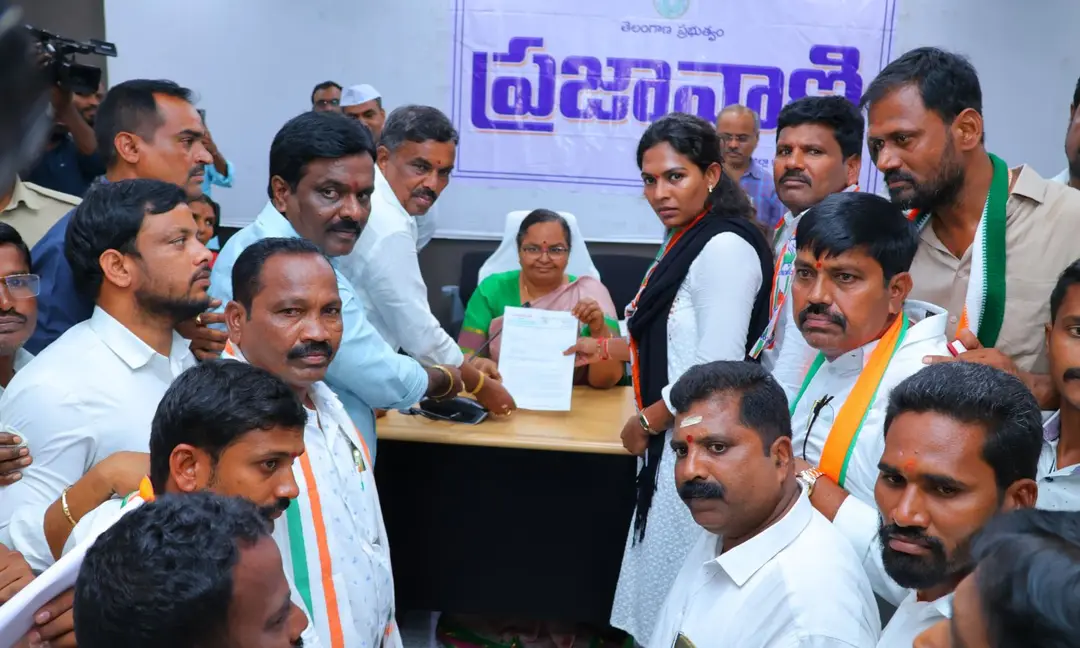
Siddipet collector orders Prajavani grievances resolved in a week
District Collector K. Haimavathi, along with Additional Collector (Revenue) Lakshmi Kiran, received petitions from people across the district at the Prajavani programme held on Monday in the Siddipet collectorate meeting hall. A total of 120 petitions on various issues were received. The collector examined each petition and directed officials of concerned departments to take resolution steps within a week and submit an action-taken report at next week's Prajavani. District Revenue Officer Nagarajamma and trainee deputy collector Bhavya also attended.
Source
Siddipet — స్థానికం · read the original report ↗
Desk check · compared with the source
What the desk checked (4)
- 120 petitions were received at the Prajavani programme held at the Siddipet collectorate meeting hall on Monday. — Figure appears in source; attributed to the reported event proceedings, no independent document cited.
- Collector K. Haimavathi directed officials to resolve the grievances within one week and submit an action-taken report at next week's Prajavani. — Attributed to the collector in the source text.
- Additional Collector (Revenue) Lakshmi Kiran received petitions along with the collector. — Named in source; role stated without further attribution.
- District Revenue Officer Nagarajamma, a special deputy collector, trainee deputy collector Bhavya and other district officials attended. — Names listed in source; the special deputy collector is unnamed in the original.
Analysts’ view opinion
Praja Vani may be an administrative exercise, but its political value is not small — it is one of the few platforms where citizens stand directly before the state machinery, which makes the volume of petitions a rough gauge of grassroots discontent. In Siddipet, 120 petitions arrived, and Collector K. Haimavathi's instruction that officials act within a week and submit an action-taken report at the next Praja Vani can be read as an attempt to fix accountability on the bureaucracy directly, bypassing intermediaries. It reinforces the broader governmental message of "responsive administration": if delivery follows, the credit accrues upward to the government; if it does not, so does the criticism.
- Setting both a one-week deadline and a compulsory action-taken report introduces measurable accountability — politically useful because it produces visible results.
- One hundred and twenty petitions in a single sitting suggests citizens still depend heavily on such grievance forums rather than routine departmental channels.
- Petitions at such forums typically centre on revenue and land issues, which makes the presence of the Additional Collector (Revenue) and the District Revenue Officer significant — though the story does not break down the nature of the petitions.
- Visible redressal ultimately credits the government of the day; a growing backlog would hand the same platform to the opposition as a talking point.
- The participation of district officers including a trainee deputy collector signals an intent to embed this as administrative culture rather than a weekly ritual.
What to watch — Watch whether action-taken reports are actually tabled at the next Praja Vani and what share of the 120 petitions is shown as resolved — that is the real test of this directive.
The story does not establish the category-wise nature of the petitions, the disposal record of earlier Praja Vani sessions, or any political reaction to the collector's directive.
Deep dive
Research brief · 8 facts · 3 dates · exam-readyThe brief
Context
Prajavani is a weekly public grievance redressal programme held at district collectorates in Telangana, where citizens submit petitions directly to the district administration. At Siddipet district collectorate, the programme was held on Monday in the collectorate meeting hall, with District Collector K. Haimavathi receiving petitions alongside Additional Collector (Revenue) Lakshmi Kiran. A total of 120 petitions on various issues were received from people across the district, and the Collector set a one-week deadline for departments to act.
Key facts
- 120 petitions on various issues were received at the Siddipet Prajavani programme held on Monday.
- District Collector K. Haimavathi received the petitions along with Additional Collector (Revenue) Lakshmi Kiran.
- The venue was the meeting hall of the Siddipet collectorate.
- The Collector examined each petition personally and issued directions to officials of the concerned departments.
- Officials were told to take resolution steps within one week and submit an action-taken report at the next week's Prajavani.
- Petitioners came from all four corners (all parts) of the district, as stated in the source.
- District Revenue Officer Nagarajamma and trainee deputy collector Bhavya attended the programme.
- Also present were district officers of various departments, the collectorate Administrative Officer (AO) and superintendents.
Timeline
- Monday (day of the programme)Prajavani held in Siddipet collectorate meeting hall; 120 petitions received; Collector directs departments to act within a week.
- 28 September 2026, 5:34 PM ISTReport on the Prajavani programme published.
- Next week's PrajavaniConcerned departments to submit action-taken reports on the petitions received.
Who has a stake
- Petitioners from across Siddipet district — Seek resolution of personal and civic grievances; the source notes they come with great faith that their problems will be solved.
- District Collector K. Haimavathi — Heads grievance redressal, examines each petition and enforces the one-week action deadline.
- Additional Collector (Revenue) Lakshmi Kiran — Jointly received the petitions; shares responsibility for revenue-side redressal.
- District Revenue Officer Nagarajamma and trainee deputy collector Bhavya — Attended the programme; part of the revenue machinery expected to follow up on petitions.
- District officers of various departments, collectorate AO and superintendents — Must take resolution steps within a week and report action taken at the next Prajavani.
Why it matters
Prajavani is the most direct interface between citizens and district administration, and the volume of 120 petitions in a single sitting signals continuing demand for grievance redressal outside routine office channels. By fixing a one-week deadline and requiring action-taken reports at the next sitting, the Collector converts a petition-receiving event into a monitored follow-up mechanism. For aspirants, it illustrates how district-level administrative accountability and citizen-centric governance work in practice.
UPSC angle
Prelims pointers
- Prajavani: weekly public grievance redressal programme at district collectorates in Telangana.
- Siddipet District Collector: K. Haimavathi; Additional Collector (Revenue): Lakshmi Kiran.
- 120 petitions received at the Monday Prajavani in the Siddipet collectorate meeting hall.
- Deadline set: resolution steps within one week; action-taken report at next week's Prajavani.
- District Revenue Officer (DRO) Nagarajamma and trainee deputy collector Bhavya attended.
- Report published on 28 September 2026.
Mains framing
Grievance redressal at the district level in India rests heavily on the Collector's office, and programmes such as Prajavani institutionalise a fixed day and venue where citizens can hand over petitions directly to the district head. The Siddipet case shows both the demand side, 120 petitions in one sitting from across the district, and an accountability design on the supply side: the Collector examined each petition, directed the concerned departments, set a one-week window for action, and required an action-taken report at the following week's programme, which creates a documented review loop rather than a one-off receipt of paper. The implicit challenge is that such platforms can become volume-driven if petitions are merely forwarded, so the value lies in verification of outcomes, categorisation of recurring complaints and feedback to the petitioner. A grounded way forward, consistent with what the source records, is strict adherence to the one-week timeline, presence of district officers of all departments as happened here, and use of the weekly action-taken report as a standing performance review of departments; broader claims beyond these are not stated in the source.
Key terms
- Prajavani
- Public grievance programme where citizens submit petitions directly to the district administration; held weekly at the collectorate.
- District Collector
- Senior-most administrative officer of a district, here K. Haimavathi of Siddipet, who reviewed each petition and issued directions.
- Additional Collector (Revenue)
- Officer assisting the Collector on revenue administration; Lakshmi Kiran received petitions along with the Collector.
- District Revenue Officer (DRO)
- District-level revenue official, here Nagarajamma, part of the collectorate's revenue hierarchy attending the programme.
- Action-taken report
- Written report by a department stating the steps taken on a grievance, to be submitted at the next week's Prajavani.
- Trainee deputy collector
- Probationary officer undergoing field training in district administration; Bhavya attended the Siddipet programme.
Practice questions
- Examine the role of the District Collector in citizen grievance redressal, using the Prajavani programme as an illustration.
- How do time-bound action-taken reports improve accountability in district administration? Discuss with reference to the Siddipet Prajavani directive.
- "Grievance platforms succeed only when follow-up is monitored." Critically analyse in the context of weekly public petition programmes at the district level.
Grounded only in the source report — figures and dates are the source's, not inferred.