
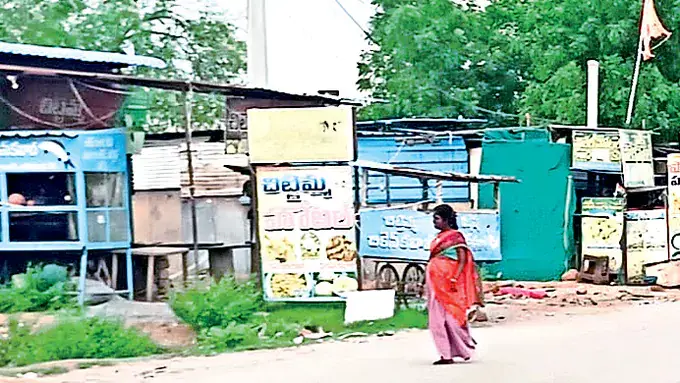
Rythu Bharosa drawn on non-agricultural land in Anantapur
Many landowners in Anantapur district are receiving schemes such as Rythu Bharosa without converting agricultural land to non-agricultural use, officials said. Registration value in the division's 12 mandals ranges from Rs 1 crore to Rs 5 crore an acre. At Narpala junction, 2.95 acres in Survey No. 157-1 valued at Rs 1.59 crore is shown as farmland though shops operate there. RDO Premanth Kumar issued a notice seeking Rs 35.32 lakh, including late fee, within 15 days. Officials estimate hundreds of such cases.
Source
Anantapur — స్థానికం · read the original report ↗
Desk check · some claims need care
What the desk checked (5)
- Land values in Anantapur revenue division range from Rs 1 crore to Rs 5 crore per acre as per registration value — Figure appears in source; no supporting document or department citation given.
- 2.95 acres in Survey No. 157-1 at Narpala junction is valued at Rs 1.59 crore and still shown as agricultural land though shops operate on it — Specific details appear in source, presented as reporter's observation; not directly attributed to a named official.
- RDO Premanth Kumar issued a notice seeking Rs 35.32 lakh including conversion fee and late fee, payable within 15 days — Attributed to the named RDO; consistent with the stated 5% conversion levy of Rs 7.98 lakh per acre.
- Hundreds of such cases exist in the division — Described as an officials' estimate; no data or record count provided.
- Revenue officials are hesitant to recover conversion fees and only issue notices — Presented as criticism in the source with no named source; RDO states recovery action is under way.
Analysts’ view opinion
At its core this is a revenue-leakage story. When land stays "agricultural" on paper while commercial shops operate on it, the state loses twice — it forgoes conversion and panchayat fees, and it pays Rythu Bharosa-type benefits to owners of what is effectively commercial property. In pockets where registration value runs from Rs 1 crore to Rs 5 crore an acre, a 5% conversion fee is not small change: a single Narpala survey number has drawn a demand of Rs 35.32 lakh, and officials estimate such cases run into the hundreds.
- Because land records (1B, adangal) do not reflect actual land use, both fee collection and beneficiary selection go wrong at the same time.
- Who gains and who pays: owners of commercialised plots gain by not converting, while genuine small farmers and panchayat-funded local services lose as scheme money and fee revenue leak away.
- Wherever land values rise sharply — city fringes, highway junctions — the gap between record and reality tends to widen, so this is unlikely to be a single-mandal problem.
- Adding a delay penalty on top of the 5% fee raises the total bill, which itself can discourage voluntary conversion — an incentive problem worth noting.
- The story itself carries the criticism that notices are issued and then left unpursued; without enforcement, demand notices remain paper revenue.
What to watch — Watch how much is actually collected once the fifteen-day deadline passes, how many more notices follow, and whether these plots are struck off 1B/adangal so scheme payments stop.
The story does not establish the total number of defaulters, the aggregate dues, or how much scheme money reached ineligible hands — "hundreds" is an official estimate — nor whether this reflects deliberate evasion or lagging record updates.
Deep dive
Research brief · 8 facts · 2 dates · exam-readyThe brief
Context
In Andhra Pradesh, land put to non-agricultural use must be formally converted by paying a conversion fee to the Revenue Department, after which the plot is removed from agricultural records (1-B and Adangal) and building permission must be taken from the gram panchayat by paying a separate fee. Once converted, farm-linked benefits such as Rythu Bharosa cannot apply to commercial land. In Anantapur district, officials say many owners have kept high-value commercial plots recorded as agricultural land, thereby escaping conversion and panchayat fees while still drawing Rythu Bharosa. The Anantapur revenue division covers 12 mandals where registration values are extremely high.
Key facts
- Anantapur revenue division has 12 mandals; land registration values there range from Rs 1 crore to Rs 5 crore per acre.
- High-value land belts named: Anantapur Rural, Narpala, Tadipatri, Raptadu, Guti, Guntakal, Uravakonda, Kalyandurg and Rayadurg.
- At Narpala junction, Survey No. 157-1 holds 2.95 acres of land recorded as agricultural, valued at Rs 1.59 crore per registration department rates.
- Open-market value of the Narpala plot is said to be higher than the registration value.
- Conversion charge is 5 per cent of value, working out to Rs 7.98 lakh per acre for this plot.
- Anantapur RDO Premanth Kumar issued a notice for Rs 35.32 lakh, including late fee, payable within 15 days.
- Commercial shops are running on the Narpala plot, yet owners continue to receive schemes such as Rythu Bharosa.
- Officials estimate hundreds of such cases in the revenue division; Narpala has the highest concentration.
Timeline
- Recently (date not stated in the source)Anantapur RDO Premanth Kumar issued a notice on the Narpala Survey No. 157-1 land demanding Rs 35.32 lakh in conversion and late fees within 15 days.
- OngoingNotices issued to many landowners; RDO says steps are being taken to recover dues from those owing money to the government.
Who has a stake
- Landowners with commercial use on agri-recorded land — Face demand notices for conversion fee plus late fee, and loss of scheme benefits once land is reclassified.
- Revenue Department / Anantapur RDO — Responsible for conversion approvals and fee recovery; faces criticism for issuing notices and not following up.
- Gram panchayats — Lose building permission fees when conversion is not done, weakening local revenue.
- State government exchequer — Crores in pending conversion fees plus wrongly paid Rythu Bharosa benefits.
- Genuine farmers — Scheme funds meant for cultivators are diverted to owners of commercial plots.
Why it matters
Land records are the basis for both taxation and welfare delivery; when commercial plots stay classified as farmland, the state loses conversion and panchayat fees while paying farm income support to non-farmers. With registration values of Rs 1 crore to Rs 5 crore an acre and hundreds of suspected cases in one revenue division alone, the leakage could run into crores. It also raises the question of whether revenue enforcement stops at issuing notices.
UPSC angle
Prelims pointers
- Rythu Bharosa: Andhra Pradesh farm support scheme; not applicable to land converted to non-agricultural use.
- 1-B and Adangal are village-level land records; converted land must be deleted from them.
- Conversion fee cited in the source: 5 per cent of registration value of the land.
- Narpala Survey No. 157-1: 2.95 acres, registration value Rs 1.59 crore, conversion cost Rs 7.98 lakh per acre.
- RDO (Revenue Divisional Officer) Premanth Kumar heads Anantapur revenue division of 12 mandals.
- Building permission for converted land requires a separate fee to the gram panchayat.
Mains framing
The Anantapur case illustrates how weak updating of land records becomes a double fiscal loss: the state forgoes conversion fees and panchayats forgo building permission fees, while farm income support is credited to owners of commercial plots. The proximate cause is that land continues to be shown in 1-B and Adangal as agricultural even where shops operate, and welfare eligibility is read directly off those records without cross-verification of actual land use. A second cause, as critics allege in the source, is enforcement that ends with the issue of tahkeeds (notices) rather than recovery; the RDO says recovery steps are now under way, with one notice demanding Rs 35.32 lakh including late fee within 15 days. The implications are equity-related as well as fiscal, since scheme money meant for cultivators reaches non-cultivators in belts where an acre is valued between Rs 1 crore and Rs 5 crore. The way forward suggested by the facts is systematic identification of such holdings, time-bound recovery of conversion and late fees, prompt deletion from agricultural records on conversion, and linking scheme eligibility to updated land classification.
Key terms
- Rythu Bharosa
- Andhra Pradesh government support scheme for farmers, applicable only to agricultural land.
- Land conversion
- Formal change of land classification from agricultural to non-agricultural on payment of a prescribed fee to the Revenue Department.
- 1-B / Adangal
- Village land records showing ownership and cultivation details; converted land must be removed from them.
- RDO
- Revenue Divisional Officer, the revenue authority for a division; Anantapur's division has 12 mandals.
- Tahkeed (notice)
- Official revenue notice served on a landowner demanding payment of dues such as conversion and late fees.
Practice questions
- How do outdated land-use records enable leakage in farm income support schemes? Discuss with reference to the Anantapur conversion fee case.
- Examine the fiscal and equity implications of non-conversion of agricultural land put to commercial use, for both state revenue and panchayat finances.
- What administrative reforms can ensure that welfare eligibility is linked to actual land use rather than stale revenue records?
Grounded only in the source report — figures and dates are the source's, not inferred.