
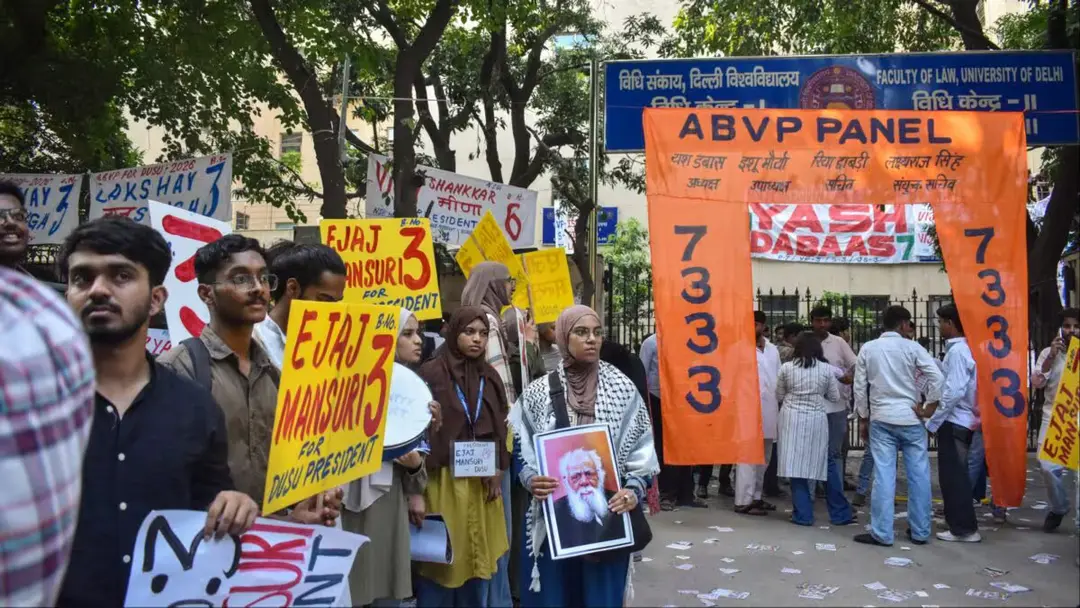
Delhi HC bars DUSU victory processions, notices to 140 candidates
The Delhi High Court on Friday barred victory processions after the declaration of Delhi University Students' Union (DUSU) election results, on roads as well as within the campus and hostels. A bench of Chief Justice Devendra Kumar Upadhyaya and Justice Tejas Karia issued show-cause notices to all 140 candidates and student organisations on collective electoral damages, saying Lyngdoh Committee norms were being brazenly violated. Additional Solicitor General Chetan Sharma said 998 challans were issued, 49 vehicles impounded, six FIRs registered and four arrests made.
Source
News18 — India · read the original report ↗
Desk check · compared with the source
What the desk checked (5)
- Delhi High Court barred victory processions after DUSU results on roads, campus and hostels. — Attributed to a bench of Chief Justice Devendra Kumar Upadhyaya and Justice Tejas Karia, with the order quoted in the source.
- Show-cause notices issued to all 140 candidates and student organisations over collective electoral damages. — Figure of 140 candidates appears in the source and is tied to the court's direction to DU to furnish the list.
- 998 challans issued, about 49 vehicles impounded, six FIRs and four arrests. — Attributed in the source to Additional Solicitor General Chetan Sharma during the hearing.
- Court said Lyngdoh Committee recommendations are being 'frequently and brazenly' violated. — Direct quote from the bench as reported; no independent verification possible.
- Counting scheduled for Friday and Saturday with results expected by Saturday. — Stated in the source as per the court proceedings; no separate official schedule cited.
Analysts’ view opinion
DUSU polls are never just student politics — through outfits linked to national parties, including NSUI and AAP's ASAP, they are a leadership nursery for mainstream politics. That is why the High Court's ban on victory processions, show-cause notices to all 140 candidates and the proposal of collective electoral damages strike directly at a culture where power is displayed through spectacle. Notably, no organisation emerged from the hearing with a clean claim of innocence, which leaves every side politically exposed rather than one.
- Because student union polls feed national parties' leadership pipelines, the court's censure is an uncomfortable signal for the parent parties too.
- For outfits that rely on the visual theatre of cavalcades and processions, losing the moment of public celebration is a real political cost.
- The proposal of collective damages is the sharpest element — it shifts liability from individual candidates to the organisational machinery.
- With counsel for NSUI and ASAP having to defend their conduct in court, no side is placed to claim moral high ground.
- The court's view that police and university action has not acted as a deterrent opens up political questions about administrative failure as well.
What to watch — Watch whether the ban actually holds once results are out, and which organisations end up facing collective damages after the violation records are filed within two weeks.
The story does not establish how much each organisation violated the norms, whether damages will finally be imposed, or what effect any of this will have on future election outcomes.
Deep dive
Research brief · 8 facts · 4 dates · exam-readyThe brief
Context
Elections to the Delhi University Students' Union (DUSU) are governed by the Lyngdoh Committee recommendations, which cap campaign spending and bar money, muscle power and defacement. Hearing a petition over violence and unruly conduct during the ongoing DUSU polls, a Delhi High Court bench of Chief Justice Devendra Kumar Upadhyaya and Justice Tejas Karia barred all victory processions after the results, on roads as well as inside the campus and hostels. The court issued show-cause notices to all 140 candidates and to student organisations, proposing "collective electoral damages" for violations. It said Lyngdoh norms were being "frequently and brazenly" violated and that police and university action was not proving to be a deterrent.
Key facts
- Delhi High Court on Friday barred any victory procession after declaration of DUSU results, on roads and within the university campus and hostels.
- Show-cause notices ordered to all 140 candidates contesting the DUSU polls and to all student organisations on why collective electoral damages should not be imposed.
- Bench of Chief Justice Devendra Kumar Upadhyaya and Justice Tejas Karia held that violation of the order would attract criminal and administrative action and amount to contempt of court.
- Additional Solicitor General Chetan Sharma told the court 998 challans were issued, around 49 vehicles impounded, six FIRs registered and four arrests made.
- The court said there could be no doubt that "frequent and brazen violation of Lyngdoh committee recommendations is occurring" and it needed to be checked "by all means".
- On cavalcades with vehicles lacking number plates and candidates standing on roofs and bonnets, the bench said: "These cavalcades create a sense of fear, terror and hegemony... What else is hooliganism?"
- ASG confirmed the person arrested for an assault on a teacher was a student, leading the court to note the issue of "outsiders" could not explain the incident.
- The petitioner must compile records establishing violations within two weeks, after which candidates and organisations get an opportunity to show cause against exemplary damages.
Timeline
- A day before the orderHigh Court warned it could take harsher steps, including staying counting of votes and declaration of results, if authorities failed to act against violence and unruly conduct.
- Friday (order date)Bench bars victory processions, issues show-cause notices to 140 candidates and student organisations, and directs DU to supply the candidate list.
- Friday and SaturdayCounting of DUSU votes scheduled, with the result expected by Saturday, as recorded in the proceedings.
- Within two weeks of the orderPetitioner to file compilation of records and documents establishing violations; candidates and organisations then get a chance to show cause.
Who has a stake
- Delhi High Court bench (CJ Devendra Kumar Upadhyaya, Justice Tejas Karia) — Enforcing Lyngdoh Committee norms and its own earlier orders; considering exemplary and collective electoral damages.
- 140 DUSU candidates — Face individual show-cause notices and possible damages, criminal and administrative action for poll violations.
- Student organisations, including NSUI and AAP's ASAP — Face collective electoral damages; NSUI said it used no money or muscle power, ASAP sought an apology over a candidate photographed on a vehicle roof.
- Delhi Police — Made responsible for ensuring no victory procession takes place; questioned over cavalcades and vehicles without number plates in North Campus.
- Delhi University administration — Directed to supply candidate list, prevent Lyngdoh violations and act against erring students; its show-cause notices seen as no deterrent.
- MCD and other authorities — Directed to ensure there is no defacement of public property during the election process.
- Teachers and campus residents — Safety at stake; the court cited an assault on a teacher and an earlier incident where a teacher was allegedly slapped after a candidate won.
Why it matters
Student union elections are a training ground for democratic politics, but the court's findings of cavalcades, defacement, arrests and an assault on a teacher point to money, muscle power and impunity displacing campus democracy. By proposing collective electoral damages on organisations and putting all 140 candidates on notice, the High Court is testing whether financial and contempt liability can enforce Lyngdoh norms where police challans and university notices have failed.
UPSC angle
Prelims pointers
- Lyngdoh Committee recommendations govern the conduct of students' union elections in Indian universities, including DUSU.
- Delhi HC bench in the DUSU case: Chief Justice Devendra Kumar Upadhyaya and Justice Tejas Karia.
- Order bars victory processions on roads and inside DU campus and hostels; violation amounts to contempt of court.
- Police action reported by ASG Chetan Sharma: 998 challans, ~49 vehicles impounded, 6 FIRs, 4 arrests.
- Show-cause notices issued to all 140 DUSU candidates plus student organisations on collective electoral damages.
- MCD directed to ensure no defacement of public property; petitioner to file compilation of violations in two weeks.
Mains framing
The DUSU episode illustrates a chronic gap between the normative framework for campus democracy and its enforcement. The Lyngdoh Committee recommendations were designed to curb money and muscle power in students' union elections, yet the Delhi High Court found their violation to be \"frequent and brazen\": cavalcades of vehicles without number plates bearing candidates' names, candidates atop roofs and bonnets, defacement of public property, and violence including an assault on a teacher by a student. The court's own reasoning identifies the causes as a deterrence deficit - challans, impoundments, FIRs and university show-cause notices have not altered behaviour - and its remedy shifts liability from individuals alone to organisations through proposed collective electoral damages, backed by contempt jurisdiction and a blanket ban on victory processions in roads, campus and hostels. The implications are twofold: judicially supervised enforcement may restore order and protect teachers and ordinary students, but sustainable reform requires the university and police to act preventively rather than reactively, with the record of violations compiled and adjudicated so that penalties are evidence-based. A way forward consistent with the order lies in strict, time-bound completion of the criminal proceedings, coordinated preventive action by DU, Delhi Police and civic bodies against defacement, and accountability of student organisations for the conduct of their candidates and supporters.
Key terms
- DUSU
- Delhi University Students' Union, the apex elected student body of Delhi University, whose polls were underway with counting on Friday and Saturday.
- Lyngdoh Committee recommendations
- Norms regulating the conduct of students' union elections, which the court said were being frequently and brazenly violated.
- Collective electoral damages
- Monetary liability the court proposes to impose jointly on student organisations and candidates for election-related violations.
- Show-cause notice
- Notice asking a party to explain why action - here, exemplary damages - should not be taken against it.
- Contempt of court
- Disobedience of a court order; the bench said breaching the victory procession ban would amount to contempt.
- Additional Solicitor General (ASG)
- Senior law officer of the Union government; ASG Chetan Sharma placed the police enforcement figures before the court.
Practice questions
- The Delhi High Court has described violations of the Lyngdoh Committee recommendations as "frequent and brazen". Examine why enforcement of campus election norms has failed and suggest institutional remedies.
- Discuss the propriety and likely effectiveness of imposing "collective electoral damages" on student organisations for the conduct of their candidates and supporters.
- Student union elections are seen as a nursery of democratic leadership. In light of the DUSU case, critically evaluate the role of money, muscle power and judicial intervention in campus politics.
Grounded only in the source report — figures and dates are the source's, not inferred.