
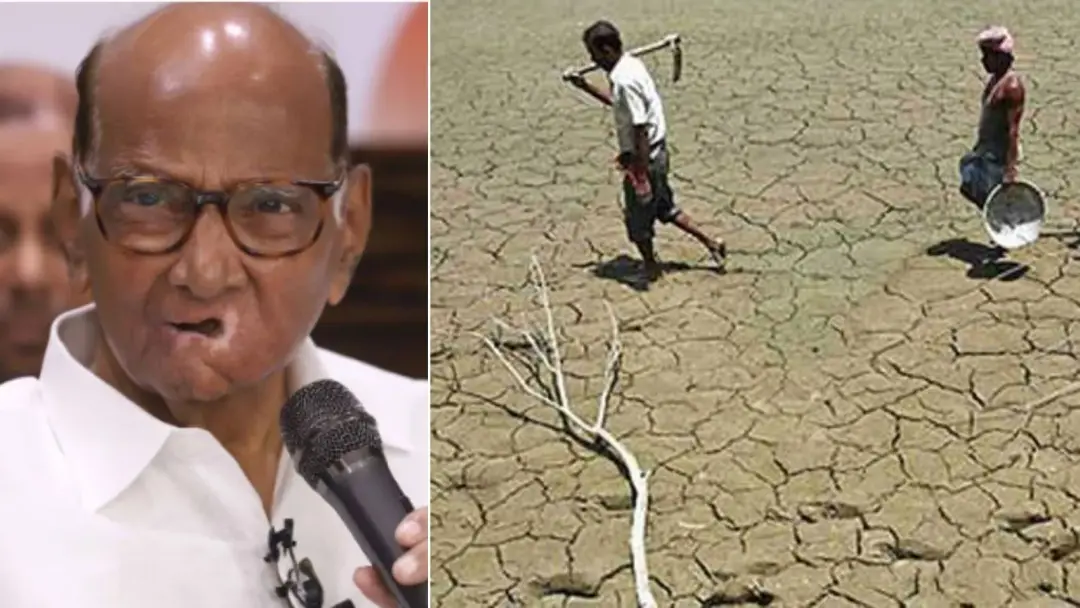
Pawar seeks drought declaration, Rs 50,000 per hectare aid in Maharashtra
NCP (SP) chief Sharad Pawar urged Maharashtra Chief Minister Devendra Fadnavis to immediately declare rain-deficit talukas drought-hit and announce relief of at least Rs 50,000 per hectare for affected farmers. In a post on X, he said soybean, cotton, bajra, maize, pigeon pea, green gram and black gram crops were withering. He also sought Rs 25,000 special assistance per farm labourer family, a loan waiver, fresh crop loans, fodder camps and full fee waiver for students in drought-hit talukas.
Source
NCP-SP (Sharad Pawar) · read the original report ↗
Desk check · compared with the source
What the desk checked (5)
- Pawar urged CM Devendra Fadnavis to declare rain-deficit talukas drought-hit and announce at least Rs 50,000 per hectare relief. — Attributed in source to Pawar's post on X; figure appears in source.
- Standing crops including soybean, cotton, bajra, maize, pigeon pea, green gram and black gram are withering in parts of the state. — Attributed to Pawar's statement; no independent data cited in source.
- Pawar sought Rs 25,000 special assistance for each farm labourer family. — Figure appears in source, attributed to Pawar.
- He sought raising the incentive for regular loan repayers from Rs 50,000 to Rs 1 lakh and retrospective Re-1 crop insurance implementation. — Both demands stated in source as Pawar's; no government response given.
- He sought distribution of Rs 17,000 per hectare crop insurance assistance announced for last year's unseasonal rain losses. — Figure appears in source; original announcement not independently verifiable here.
Analysts’ view opinion
This is a political demand list, but its fiscal arithmetic is far from trivial. Rs 50,000 per hectare, Rs 25,000 per farm-labour family, a loan waiver, full fee waivers and fodder camps together imply a sizeable additional claim on the state exchequer — and the story puts no figure on that cost. At the same time, withering soybean, cotton, bajra, maize, pigeon pea, green gram and black gram means farm incomes, rural demand and farm-labour employment take a simultaneous hit, so inaction also carries a price, paid by the rural economy.
- Cash transfers (Rs 50,000 a hectare, Rs 25,000 a family) deliver the fastest relief but strain the state's deficit and can crowd out capital spending.
- Demanding a loan waiver alongside fresh crop loans pulls in two directions: waivers can dent bank asset quality and repayment discipline, tightening later credit flow — the call to raise the incentive for regular repayers is itself an acknowledgement of that risk.
- If crop losses cut supply, pulses and oilseed prices could face upward pressure, which hurts consumers while offering little gain to farmers who have nothing left to sell.
- Fodder camps, tankers, employment-guarantee works and transformer repairs are cheaper, better-targeted interventions that can prevent lasting asset losses such as livestock deaths or ruined orchards.
- The demand to declare drought before formal criteria are met matters economically: delay can push relief past the kharif loss and rabi sowing window, while relaxed criteria can widen coverage and cost.
What to watch — Watch how many talukas the state actually notifies as drought-hit, the size of any package, and where in the budget the money is found.
These are an opposition leader's demands; the story establishes neither the scale of the rainfall deficit and crop loss, nor any cost estimate or government response.
Deep dive
Research brief · 8 facts · 3 dates · exam-readyThe brief
Context
NCP (SP) chief Sharad Pawar has written to Maharashtra Chief Minister Devendra Fadnavis seeking the immediate declaration of rain-deficit talukas in the state as drought-hit, citing deficient rainfall that has left standing kharif crops withering. In a post on X on Friday, Pawar listed a package of demands ranging from per-hectare relief and farm labourer assistance to loan waivers, crop insurance changes, fodder camps and fee waivers. He argued the state should not wait for formal drought criteria to be met before declaring drought and identifying affected talukas.
Key facts
- Pawar sought a relief package of at least Rs 50,000 per hectare for farmers in rain-deficit talukas of Maharashtra.
- He demanded Rs 25,000 in special assistance for each family of farm labourers.
- Crops named as withering: soybean, cotton, bajra, maize, pigeon pea, green gram and black gram.
- He asked that the incentive for farmers who regularly repay loans be raised from Rs 50,000 to Rs 1 lakh.
- He sought that farmers who took crop loans in 2025-26 but defaulted this year be covered under the proposed loan waiver scheme.
- He demanded retrospective implementation of the Re-1 crop insurance scheme and retrospective application of previously excluded insurance triggers.
- He sought distribution of crop insurance assistance of Rs 17,000 per hectare announced for losses from unseasonal rains last year.
- He demanded a complete waiver of educational fees, not merely examination fees, for students in drought-declared talukas.
Timeline
- Last year (as referenced)Crop insurance assistance of Rs 17,000 per hectare was announced for losses caused by unseasonal rains; Pawar says it is yet to be distributed.
- 2025-26Farmers took crop loans; some defaulted this year, and Pawar wants them included in the proposed loan waiver scheme.
- Friday (date not stated in the source)Pawar posted on X urging CM Fadnavis to declare rain-deficit talukas drought-hit and announce relief measures.
Who has a stake
- Farmers in rain-deficit talukas — Withering soybean, cotton, bajra, maize, pigeon pea, green gram and black gram crops; seek Rs 50,000 per hectare relief, loan waiver and fresh crop loans.
- Farm labourer families — Loss of work due to crop failure; Pawar seeks Rs 25,000 special assistance per family.
- Maharashtra government / CM Devendra Fadnavis — Must decide on drought declaration, taluka identification and the fiscal cost of the relief package.
- Sharad Pawar and NCP (SP) — Pressing the government on agrarian distress and drought relief through public demands on X.
- Students in drought-affected talukas — Seeking complete waiver of educational fees, not just examination fees.
- Livestock owners and orchard farmers — Need fodder camps, drinking water, veterinary services and tankers to protect fruit orchards.
Why it matters
Drought declaration is the trigger for a package of statutory and administrative reliefs — compensation, loan concessions, fee waivers, fodder camps and employment guarantee works — so the timing of the declaration directly determines whether distressed farmers get help during the crop cycle or after it. Pawar's demand that the state act without waiting for formal criteria highlights the gap between rainfall-based technical thresholds and on-ground crop loss. The demands also spotlight pending dues, such as the Rs 17,000 per hectare insurance assistance announced for last year's unseasonal rain losses.
UPSC angle
Prelims pointers
- Sharad Pawar is the chief of NCP (SP); Devendra Fadnavis is the Chief Minister of Maharashtra.
- Demand: at least Rs 50,000 per hectare relief for drought-affected farmers; Rs 25,000 per farm labourer family.
- Loan repayment incentive sought to be raised from Rs 50,000 to Rs 1 lakh.
- Re-1 crop insurance scheme: Pawar sought retrospective implementation and retrospective application of excluded triggers.
- Rs 17,000 per hectare crop insurance assistance was announced for last year's unseasonal rain losses.
- Crops cited as affected: soybean, cotton, bajra, maize, pigeon pea, green gram, black gram.
Mains framing
Deficient rainfall in Maharashtra has hit standing kharif crops — soybean, cotton, bajra, maize, pigeon pea, green gram and black gram — with rising pest and disease attacks, and threatens agriculture, drinking water and fodder availability. The core policy question raised by Sharad Pawar is procedural as much as fiscal: whether drought should be declared only after formal criteria are met, or whether the state should pre-empt the technical threshold to release relief while crops can still be salvaged and labourers still need work. His demands sequence relief across immediate compensation (Rs 50,000 per hectare, Rs 25,000 per farm labourer family), credit repair (loan waiver, fresh crop loans, higher repayment incentive from Rs 50,000 to Rs 1 lakh, inclusion of 2025-26 defaulters), insurance reform (retrospective Re-1 crop insurance and previously excluded triggers, release of the pending Rs 17,000 per hectare assistance), and public-service continuity (employment guarantee works including water conservation, tankers for orchards, fodder camps, drinking water and veterinary services, prompt transformer repairs, and full educational fee waivers). The way forward implied is early taluka-level identification of distress, front-loading of employment guarantee and water conservation works, and clearing legacy insurance and compensation dues so that relief is not delayed into the next cropping season.
Key terms
- Taluka
- An administrative sub-division of a district; drought is declared and relief targeted at this level in Maharashtra.
- NCP (SP)
- Nationalist Congress Party (Sharadchandra Pawar), the party headed by Sharad Pawar.
- Re-1 crop insurance scheme
- Crop insurance arrangement under which farmers pay a nominal Re 1 premium; Pawar wants it applied retrospectively.
- Insurance triggers
- Specified conditions under which a crop insurance claim becomes payable; Pawar seeks retrospective application of previously excluded ones.
- Fodder camps
- Government-run camps supplying fodder and water for livestock during drought.
- Employment guarantee scheme works
- Public works, including agriculture and water conservation, taken up to provide wage employment in distress-hit talukas.
Practice questions
- Drought declaration in India is based on technical criteria such as rainfall deficiency. Examine the argument that states should declare drought before formal criteria are met, using the Maharashtra case.
- Discuss how crop insurance design — premium levels, excluded triggers and claim disbursal delays — affects farmers' resilience to rainfall deficiency.
- Evaluate the effectiveness of relief instruments such as per-hectare compensation, loan waivers, fodder camps and employment guarantee works in addressing agrarian distress during drought.
Grounded only in the source report — figures and dates are the source's, not inferred.