
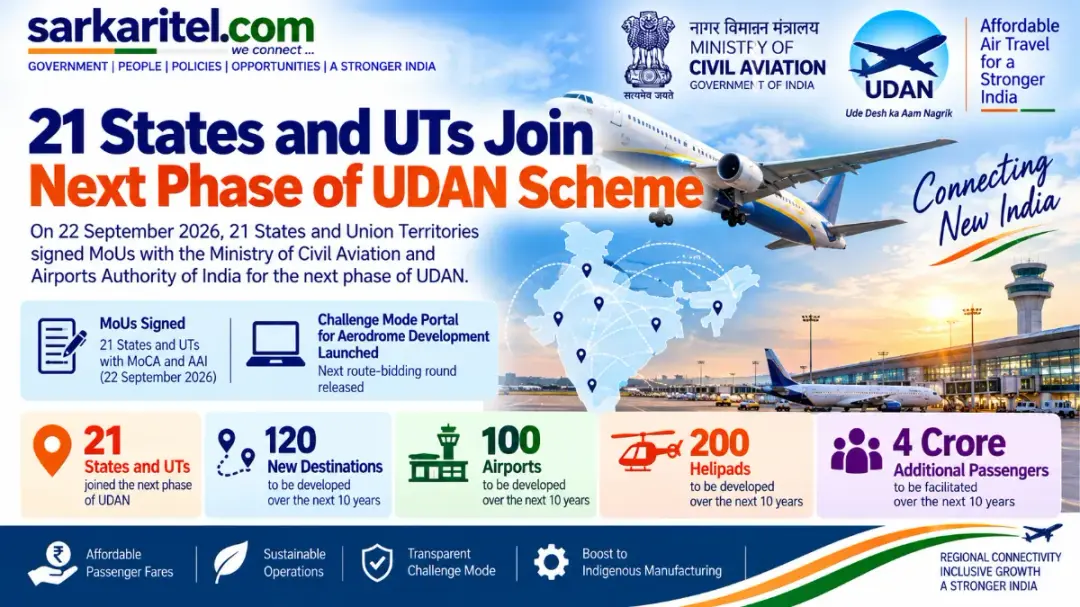
21 States, UTs sign MoUs for Modified UDAN phase
Twenty-one States and Union Territories have signed MoUs with the Civil Aviation Ministry under the next phase of the UDAN regional connectivity scheme. Modified UDAN, running from FY 2026-27 to FY 2035-36 with an outlay of ₹28,840 crore, provides for 100 aerodromes and 200 modern helipads. The ministry said the phase aims to serve four crore additional passengers and connect 120 new destinations. Minister Kinjarapu Ram Mohan Naidu launched a Challenge Mode for aerodrome development on September 22.
Source
Civil Aviation — Ram Mohan Naidu · read the original report ↗
Desk check · compared with the source
What the desk checked (5)
- 21 States and UTs have signed MoUs with the Civil Aviation Ministry for the next phase of UDAN. — Stated in source and attributed to the Ministry of Civil Aviation; figure consistent across headline and body.
- Modified UDAN runs 10 years from FY 2026-27 to FY 2035-36 with an outlay of ₹28,840 crore. — Figures appear in source, attributed to the scheme details; no independent verification possible.
- Scheme targets 100 aerodromes, 200 modern helipads, 120 new destinations and four crore additional passengers. — Attributed to the Civil Aviation Ministry; internally consistent within the source.
- Since UDAN's launch, 95 airports, heliports and water aerodromes have been connected, benefiting over 1.7 crore passengers. — Attributed to the ministry; cumulative figure stated without underlying data.
- Challenge Mode for Aerodrome Development was launched by the minister on September 22. — Date and attribution given in source; minister named as Kinjarapu Ram Mohan Naidu.
Analysts’ view opinion
The signing of MoUs by 21 States and UTs under Modified UDAN is more than an administrative step — it hands the Centre a durable instrument of political distribution. A ten-year window, an outlay of ₹28,840 crore, 100 aerodromes and 200 helipads means a steady supply of foundation-stone and inauguration moments spanning the next two general election cycles. Because the Challenge Mode requires States themselves to nominate sites, proactive States stand to gain and slower ones to lose — which also opens space for charges that the Centre is playing favourites.
- The MoU structure gives the Centre political cover: if projects slip, responsibility can plausibly be shifted to the States.
- Making States compete through Challenge Mode tilts the scheme towards competitive rather than cooperative federalism.
- The focus on hilly, remote, island and aspirational regions targets seats that are electorally small but symbolically powerful.
- With Civil Aviation held by TDP's Kinjarapu Ram Mohan Naidu, the scheme also raises the visibility of NDA coalition partners.
- States that have not signed could build a 'denied our share' narrative — though the story does not name which States stayed out.
What to watch — Watch which States and which constituencies win the first round of Challenge Mode selections — that will reveal the scheme's real political geography.
The story does not identify the 21 signatories, who abstained, or how funds will be distributed; these remain stated targets rather than delivered infrastructure.
Deep dive
Research brief · 8 facts · 4 dates · exam-readyThe brief
Context
UDAN (Ude Desh ka Aam Naagrik) is the Centre's regional connectivity scheme aimed at making air travel affordable and linking unserved and underserved airports. The Civil Aviation Ministry has now moved to a successor phase, called Modified UDAN, to run for 10 years from FY 2026-27 to FY 2035-36. Twenty-one States and Union Territories have signed MoUs with the ministry, creating a framework for coordinated action between the Centre, States and the Airports Authority of India (AAI). The signing marks the shift of Modified UDAN from policy planning to implementation.
Key facts
- 21 States and Union Territories have signed MoUs with the Ministry of Civil Aviation for the next phase of UDAN.
- Modified UDAN runs for 10 years, from FY 2026-27 to FY 2035-36, with a total outlay of ₹28,840 crore.
- The scheme provides for development of 100 aerodromes from existing unserved airstrips and 200 modern helipads in hilly, remote, island and aspirational regions.
- The phase targets travel for four crore additional passengers and connectivity to 120 new destinations over the coming decade.
- Since UDAN's launch, 95 airports, heliports and water aerodromes have been connected through hundreds of routes, benefiting more than 1.7 crore passengers.
- Civil Aviation Minister Kinjarapu Ram Mohan Naidu launched the Challenge Mode for Aerodrome Development on September 22.
- Under Challenge Mode, State Governments and UT Administrations can nominate airstrips and helipads for development through a dedicated portal.
- The scheme provides a tapered five-year Viability Gap Funding (VGF) support mechanism for airline operators and promotes indigenous aircraft and helicopter capabilities.
Timeline
- Since UDAN's launch (year not stated in the source)95 airports, heliports and water aerodromes connected through hundreds of routes, benefiting over 1.7 crore passengers.
- September 22Civil Aviation Minister Kinjarapu Ram Mohan Naidu launches the Challenge Mode for Aerodrome Development, with a dedicated portal for States/UTs to nominate airstrips and helipads.
- September 23 (New Delhi)Ministry announces that 21 States and UTs have signed MoUs under the next phase of UDAN.
- FY 2026-27 to FY 2035-36Modified UDAN implementation period, with an outlay of ₹28,840 crore.
Who has a stake
- Ministry of Civil Aviation — Designs and funds Modified UDAN; must deliver 100 aerodromes, 200 helipads, 120 new destinations and four crore additional passengers.
- 21 signatory States and Union Territories — Nominate airstrips and helipads under Challenge Mode and coordinate land and infrastructure support for regional airports.
- Airports Authority of India (AAI) — Party to the coordinated Centre-State framework for developing aviation infrastructure.
- Regional airline and helicopter operators — Receive tapered five-year Viability Gap Funding support to make thin regional routes commercially viable.
- Residents of hilly, remote, island and aspirational regions — Gain air access through new aerodromes and modern helipads in unserved and underserved areas.
- Civil Aviation Minister Kinjarapu Ram Mohan Naidu — Political ownership of the scheme's rollout; launched the Challenge Mode mechanism.
Why it matters
Regional air connectivity determines how quickly remote, hilly and island regions are linked to the national economy, and the ₹28,840 crore Modified UDAN phase shifts the emphasis from route subsidies alone to building physical infrastructure. With 21 States and UTs on board, execution now depends on Centre-State coordination and on airlines sustaining routes after the tapered five-year VGF ends. It is also a test of whether nomination-based "Challenge Mode" selection can speed up airport development.
UPSC angle
Prelims pointers
- UDAN stands for Ude Desh ka Aam Naagrik, the regional connectivity scheme of the Ministry of Civil Aviation.
- Modified UDAN: 10-year scheme, FY 2026-27 to FY 2035-36, outlay ₹28,840 crore.
- Targets: 100 aerodromes from existing unserved airstrips, 200 modern helipads, 120 new destinations, four crore additional passengers.
- Achievement so far: 95 airports, heliports and water aerodromes connected; over 1.7 crore passengers benefited.
- Challenge Mode for Aerodrome Development launched on September 22; States/UTs nominate sites via a dedicated portal.
- Viability Gap Funding under the new phase is tapered over five years for airline operators.
Mains framing
India's regional aviation push has so far relied largely on Viability Gap Funding to make thin routes flyable, but the binding constraint has increasingly been the absence of usable airside infrastructure in unserved and underserved regions. Modified UDAN, with a ₹28,840 crore outlay over FY 2026-27 to FY 2035-36, responds by putting infrastructure at the centre: 100 aerodromes from existing airstrips, 200 modern helipads in hilly, remote, island and aspirational areas, continued but tapered five-year VGF, and promotion of indigenous aircraft and helicopter capabilities. The 21 MoUs and the new Challenge Mode, under which States and UTs nominate airstrips and helipads through a portal before they move to bidding and route development, signal a cooperative-federalism model in which land, clearances and local prioritisation rest with States while the Centre and AAI provide funding and technical execution. The implementation risk lies in operational sustainability - whether routes survive after subsidy tapering - and in uneven State capacity to nominate and develop sites. A credible way forward is to sequence aerodromes by demonstrated demand, link helipad networks to tourism, medical evacuation and disaster response, use the portal for transparent, time-bound selection, and track outcomes against the stated targets of 120 new destinations and four crore additional passengers rather than only against capital spent.
Key terms
- UDAN
- Ude Desh ka Aam Naagrik, the Centre's regional connectivity scheme to link unserved and underserved airports.
- Modified UDAN
- The next 10-year phase of UDAN, FY 2026-27 to FY 2035-36, with an outlay of ₹28,840 crore, focused on infrastructure and Centre-State cooperation.
- Viability Gap Funding (VGF)
- Government support to airline operators to cover the shortfall on commercially unviable regional routes; tapered over five years in the new phase.
- Challenge Mode for Aerodrome Development
- Mechanism launched on September 22 allowing States and UTs to nominate airstrips and helipads for development via a dedicated portal, before bidding and route development.
- Airports Authority of India (AAI)
- Central body that is part of the coordinated Centre-State framework for developing regional aviation infrastructure under the MoUs.
- Water aerodrome
- A facility on a water body for seaplane operations; counted among the 95 facilities connected so far under UDAN.
Practice questions
- Modified UDAN shifts emphasis from route subsidies to aerodrome and helipad infrastructure. Examine how this change addresses the limitations of the earlier regional connectivity model.
- "Regional air connectivity in India is as much a federal coordination challenge as a funding challenge." Discuss with reference to the 21 MoUs and the Challenge Mode mechanism.
- Evaluate the sustainability of regional air routes once tapered five-year Viability Gap Funding support ends, and suggest measures to sustain connectivity.
Grounded only in the source report — figures and dates are the source's, not inferred.