
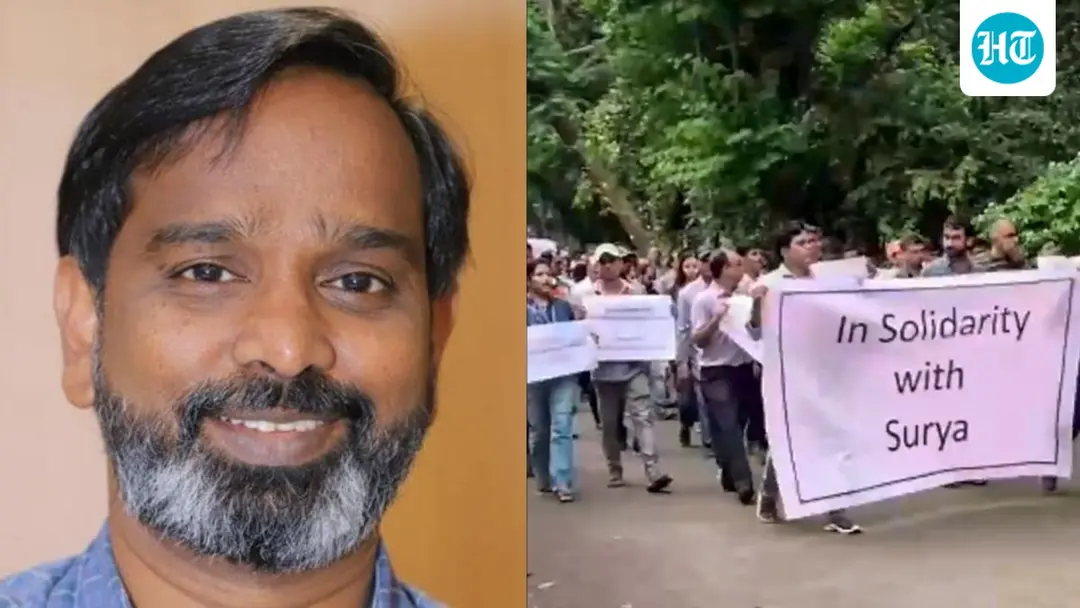
Ex-IIT Delhi director backs Prof Doolla in IIT Bombay death row
Former IIT Delhi director V Ramgopal Rao has backed IIT Bombay professor Suryanarayana Doolla amid the controversy over a BTech student's death, saying on X he was disturbed to see Doolla vilified and urging a fair examination of the concerns raised. A case of abetment to suicide and caste discrimination has been registered against Doolla, and the Mumbai Crime Branch is investigating. The second-year student was found dead in his hostel room on September 18. Rao also suggested a five-year BTech programme.
Source
Hindustan Times — India · read the original report ↗
Desk check · some claims need care
What the desk checked (5)
- Former IIT Delhi director V Ramgopal Rao backed IIT Bombay professor Suryanarayana Doolla and called him a faculty member of high integrity. — Attributed in source to Rao's post on X, with quotes reproduced.
- A case of abetment to suicide and caste discrimination has been registered against Doolla; the Mumbai Crime Branch is investigating. — Stated in source without naming the police document or official; repeated twice in the text.
- Doolla was removed as Dean of Administrative Affairs and sent on leave to facilitate an impartial probe. — Attributed only to unnamed 'sources' in the source text.
- A second-year BTech student of the Department of Energy Science and Engineering was found dead in his hostel room on September 18, hours after allegedly being caught using a mobile phone to access ChatGPT during an exam. — Attributed to unnamed 'officials'; date and department appear in the source.
- Rao proposed making BTech a five-year programme with options to finish in four or three-and-a-half years. — Figures and proposal appear in the source as Rao's own statements.
Analysts’ view opinion
What began as an individual criminal matter is turning into a debate about how IIT degree programmes are designed. Ramgopal Rao's intervention bundles two distinct claims: a procedural one, that a faculty member facing allegations deserves a fair examination rather than a public campaign, and a policy one, that a "one size fits all" curriculum no longer suits classrooms with sharply different academic and language backgrounds. The family's caste-discrimination allegations are serious and under investigation, so the structural reform conversation cannot substitute for accountability on that count.
- The institutional response so far has two tracks — removal from an administrative deanship, leave to enable an impartial probe, and a ten-member committee — running alongside the police investigation.
- Parallel criminal and internal inquiries are routine in such cases, but how their findings are sequenced and how much is made public is the real governance question.
- The five-year BTech idea is essentially a flexible-credit model, and its strongest design feature is normalising extra time so that slower-paced students are not singled out, which sits comfortably with the broader national push towards flexible durations and multiple exit points.
- Implementation costs are the weak link: an extra year implies fee, hostel and scholarship implications, faculty and classroom capacity, and placement-cycle effects, none of which the story addresses but all of which would decide feasibility.
- Expanded academic support alone does not answer an allegation of caste-based humiliation; the performance of grievance machinery such as complaint channels, SC/ST cells and counselling deserves separate scrutiny.
What to watch — Watch how much of the ten-member committee's findings and the Crime Branch investigation is disclosed, and whether the five-year BTech suggestion is picked up as a formal proposal at senate or IIT Council level.
The story records allegations, a statement of support and one individual's suggestion — it does not establish guilt or innocence, does not settle what caused the student's death, and does not show that any institution has endorsed the five-year model.
Deep dive
Research brief · 8 facts · 4 dates · exam-readyThe brief
Context
A second-year BTech student of IIT Bombay's Department of Energy Science and Engineering was found dead in his hostel room on September 18, hours after he was allegedly caught using a mobile phone to access ChatGPT during a mid-semester examination. A case of abetment to suicide and caste discrimination has been registered against professor Suryanarayana Doolla, who was removed as Dean of Administrative Affairs after protests and later sent on leave; the Mumbai Crime Branch is investigating and a 10-member institute committee has begun its own probe. Former IIT Delhi director V Ramgopal Rao has now publicly backed Doolla on X, saying he was "disturbed" to see him "vilified", while also arguing that IITs need to move away from a "one size fits all" academic model.
Key facts
- A second-year BTech student of IIT Bombay's Department of Energy Science and Engineering was found dead in his hostel room on September 18.
- The death came hours after the student was allegedly caught using a mobile phone to access ChatGPT during a mid-semester examination, according to officials.
- A case of abetment to suicide and caste discrimination has been registered against professor Suryanarayana Doolla.
- The student's mother alleged her son told the family he was tortured, abused and humiliated because of his caste.
- Doolla was removed as IIT Bombay's Dean of Administrative Affairs following protests and was sent on leave to facilitate an impartial probe, according to sources.
- The Mumbai Crime Branch is investigating the case; a 10-member IIT Bombay committee has begun its own probe into the death.
- Former IIT Delhi director V Ramgopal Rao, with more than 25 years of experience at IIT Bombay and IIT Delhi, called Doolla "one of the finest faculty members" and "a gentleman of the highest integrity".
- Rao proposed extending IIT BTech programmes to five years, allowing students meeting required credits to finish in four years or potentially three-and-a-half years.
Timeline
- September 18Second-year BTech student found dead in his IIT Bombay hostel room, hours after allegedly being caught using a mobile phone to access ChatGPT in a mid-semester exam.
- After the death (date not stated in the source)Protests follow; Doolla is removed as Dean of Administrative Affairs and a case of abetment to suicide and caste discrimination is registered against him.
- SubsequentlyDoolla sent on leave to facilitate an impartial probe; Mumbai Crime Branch investigates; a 10-member IIT Bombay committee begins its inquiry.
- Latest developmentFormer IIT Delhi director V Ramgopal Rao posts on X backing Doolla and proposing a five-year BTech model.
Who has a stake
- The deceased student's family — The mother alleges caste-based torture, abuse and humiliation; the family seeks accountability for the death.
- Prof Suryanarayana Doolla — Faces a case of abetment to suicide and caste discrimination, has lost his dean's post and been sent on leave; his reputation and career are at stake.
- IIT Bombay administration — Must run a credible internal inquiry through its 10-member committee and address campus protests and caste-discrimination allegations.
- Mumbai Crime Branch — Investigating agency in the abetment to suicide and caste discrimination case.
- V Ramgopal Rao, former IIT Delhi director — Publicly defending Doolla and pushing a systemic reform agenda, including a flexible five-year BTech.
- IIT students, especially from diverse backgrounds — Affected by the "one size fits all" academic model, coaching-driven entry, varying JEE Advanced ranks and language barriers.
Why it matters
A student death on an IIT campus, combined with allegations of caste discrimination and abetment to suicide, tests how India's elite technical institutions handle both accountability and due process for faculty. Rao's intervention shifts part of the debate from individual blame to systemic design — heterogeneous classrooms, coaching-driven admissions, language barriers and rigid four-year timelines. How IIT Bombay's committee and the Mumbai Crime Branch conclude will shape student-welfare and anti-discrimination practice across the IIT system.
UPSC angle
Prelims pointers
- Student was from IIT Bombay's Department of Energy Science and Engineering; found dead in hostel room on September 18.
- Charges registered against Prof Suryanarayana Doolla: abetment to suicide and caste discrimination.
- Investigating agency: Mumbai Crime Branch; IIT Bombay has also set up a 10-member internal committee.
- V Ramgopal Rao is a former director of IIT Delhi, with over 25 years at IIT Bombay and IIT Delhi.
- Rao's proposal: make five years the standard BTech duration, with early exit in four or three-and-a-half years on credit completion.
- Doolla was removed as Dean of Administrative Affairs at IIT Bombay and later sent on leave.
Mains framing
The IIT Bombay case brings together two distinct questions: whether institutional processes adequately protect students from caste-based humiliation and exam-related distress, and whether they equally protect faculty from trial by public campaign before inquiries conclude. The immediate trigger was an alleged mobile-phone/ChatGPT violation during a mid-semester exam, followed by the student's death and his mother's allegation of caste-based torture and abuse; the response has been an FIR for abetment to suicide and caste discrimination, removal of the accused professor from his dean's post, his being sent on leave, a Mumbai Crime Branch probe and a 10-member institute committee. Former IIT Delhi director V Ramgopal Rao's intervention reframes the matter structurally: IIT classrooms are now highly heterogeneous, with students entering through an intensive coaching culture, widely differing JEE Advanced ranks, unequal academic preparation and language barriers, yet the academic model remains "one size fits all". His way forward is a flexible five-year BTech as the default, with faster exit for those who earn the credits, and academic support such as recorded lectures, online material and language assistance — with the "psychological advantage" that students needing extra time are following the design rather than being singled out. The balance to strike is upholding academic standards while making time and support a systemic responsibility, and running fair, time-bound inquiries that neither dilute caste-discrimination grievances nor substitute public vilification for evidence.
Key terms
- Abetment to suicide
- Criminal charge alleging that a person's acts instigated or drove another to take their own life; registered here against Prof Doolla.
- Dean of Administrative Affairs
- Senior administrative post at IIT Bombay; Doolla was removed from it following protests over the student's death.
- JEE Advanced
- Entrance examination through which students gain admission to IITs; Rao notes students enter with widely different ranks and preparation.
- One size fits all approach
- Rao's term for IITs' uniform curriculum and pace expectations despite highly heterogeneous student backgrounds and languages.
- Five-year BTech model
- Rao's proposal to make BTech nominally five years, with completion in four or three-and-a-half years for students meeting required credits.
- Mumbai Crime Branch
- Specialised police unit investigating the case registered against the IIT Bombay professor.
Practice questions
- Institutional grievance redress in higher education must balance protection of students from discrimination with due process for faculty. Examine with reference to the IIT Bombay student death case.
- "Elite technical institutions admit an increasingly heterogeneous student body but retain a uniform academic model." Discuss the merits and risks of a flexible five-year BTech as a remedy.
- What institutional mechanisms exist in premier Indian institutes to address caste discrimination and student mental health, and how can their credibility be strengthened?
Grounded only in the source report — figures and dates are the source's, not inferred.