
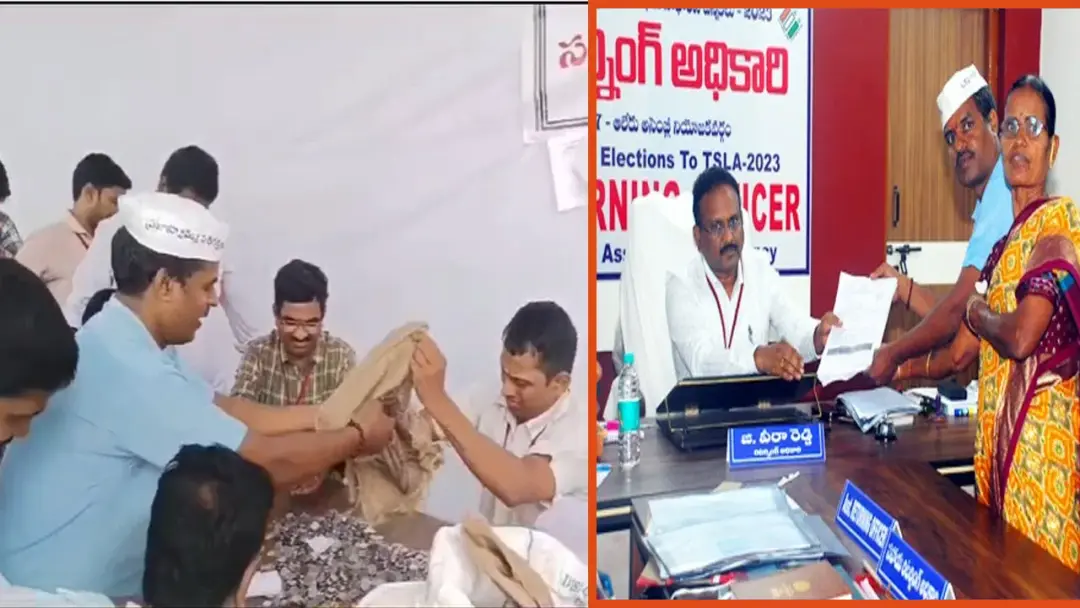
Independent pays Alair nomination deposit in one-rupee coins
Gujja Ramchandra Reddy, a social activist from Gourayipalli village in Yadagirigutta mandal of Yadadri district, filed his nomination as an independent candidate for the Alair Assembly seat in Telangana, paying the Rs 10,000 deposit with 10,000 one-rupee coins collected as donations from the public. Election officials took two hours to count the coins. He has contested the same way four times since 2009, saying democracy has turned into a rule of money.
Source
Alair — MLA & నియోజకవర్గం · read the original report ↗
Desk check · compared with the source
What the desk checked (5)
- Gujja Ramchandra Reddy of Gourayipalli village, Yadagirigutta mandal, Yadadri district filed nomination as an independent for the Alair Assembly seat. — Stated as fact in the source; no official document or official quoted.
- The nomination deposit for an Assembly election is Rs 10,000. — Figure appears in the source; no source given for the rule.
- He paid the deposit with 10,000 one-rupee coins collected as donations from the public. — Attributed to the candidate and described by the source; figure appears in source, not independently verifiable here.
- Election officials took two hours to count the coins. — Stated in the source with no official attribution.
- He has filed nominations in four consecutive Assembly elections since 2009, each time paying with rupee coins. — Attributed to the candidate; no records cited.
Analysts’ view opinion
This is not a story that changes a result, but it is one that carries a political message. By paying his Rs 10,000 deposit in ten thousand one-rupee coins collected as public donations, Gujja Ramchandra Reddy has turned ordinary voter frustration with the rising cost of elections into a visual metaphor. The fact that he has done this four times since 2009 suggests a sustained protest style rather than a one-off publicity move — unlikely to cost the major parties a seat, but useful in forcing an uncomfortable conversation about campaign spending.
- Funding a deposit one rupee at a time is a low-cost, high-signal way of contrasting people's money with parties' large-scale expenditure.
- The real contest in Aleru will be between the main parties; an independent's strength here lies in agenda-setting, not vote share.
- His critique — that democracy has become rule by money and that cash-for-votes corrodes it — targets no single party, which makes it awkward for any of them to rebut.
- The two hours officials needed to count the coins is precisely what generated media attention, and that visibility is the strategy's real payoff.
- Major parties typically do not engage such protests directly; silence is their safest response.
What to watch — Watch whether his nomination survives scrutiny and whether the coin protest pushes election spending into the Aleru campaign conversation.
The story does not establish how many votes he has won in past contests, who else is in the Aleru field, or how any party has responded to the gesture.
Deep dive
Research brief · 8 facts · 3 dates · exam-readyThe brief
Context
Telangana's Assembly election nomination process was in its final phase when an independent candidate turned a routine formality into a protest. Gujja Ramchandra Reddy, a social activist from Gourayipalli village in Yadagirigutta mandal of Yadadri district, filed his nomination for the Alair Assembly seat and paid the mandatory Rs 10,000 security deposit entirely in one-rupee coins donated by the public. Election officials at the Returning Officer's office were taken aback and needed two hours to count the coins. Reddy says he has done this at every Assembly election since 2009 to protest the role of money in elections.
Key facts
- Gujja Ramchandra Reddy, a social activist from Gourayipalli village, Yadagirigutta mandal, Yadadri district, filed nomination as an independent for the Alair Assembly seat.
- The security deposit for filing an Assembly election nomination is Rs 10,000, as stated in the source.
- He paid the deposit with 10,000 one-rupee coins collected as donations from the public, carried in a bundle to the Returning Officer's office.
- Election officials took two hours to count the 10,000 coins.
- Reddy has filed nominations in four consecutive Assembly elections since 2009, each time paying the deposit with donated one-rupee coins.
- He says democracy has turned into 'dhanaswamyam' (rule of money) and that voters have been reduced to pawns.
- He criticises parties for turning politics, which should be a field of service, into a business, and calls cash-for-vote a danger to democracy.
- At the time of the story, Telangana's nomination filing period had reached its final phase.
Timeline
- 2009Ramchandra Reddy begins contesting Assembly elections as an independent, paying the deposit in donated one-rupee coins.
- 2009 to the present electionHe files nominations in four consecutive Assembly elections, following the same coin-deposit practice each time.
- Final phase of nominations, current Telangana Assembly electionHe files his nomination for Alair with 10,000 one-rupee coins; officials take two hours to count them.
Who has a stake
- Gujja Ramchandra Reddy — Independent candidate using the coin deposit as a symbolic campaign against money power in elections.
- Election officials / Returning Officer, Alair — Had to accept and count 10,000 coins, spending two hours on the verification of the deposit.
- Public donors of Gourayipalli and nearby areas — Contributed one rupee each, making the deposit a collective act of civic participation.
- Voters of Alair constituency — Reddy argues they have become pawns in a money-driven electoral contest.
- Political parties — Face the criticism that they have converted a service-oriented political sphere into a business.
Why it matters
The episode dramatises a core anxiety of Indian electoral democracy: that the cost of contesting and the practice of cash-for-vote squeeze out ordinary citizens. By funding a statutory deposit one rupee at a time from public donations, an independent candidate turns a procedural requirement into a statement about small-donor, transparent political funding. It also shows how symbolic protest inside the legal electoral process can draw attention where organised campaigns cannot.
UPSC angle
Prelims pointers
- Alair is an Assembly constituency in Yadadri district, Telangana; Yadagirigutta is a mandal in the same district.
- Security deposit for filing an Assembly election nomination cited in the source: Rs 10,000.
- Nominations are filed with the Returning Officer of the constituency.
- Gujja Ramchandra Reddy has contested Assembly polls as an independent four times since 2009, paying deposits in one-rupee coins.
- Officials took two hours to count 10,000 one-rupee coins paid as deposit.
Mains framing
The Alair coin-deposit protest crystallises the debate over money power in Indian elections. The statutory deposit is only a small entry threshold, but the candidate's point is broader: campaigns increasingly run on expenditure and inducements, so that a service-oriented political sphere behaves like a business and voters become instruments rather than principals. The causes he identifies are cash-for-vote practices and party dependence on large, opaque funding; the implication is the exclusion of citizen candidates and the erosion of substantive equality in political competition, even where formal equality of candidature exists. The way forward suggested by his own method is small-donor, publicly raised and visible funding, paired with voter education of the kind he says he undertakes; institutionally, this points to stronger enforcement against electoral inducements and greater transparency in political finance. Whether such symbolic contests translate into electoral or behavioural change is not stated in the source, but the episode's value lies in reframing a routine nomination formality as a question about who can realistically seek office.
Key terms
- Independent candidate
- A candidate contesting without a political party's ticket, as Reddy is doing in Alair.
- Security deposit
- The amount a candidate must pay while filing nomination; Rs 10,000 for an Assembly seat per the source.
- Returning Officer
- The official who receives nominations and conducts the election in a constituency.
- Dhanaswamyam (rule of money)
- Reddy's term for democracy distorted by money power in elections.
- Cash-for-vote (ottuku notu)
- The practice of paying voters for support, which Reddy calls a danger to democracy.
Practice questions
- Does the rising cost of contesting elections undermine the constitutional promise of equal political opportunity? Discuss with reference to independent candidates.
- Examine how symbolic protest by citizens within the electoral process can supplement formal regulation of money power in elections.
- What measures can improve transparency in political funding in India? Evaluate the role of small-donor contributions.
Grounded only in the source report — figures and dates are the source's, not inferred.