
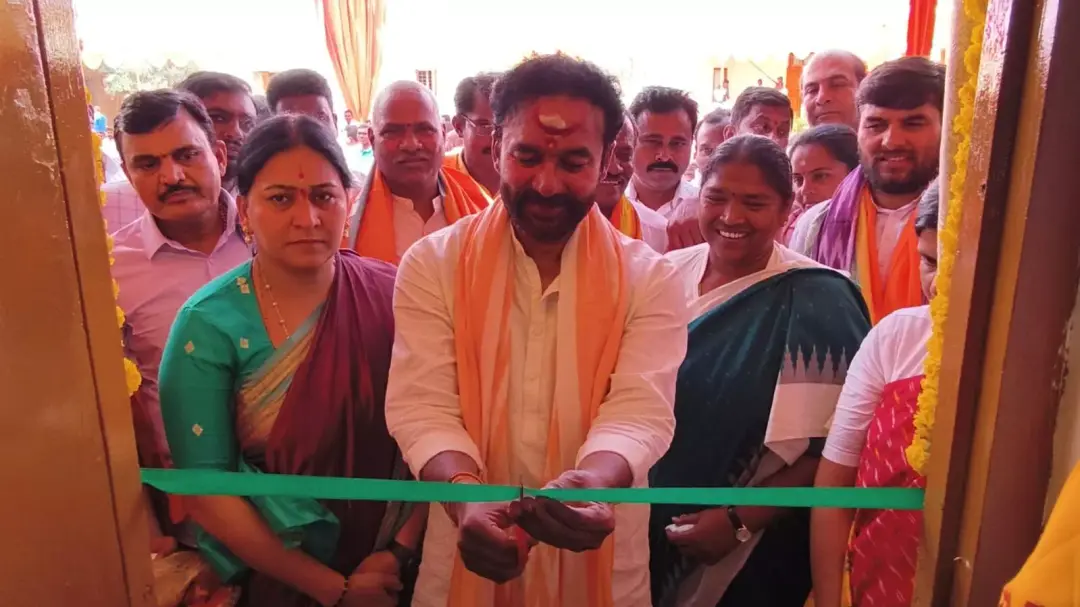
Sammakka–Sarakka Central Tribal University campus opened in Mulugu
Union Tourism and Culture Minister G. Kishan Reddy, State Minister Dhanasari Anasuya Seetakka and MP Kavitha inaugurated the Sammakka–Sarakka Central Tribal University campus at the Youth Training Centre in Jakaram, Mulugu district. Kishan Reddy said Rs 889.07 crore has been allocated for the university. Seethakka said 35% of seats are reserved for tribal students, with classes beginning next academic year and admissions through online applications. District Collector Ila Tripathi and Mulugu SP Shabarish attended.
Source
Mulugu — jobs · read the original report ↗
Desk check · compared with the source
What the desk checked (5)
- Sammakka–Sarakka Central Tribal University campus was inaugurated at the Youth Training Centre in Jakaram, Mulugu district. — Attributed in source to an event with named attendees; internally consistent.
- Rs 889.07 crore has been allocated for the university. — Figure appears in source but no budget document or official order is cited.
- 35% of seats are reserved for tribal students. — Attributed to Minister Seethakka's remarks at the event.
- Tribal literacy rates in Telangana, especially among women, are low. — Stated as part of Union Minister Kishan Reddy's remarks; no data source given.
- Classes will begin in the upcoming academic year with online applications for admission. — Attributed to Minister Seethakka; no dates or portal details in source.
Analysts’ view opinion
A central tribal university physically sited inside a tribal district, rather than in a state capital, is the most consequential design choice here — proximity has historically been the single biggest determinant of whether first-generation tribal students actually enrol. The Rs 889.07 crore allocation and a 35% reservation for tribal students signal intent, but the campus is starting out of a Youth Training Centre, which makes this an inauguration of access rather than of completed infrastructure. Whether this becomes an education hub, as the state minister framed it, will depend less on the announcement and more on faculty recruitment, hostels, bridge and language support, and how the remaining 65% of seats are filled.
- Locating the campus in Mulugu rather than an urban centre directly addresses the distance-and-cost barrier that has limited tribal participation in higher education.
- The 35% tribal quota exceeds standard ST reservation norms, but the story does not specify how it interacts with existing ST/SC/OBC/EWS categories or the domicile question for local Telangana tribal youth.
- Naming the university after Sammakka and Sarakka is a deliberate legitimacy strategy — cultural ownership tends to improve community buy-in for institutions that otherwise feel externally imposed.
- The real implementation risk in remote-area campuses is not money but staffing and student retention: faculty willing to relocate, hostel capacity, and academic support for first-generation learners.
- Running a new university from a Youth Training Centre repeats a familiar Indian pattern of starting classes in borrowed premises, which works if permanent construction keeps pace and stalls institutions when it does not.
What to watch — Watch for the first admission cycle numbers, the course mix on offer, and whether the sanctioned funds translate into a permanent campus and sanctioned faculty posts on a published timeline.
The story does not establish how much of the Rs 889.07 crore has actually been released, what courses or student intake are planned, the construction schedule, or how the 35% quota fits within existing reservation rules.
Deep dive
Research brief · 8 facts · 2 dates · exam-readyThe brief
Context
The Sammakka–Sarakka Central Tribal University campus was inaugurated at the Youth Training Centre in Jakaram, Mulugu district, Telangana — a predominantly tribal area. The university is named after Mulugu's revered deities Sammakka and Sarakka. It is intended to expand higher education access for tribal communities in a region where tribal literacy, particularly among women, is low. The inauguration was led by Union Tourism and Culture Minister G. Kishan Reddy along with State Minister Dhanasari Anasuya Seetakka and MP Kavitha.
Key facts
- The Sammakka–Sarakka Central Tribal University campus was inaugurated at the Youth Training Centre, Jakaram, Mulugu district, Telangana.
- Rs 889.07 crore has been allocated by the government for the university, as stated by Union Minister G. Kishan Reddy.
- 35% of seats in the university are reserved for tribal students, according to Minister Dhanasari Anasuya Seetakka.
- Classes are to begin in the upcoming academic year, with admissions through online applications.
- The inauguration was done by Union Tourism and Culture Minister G. Kishan Reddy, State Minister Dhanasari Anasuya Seetakka and MP Kavitha.
- The university is named after Mulugu's revered deities Sammakka and Sarakka, as noted by MP Kavitha.
- Kishan Reddy linked the university to the goal of raising tribal literacy to 100% in Telangana, where tribal literacy — especially among women — is low.
- Officials present included Tribal Welfare Department Secretary Sarath, District Collector Ila Tripathi, Mulugu SP Shabarish and MP Sitaram Naik.
Timeline
- Day of inauguration (coinciding with International Women's Day, as Kishan Reddy extended wishes to women)Sammakka–Sarakka Central Tribal University campus inaugurated at Youth Training Centre, Jakaram, Mulugu district.
- Upcoming academic yearClasses at the university are scheduled to begin; tribal youth encouraged to apply online for admission.
Who has a stake
- Tribal students and youth of Mulugu and Telangana — Direct beneficiaries — 35% reserved seats, higher education access closer to home, and anticipated employment opportunities.
- Union Government / Ministry handling the allocation — Has allocated Rs 889.07 crore for the university; its credibility on tribal higher education delivery is tied to the project.
- Telangana State Government (Minister Dhanasari Anasuya Seetakka) — Seeks to position Mulugu as an education hub alongside its status as a tourism destination.
- Mulugu district administration (Collector Ila Tripathi, SP Shabarish) — Responsible for local coordination, campus functioning and law and order during rollout.
- Tribal Welfare Department (Secretary Sarath) — Nodal department for tribal education and empowerment outcomes from the university.
- Elected representatives (MP Kavitha, MP Sitaram Naik) — Political ownership of the project and accountability for educational and employment gains promised to local tribal youth.
Why it matters
Tribal literacy in Telangana, especially among tribal women, remains low, and a dedicated central tribal university in a tribal district reduces the distance — physical and social — between Adivasi youth and higher education. The 35% seat reservation and the Rs 889.07 crore allocation signal an attempt to convert access promises into institutional capacity. Whether the campus becomes a genuine education hub or remains a building will depend on faculty, hostels, online admission outreach and course relevance in the first academic year.
UPSC angle
Prelims pointers
- Sammakka–Sarakka Central Tribal University is located at Jakaram, Mulugu district, Telangana; named after deities Sammakka and Sarakka.
- Allocation announced for the university: Rs 889.07 crore.
- Seat reservation for tribal students at the university: 35%.
- Inaugurated by Union Tourism and Culture Minister G. Kishan Reddy with State Minister Dhanasari Anasuya Seetakka and MP Kavitha.
- Dhanasari Anasuya Seetakka's portfolios (as stated): Panchayat Raj, Rural Development, Health and Child Welfare.
- Admissions to be through online applications; classes from the upcoming academic year.
Mains framing
The opening of the Sammakka–Sarakka Central Tribal University campus in Mulugu reflects a shift in tribal education policy from scholarship-and-hostel support towards creating dedicated higher-education institutions inside tribal geographies. The rationale, as articulated at the inauguration, is the persistently low tribal literacy rate in Telangana — worst among tribal women — which conventional, distant universities have not corrected; locating a campus in a tribal district lowers migration, cost and cultural barriers, while the 35% reservation for tribal students institutionalises access. The Rs 889.07 crore allocation indicates capital commitment, and Minister Seetakka's framing of Mulugu as both a tourism destination and an emerging education hub suggests a wider local-economy expectation, including employment for tribal youth. The risks are familiar to new central universities: thin faculty strength, incomplete hostel and residential infrastructure, and courses that may not match local livelihood needs. An online-only admission route can itself exclude first-generation applicants in low-connectivity habitations. The way forward, on the evidence in the source, lies in aggressive offline outreach for online admissions, timely readiness of academic infrastructure before classes begin in the upcoming academic year, and monitoring of tribal female enrolment as the real test of the 100% tribal literacy goal invoked at the launch.
Key terms
- Sammakka–Sarakka Central Tribal University
- Central tribal university whose campus was inaugurated at Jakaram, Mulugu district, Telangana, named after locally revered deities.
- Tribal seat reservation (35%)
- Share of the university's seats earmarked for tribal students, as announced by Minister Seetakka.
- Tribal Welfare Department
- State department, represented at the event by Secretary Sarath, that handles tribal education and welfare administration.
- Tribal literacy rate
- Proportion of literate persons among tribal population; cited as low in Telangana, particularly among tribal women.
- Education hub
- Minister Seetakka's description of the role Mulugu could play, alongside its existing identity as a tourism destination.
Practice questions
- Dedicated tribal universities are increasingly seen as the answer to low Adivasi participation in higher education. Examine the promise and the limitations of this institutional approach, with reference to the Sammakka–Sarakka Central Tribal University.
- Low literacy among tribal women is both a cause and a consequence of exclusion from higher education. Discuss how a reserved-seat model in a tribal district can address this, and what complementary measures are needed.
- Discuss how locating higher-education institutions within tribal districts can support inclusive regional development, using the case of Mulugu as both a tourism destination and a proposed education hub.
Grounded only in the source report — figures and dates are the source's, not inferred.