
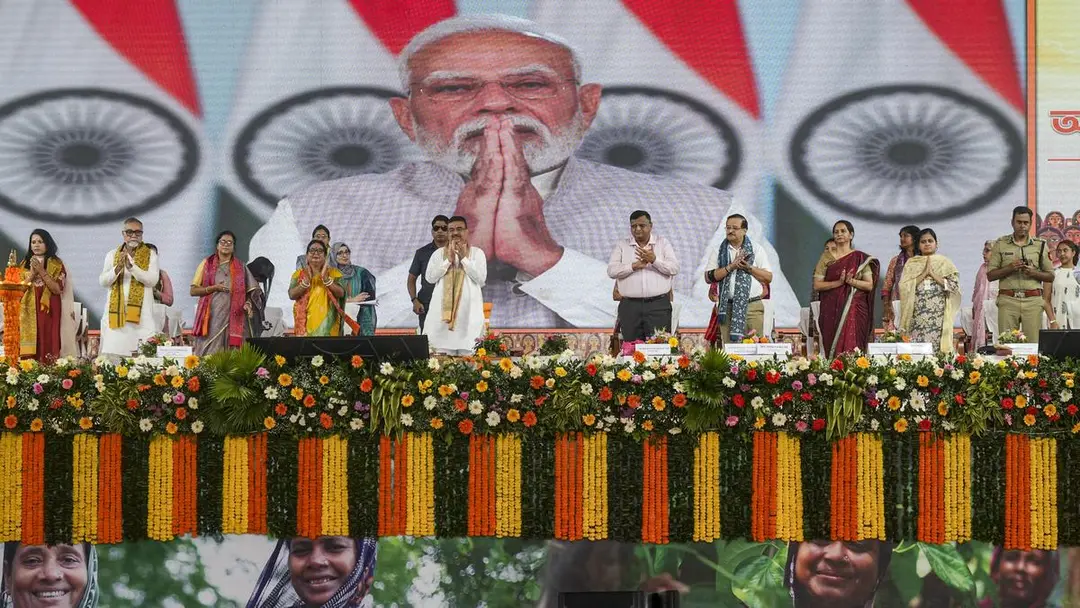
No cut-money culture in Bengal anymore, says PM Modi
Prime Minister Narendra Modi said on Thursday that there is no longer a culture of cut-money in West Bengal. He spoke in a virtual address after releasing the fourth instalment of ₹3,000 under the Annapurna Yojana to around 1.5 crore women beneficiaries in the State. Money is transferred directly into women's bank accounts without intermediaries, he said. Modi added that no eligible woman would be denied benefits, and that over 50 lakh families would be given pucca houses.
Source
The Hindu — National · read the original report ↗
Desk check · compared with the source
What the desk checked (5)
- There is no longer a culture of cut-money in West Bengal. — Direct quote attributed to PM Narendra Modi; presented as his assertion, not independently verified in the source.
- Modi released the fourth instalment of ₹3,000 under Annapurna Yojana to around 1.5 crore women in West Bengal. — Figures appear in the source as reported detail; no separate government document cited.
- Trinamool Congress's Lakshmir Bhandar gave ₹1,500 per month to over 2.2 crore beneficiaries. — Comparative figure stated by the publication without an attributed source.
- More than 50 lakh families will be identified and given pucca houses. — Attributed to Modi's address; forward-looking commitment, not an outcome.
- Some women have protested, claiming denial of benefits despite eligibility. — Reported by the publication in general terms; no numbers, locations or named sources given.
Analysts’ view opinion
This was less a welfare event than a political audit of the BJP's first months in power in West Bengal. By tying the Annapurna cash transfer to the claim that "cut-money" is finished, Mr. Modi is trying to convert an anti-corruption campaign promise into a lived, bank-account-level experience for 1.5 crore women — the same constituency the Trinamool Congress cultivated through Lakshmir Bhandar. The vulnerability is built into the design: where the predecessor scheme was universal, this one has eligibility criteria and verification, and every excluded woman is a potential opposition talking point.
- Direct benefit transfer is being deployed as a political argument, not just an administrative one — the pitch is that removing intermediaries removes the local political middleman who extracted commissions.
- Women voters are clearly the pivot of BJP strategy in Bengal, mirroring the earlier TMC playbook of a monthly cash entitlement aimed at the same bloc.
- The universal-versus-targeted contrast is the sharpest political fault line: the story notes the earlier scheme reached over 2.2 crore women, while Annapurna's verified list stands at around 1.5 crore.
- Mr. Modi's assurance that "not a single eligible woman" will be left out reads as pre-emptive defence against the protests and opposition charge of exclusion that the story records.
- The pucca housing announcement for over 50 lakh families and the "stalled central schemes" framing extend the argument beyond one scheme to a broader claim that Bengal was previously denied its due.
What to watch — Watch whether the verification drive expands the beneficiary list closer to the earlier universal coverage, and whether the opposition can turn scattered exclusion protests into a sustained statewide campaign.
The story does not establish any independent verification that cut-money has actually ended, nor does it quantify how many eligible women have been left out or provide the government's response to those protests.
Deep dive
Research brief · 8 facts · 5 dates · exam-readyThe brief
Context
West Bengal saw a change of government in May 2026, with the BJP coming to power after an Assembly election campaign in which it promised to end "cut-money" corruption and to launch the Annapurna Yojana as a rival to the Trinamool Congress's Lakshmir Bhandar cash transfer scheme. On September 17, 2026 — his 76th birthday — Prime Minister Narendra Modi virtually addressed an 'Annapurna Divas' event in Kolkata and released the fourth instalment of the scheme. He asserted that direct bank transfers had eliminated the culture of middlemen taking commissions from scheme beneficiaries. The claim comes amid protests by some women who say they have been declared ineligible despite qualifying, following the new government's beneficiary verification drive.
Key facts
- PM Modi released the fourth instalment of ₹3,000 under the Annapurna Yojana to around 1.5 crore women beneficiaries in West Bengal on September 17, 2026.
- Modi said money goes directly into women's bank accounts "without any intermediary" and that "now there is no cut-money in West Bengal".
- Cut-money refers to commission charged by local politicians to help citizens avail government scheme benefits; the BJP had promised to end it in its Assembly poll campaign.
- The Annapurna Yojana was promised by the BJP to counter the Trinamool Congress government's Lakshmir Bhandar, under which over 2.2 crore women received ₹1,500 per month.
- Lakshmir Bhandar was a universal scheme, whereas Annapurna Bhandar has an eligibility criterion.
- The BJP government, after coming to power in May 2026, began verification of beneficiaries, criticised by the opposition as a diversion from its promise.
- Modi said more than 50 lakh families will be identified and given pucca houses in the State.
- The event was addressed on Modi's 76th birthday; West Bengal Chief Minister Suvendu Adhikari, State Cabinet Minister Tapas Roy, MoS Purnima Chakraborty and MoS Malati Rava Roy were present in Kolkata.
Timeline
- Before the West Bengal Assembly electionsBJP leadership, including PM Modi, promises to stop cut-money corruption and announces the Annapurna Yojana to counter Lakshmir Bhandar.
- May 2026BJP comes to power in West Bengal; work on Annapurna Yojana begins within days, and verification of beneficiaries starts.
- After verification beganOpposition criticises verification as a diversion from the promise; some women protest that they are denied benefits despite being eligible.
- September 17, 2026PM Modi virtually addresses 'Annapurna Divas' in Kolkata on his 76th birthday and releases the fourth instalment of ₹3,000 to about 1.5 crore women.
- September 18, 2026Report published (04:07 am IST).
Who has a stake
- Around 1.5 crore women beneficiaries in West Bengal — Receive ₹3,000 per instalment directly into bank accounts under the Annapurna Yojana.
- Women excluded after verification — Claim they are being denied benefits despite being eligible; some have protested.
- Prime Minister Narendra Modi and the BJP — Credibility of the poll promise to end cut-money and to deliver Annapurna Yojana universally to eligible women.
- West Bengal BJP government (CM Suvendu Adhikari, ministers Tapas Roy, Purnima Chakraborty, Malati Rava Roy) — Implementation of Annapurna Yojana, beneficiary verification and delivery of pucca houses to over 50 lakh families.
- Trinamool Congress / opposition — Defends its universal Lakshmir Bhandar scheme (over 2.2 crore women at ₹1,500 a month) and attacks the verification drive as dilution of BJP's promise.
- Local politicians and intermediaries — Direct benefit transfer removes their role as commission-taking middlemen in scheme delivery.
Why it matters
Cash-transfer schemes for women have become the decisive currency of West Bengal politics, and the shift from a universal Lakshmir Bhandar to a criteria-based Annapurna Yojana changes who gets money and who does not. The dispute over verification and exclusion tests whether direct bank transfers actually eliminate leakage and middlemen, or simply shift the grievance from commissions to eligibility denials.
UPSC angle
Prelims pointers
- Annapurna Yojana: West Bengal cash transfer of ₹3,000 per instalment; fourth instalment released September 17, 2026 to about 1.5 crore women.
- Lakshmir Bhandar: Trinamool Congress government's universal scheme paying over 2.2 crore women ₹1,500 per month.
- "Cut-money" means commission charged by local politicians to help citizens access government scheme benefits.
- BJP formed the West Bengal government in May 2026; Suvendu Adhikari is referred to as Chief Minister in the source.
- PM Modi's 76th birthday coincided with the 'Annapurna Divas' event in Kolkata on September 17, 2026.
- Modi announced that over 50 lakh families would be identified and given pucca houses in West Bengal.
Mains framing
The West Bengal transition from Lakshmir Bhandar to Annapurna Yojana illustrates both the promise and the pitfalls of welfare through direct cash transfers. The stated rationale is anti-corruption: by crediting ₹3,000 straight into the accounts of about 1.5 crore women, the government claims to have removed the "cut-money" intermediary who charged commissions for access to schemes, a practice the BJP campaigned against and now declares ended. The design change, however, is significant — the earlier scheme was universal, covering over 2.2 crore women at ₹1,500 a month, while the new one applies eligibility criteria enforced through a verification drive begun soon after the May 2026 change of government. The opposition frames this as dilution of an electoral promise, and protests by women who say they qualify yet were excluded show that targeting errors can generate the same sense of arbitrary denial that middlemen once produced. The way forward, as suggested by the Prime Minister's own assurance that "not a single eligible woman" will be left out, lies in transparent and appealable eligibility lists, published grievance redress, and audit of exclusions — alongside the promised delivery of pucca houses to over 50 lakh families, so that welfare claims are judged by verifiable coverage rather than announcements.
Key terms
- Cut-money
- Commission charged by local politicians to help citizens avail the benefits of government schemes.
- Annapurna Yojana
- BJP's West Bengal cash transfer scheme for women, paying ₹3,000 per instalment with eligibility criteria; fourth instalment released September 2026.
- Lakshmir Bhandar
- Trinamool Congress government's universal cash scheme giving over 2.2 crore women ₹1,500 per month.
- Annapurna Divas
- Event in Kolkata on September 17, 2026 at which PM Modi virtually released the fourth Annapurna Yojana instalment.
- Beneficiary verification
- Process started by the new State government to check eligibility of scheme claimants; criticised by the opposition.
- Pucca house
- Permanent housing; Modi said over 50 lakh families would be identified and given such houses.
Practice questions
- Do direct benefit transfers eliminate corruption in welfare delivery, or merely relocate it? Discuss with reference to the shift from Lakshmir Bhandar to Annapurna Yojana in West Bengal.
- Compare universal and criteria-based cash transfer schemes for women. What are the trade-offs in coverage, cost and exclusion errors?
- Examine how competitive welfare promises during State elections shape the design and fiscal sustainability of women-focused cash transfer schemes.
Grounded only in the source report — figures and dates are the source's, not inferred.